
Subscribe to this free Newsletter at
Keeping Chickens Newsletter
January 2014 Vol. 2
|
Jump To Page
|
||||
Printable PDF version of this Newsletter
(right click over the above link and then save to your computer)

|
January
2014 |
|
the
sea met the land. Life developed there from lower to higher forms,
and eventually there came a time when part of these organism adapted
themselves to live upon the land and went farther and farther away
from the coast into the interior, while other organisms went deeper
and deeper into the sea. Some adapted themselves to live in colder
climates on land and some went into colder waters of the sea, so
that after many millions of years all parts of the earth came to
be populated with living creatures.
The remote
ancestors of the animals known as mammals, including man, quit
the seashore countless millions of years before the ancestors
of the birds - so long before, in fact, that, in comparison, it
seems but yesterday that the pterodactyls, creatures half bird
and half reptile, emerged from the sea and flew in the air. Skeletons
of these queer creatures have been found embedded in stone and
they may now be seen at museums. Naturalists have drawn pictures
of them, showing exactly how they looked.
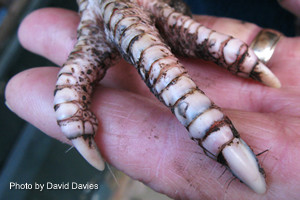
because they came to be used for running and perching instead of paddling or waddling, but they still retained their scales because these appendages were equally useful in their new mode of life. So closely akin are the reptile and birds that naturalists have classified them together under the name of sauropsida. All of them have scales either on the whole body or the legs. Another common characteristic is that they lay eggs. We mentioned before the strongly developed instincts of hens, which take the place of the reasoning faculties. This is equally true of the other members of the sauropsida family. An interesting instance is that of the baby turtle. The mother lays the eggs on the sand some distance from the water, where the sun hatches them. As soon as the little turtle comes out of the shell it turns its head about the starts straight toward the sea. You may pick it up, roll it around and turn its head in any direction, |
|
Jump To Page
|
||||