
Subscribe to this free Newsletter at
Keeping Chickens Newsletter
January 2014 Vol. 2
|
Jump To Page
|
||||
Printable PDF version of this Newsletter
(right click over the above link and then save to your computer)

|
January
2014 |
|
but it will immediately face about the start as straight as an arrow for the sea. This is instinct, the same sort of instinct that causes a little chick when placed at night near a coal burning brooder to flop nearer to it if cold and farther from it if too hot and that causes a hen to scuttle for cover if her old enemy the hawk appears across the sky. The domestication of the hen is of comparatively recent date. There were two periods of domestication, one considerably earlier than the other. In each instance a widely different set of ancestors were used.
The earliest period of domestication took place in very ancient times by the Chinese or some other Asiatic or Malayan people, and the result was the so called Asiatic, or heavy breeds of fowls. The wild ancestors of these hens are now extinct; naturalists have never found any wild prototype for the Asiatic type of domestic fowl. Judging by the characteristics of their descendants, however, the wild progenitors of the modern Brahmas, Cochins and Langshans and their kin, the Wyandottes, Reds, Plymouth Rocks, Orpingtons. Cornish, etc., had probably already nearly lost the power of flight, like the ostrich. This accounts for the phlegmatic disposition of their descendants. The fact that their domestication was of very ancient date also accounts for their tameness as compared with the lighter breeds of fowl. Of
much later date came the domestication of the jungle fowl of India,
whose wild type known to science as Gallus Bankiva even
now flits from limb to limb in its native habitat and may readily
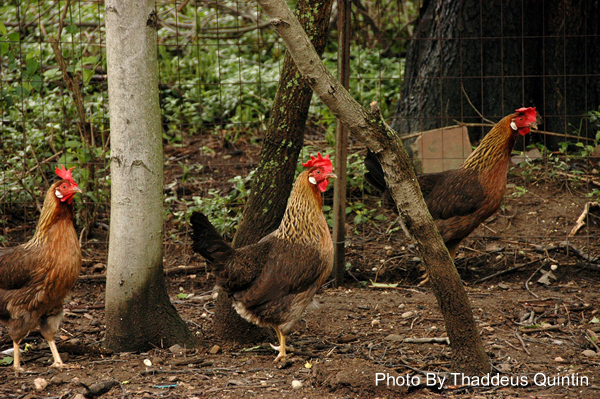
be mistaken for the Partridge Leghorn of the modern
fancier. |
|
Jump To Page
|
||||