Keeping Chickens Newsletter August 2017

Preparedness For Winter and A Look Back In Time Through Old Poultry Ads
There is a certain human quality in all humans which makes us put off until tomorrow that which we should do today.
I have it; you have it and everybody possesses their full share. It is difficult to make and keep a schedule of things to be done and things that must be done at regular intervals throughout the year. We all remember that our grandmothers set aside certain honored days or weeks for tasks that were considered absolutely necessary at such periods. There was a time for putting winter clothes in storage for the summer and there was also a certain time for taking winter clothes out of storage for the winter. Strawberries had to be put up when strawberries were ripe and if she waited too long to can the cherries the birds would have them all.
Later generations do not seem to have been thoroughly imbued with the old customs and modern poultry keepers do not differ from the rest of mankind.
side note : This article (and the surrounding ads) are from many years ago so the ‘modern’ poultry keepers referred to are not as ‘modern’ as those today – but apart from a few choice phrases I don’t think this article shows it’s age too badly and the reminder to do the necessary checks, repairs and preparations around your coop and yard before the weather turns is still very valid.
 Thus it is that very often the first cold days of fall and the first chill winds which warn us that winter is not far away make their appearance in the poultry yards before their effects have been anticipated and preparations made. One often hears the expression “why winter is very early this year” instead of that winter is really coming on at its usual time but has not been prepared for. The hot days of September are very apt to lull us into forgetfulness of the cool nights of October and we who go snugly to bed do not realize the chill of the fall nights and early mornings – that is if some poultry keepers get up a little late!
 I am, therefore, reminded that a word or two regarding preparations for the coming cold season may not be out of place at this time, especially if any of us are either counting on exhibiting at the winter shows or in getting our laying stock properly settled down in their winter quarters in ample time to assure a good yield of eggs.
 Necessarily the first item in the Preparedness Platform is the proper cleansing and arranging for the breeding houses. These buildings owing to the rush of summer work have undoubtedly not received their share of attention; lice and mites increase very rapidly in the hot weather and when we come to a thorough overhauling of our perches, droppings-boards and nests we find that many have lodged there and must be exterminated. The roosting quarters should receive a thorough brushing down and the walls a liberal coat of white-wash in which a generous proportion of disinfectant has been mixed. The old sand from the scratching sheds should be removed and a new layer put in so that it will be thoroughly dry before the straw is placed over it. Grit and shell boxes must be cleaned and refilled; water pans must be sterilized and every part of the house set in order for its occupants.
 Grain bins at this time ought to be thoroughly looked into, swept out and the mice which will always be found near them poisoned off. If there are any signs of rats a couple of good cats should be shut up in the building for a little while or ferrets used. If neither are handy any of the good rat poisons can be used provided the house can be closed securely. The yards should be equally as well looked after. The old bare places should be turned over and heavily seeded to some good grass mixture; trees grubbed about and fences carefully examined.
 When we have gotten our poultry houses in fit shape for their reception we would naturally look for the birds to fill them. In all probability the hens which we have saved over for breeders have been rusticating at free range on scant grain mixture and plenty of grass. They are coming through their molt in satisfactory shape and have been examined frequently for body and neck lice, but if not they will need our attention at once. An increased use of oil meal given gradually at this time will facilitate the molt and another rigid culling will no doubt eliminate a few specimens which have not come up to requirements or do not seem to show the necessary constitutional vigor to insure production during the coming winter. The males have long since been separated and no doubt confined in single coops with shady runs and are showing satisfactory health and stamina. A number of them perhaps will need to have their legs cleaned – indeed, all adult birds at this time should be carefully looked at for signs of scaly legs and an application of lard and sulphur with a few drops of disinfectant applied. In this connection it is well to remember that a good breeding male should not be discarded until you are sure beyond doubt that he has lost his ability to breed. Too many are apt to discard a useful breeding cock because they think they have a cockerel coming on that will do better, but you never can tell until you try and a bird which has once given evidence of being a good breeder may be retained with usefulness for a number of years.

 After assuring ourselves that the old stock has been carefully gone over we next turn to the youngsters and this is really a harder problem than confronts us with the older generation. We know or ought to know something about the breeding ability of the birds we have used during the past season, but we know nothing or very little about what this season’s crop will produce when mated up. Such young stock as we intend to use should be very carefully inspected and treated for the next few months. We do not wish to breed from immatured stock nor from any specimen which does not show an abundance of life and vigor, and all of the late mated chicks should be hurried along in their development from now on with as much speed as is consistent without undue forcing. The pullets will undoubtedly need a different ration from the cockerels. We should not be in too much of a hurry to force our pullets into laying. Breeding females should never be forced for egg production but the cockerels should be given a diet which will insure their early maturity. The older they are and the better developed they are when used in the breeding pens the better we will be off and we know that we cannot make too careful a selection of our male birds.

 Some breeders think that pullets should never be bred from but there should seem to be no reason why a female which is really fully developed and a strong constitution should not be used for at least the latter part of the breeding season. In order to insure the consistent and proper development of the young stock precautions must be taken against over-crowding and the more room both on the range and on the perches that the young stock can have the better will it develop.
  Therefore, close culling should be resorted to on the range and every specimen not considered of real usefulness as a breeder should be placed in the fattening pen and fitted for the market. Poor looking chicks, possessing many of the faults that we are anxious to avoid, will never make desirable additions to our breeding pens, but they will taste just as good as the best of our exhibition birds or will grace the table just as fittingly as some of the progeny from our heavy laying pens.
 If we intend, as all of us should, to exhibit at the coming shows we should get the training quarters cleaned and the coops ready. Handling makes the birds tame. A wild specimen never shows to advantage. Constant observation of the intended show stock will lead to better specimens being selected and will tend to keep them in better condition. Cooping birds too long before they are intended to be shown is a mistake but a day or two in the exhibition coops now and then will work wonders and will give us an opportunity to hurry along and get ready many specimens that would otherwise be undeveloped.
 So it is that in the early fall months we must be ever on our guard in preparing for the winter that is to come. A few hours of work at this time will mean both eggs and ribbons and that is what we are after. Do not, therefore, let up in your work for a moment at this time. Application to the business in which you are engaged may mean just the rewards of which you have been so long in search, but neglect or inattention will necessarily result in loss. More good chicks have been spoiled at this time than ever cooped in any show room and it is the final touches, the care and preparation and the finishing that counts.


A Comment About Roosters, How Much To Feed and more
John : Thanks for the latest newsletter. About roosters fighting : we had bantams when I was a kid. We had a rooster called Joey and a hen called Maggie. Maggie was allowed to sit on her eggs, and produced another rooster whose name I forget. Anyway, Joey’s son and Joey used to fight, so we had to separate them. It seemed surprising to us at the time that family members would fight, but come to think of it, the same thing happens with human beings! John
Gloria : Any tips for egg eating chickens??
My Reply : There are some tips in the article here : https://www.keepingchickensnewsletter.com/june2017/ways-to-stop-hens-from-eating-their-eggs.htm and also a video showing a simple ‘rollaway’ nestbox idea which prevents them having the chance to get at the eggs if they can’t be persuaded to stop any other way. Hope that helps!

Jabab : Good morning. I want to start a backyard poultry with ten layers. How much feeds in kilos will I need for brooding, growing and the laying periods?
My Reply : It can vary depending on the size of the chickens, any other food they might have available to them (if free ranging for instance) and also if you have any freeloaders such as rats or other wild birds helping themselves to the food if it is left uncovered. As a rough guide it is likely you would need 10-12kg of chick food to get your ten chicks through their first 4 weeks and they could get through around 50kg of chick/grower in total by the end of their first 12 weeks. Depending on all the different variables you may find they get through 30-35kg a month as adults.
Miko : hi, I have a rescue bantam she started to moult in winter for a little time, I have no idea of the age she is, but she is still full of life, any ideas? rgds Miko
My Reply : It is normal for chickens to have a main moult once a year after they are 18 months old so she is likely to now be at least two and a half years old.

First Time With Chickens
Lori : Gina, Hi! This is my first ever attempt at raising chickens. I never dreamed that I would want chickens. Back when I was a kid, my Grandma had chickens. She used them for eggs and for meat but they were never anything that I thought that I would like to have as a pet; I knew even back then that if I owned them, they would never be eaten. I just couldn’t do that.
That mindset, however, changed with a picture that I saw on Facebook of this little girl holding this huge Rooster. I had never seen a Rooster so big and thought, ‘There is no way that this can be real.’ So, I Googled it and, to my surprise, discovered that these chickens were, in fact real! I learned that they were Brahmas and that the Rooster could get up to 26″ tall and weigh as much as 18 lbs. and that the Hen could get up to 10 lb. (I never have found how tall she can get but you can tell from the pictures that she is no ways near as tall as the Rooster.) After that, on a whim, I looked up where you could buy them and I found them at Purely Poultry. Well, of course, I had to have a couple of them. I ordered five of them, all day olds; a Rooster and four Hens. I bought a Brooder and a Coop, which I don’t think is going to be big enough and may have to add on to. We’d already decided to add an additional fenced in area for them to be able to run, the little built in run just seems way too small.

Anyway, my chicks are four days old, now, and, so far, seem to be doing fine. I am attaching a few pictures of them. They are starting to feather out and are the cutest little things!
When they first arrived, one of the little Hens seemed wobbly and unable to keep up with the rest of the chicks. Turned out she was just cold, thankfully, because as soon as she had warmed up she was racing around the brooder with the rest of them. She is every bit as alert and active as the others now.

So far, I have had to battle not being able to get my heat regulated and a case of pasty butt, which I am hoping is over with. I am of high hopes that all five chicks survive, under my care, to adulthood. I just wanted to share my story with you. Sincerely, Lori Taylor
An Australian Chicken Run
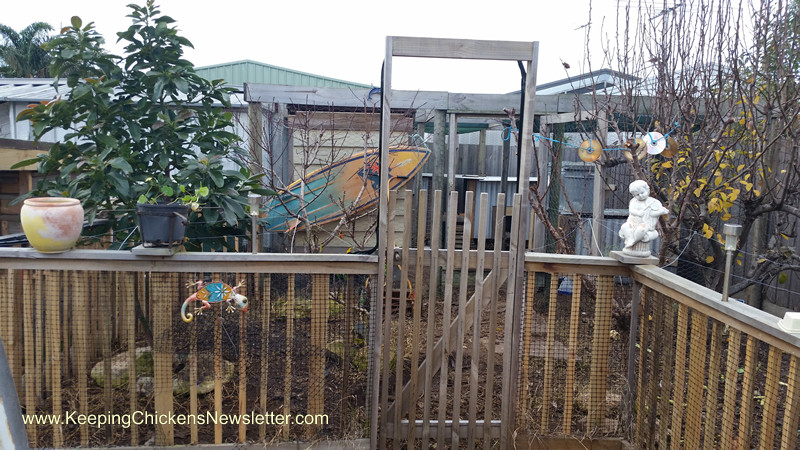
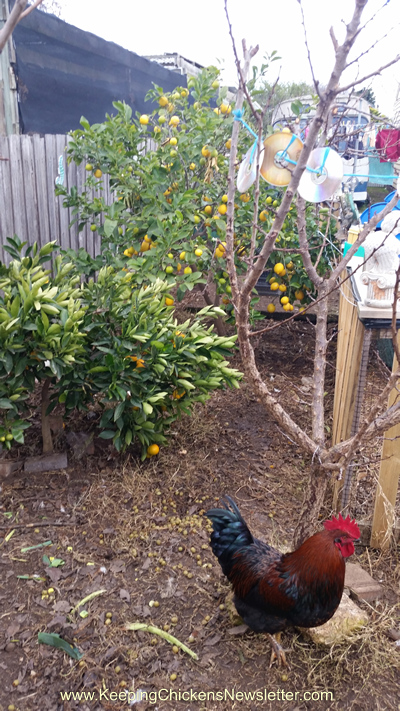
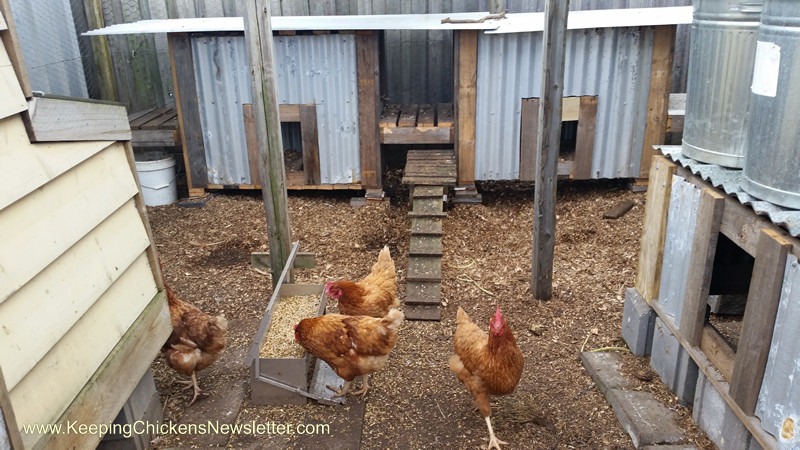
Michelle : Hi this is my chicken run and chickens in St leonards Victory Australia.