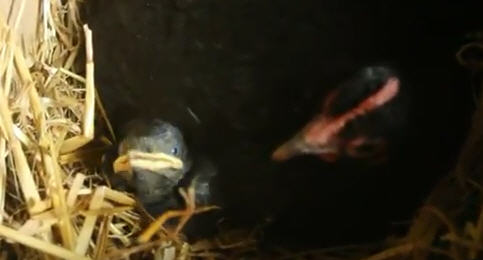
These are just a few of the cute, funny, naughty or just plain weird things our chickens have been getting up to which have featured in the newsletter over the years.
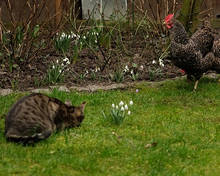
Chickens and Cat Food

Melissa Hello, I have a question, my chickens love cat food and I was wondering if this is okay for them to eat? We have a barn cat that moved in so we had him neutered and he happily lives outside. We have tried to bring him in but he won’t stay. Anyway we feed him on our back porch and the chickens come and eat the cat food. Our chickens are free to roam wherever they want so I want to make sure the cat food isn’t going to harm them. Thank you so much for your time and help. I would also like to say your newsletter is awesome! Thank you again, Melissa
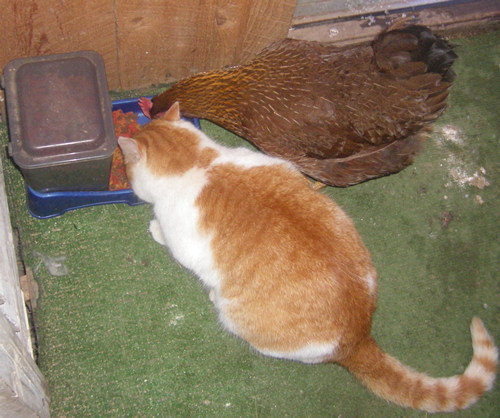

Many chickens enjoy cat food as an occasional treat – just be sure
you have an understanding cat! 

My Reply : Chickens love variety in their diets and will eat all sorts of food and scraps. The general rule with any ‘treats’ (i.e. something not part of their nutritionally balanced diet) is that they should not be more than 10{d5282123537f4ae2af101911d100f16a2c80c27049f1391c1ab6ea474c1bc6e6} of their daily intake. Treats should also not be sugary or salty etc. Cat food is relatively high in fat and protein and so is not the most ideal treat, but it will not hurt as an occasional treat, and some chicken owners find it useful to offer a little as a protein boost for times such as when they are going through a moult.
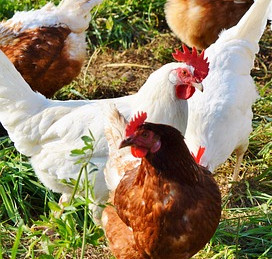
A New Form Of Entertainment – Chicken TV

I love watching animal antics. I especially enjoy animals that stay close to me, since I can’t see them well if they’re very far away.

Now the cats, the dog and the humans have a new form of entertainment. Chicken TV. Yes, we’ve started raising chickens, and they are better than any situation comedy on television.

At first I thought one of the roosters had a broken internal clock. Reveille arrived at 5:30 AM, when the moon was fairly high in the sky and the sun was but a promise. I wasn’t about to open the coop at that hour, and I wondered whether the rest of the flock would be deaf after listening to so much exuberant noise in close quarters.

How often do roosters crow? If you’ve never been around chickens, you might not know that roosters only crow once in the movies. They cut loose whenever they feel like it, and ours tend to crow in sets of ten or twelve.

I really don’t mind the noise, but I admit that I’ve had to readjust my own night-owlish tendencies to be sure I’m up early enough to let the flock out and feed them. For the last couple of days, our morning song has come at 6:30, so I think the rooster has initiated his own time setting, which I call Rooster Standard Time or RST.

We have another rooster with a faulty voice. If he were human, I’d say he must be a heavy smoker. Oh, his call starts out strong and proud as any rooster, but at the end if falters into a pathetic staccato noise that makes me think he’s about to have a coughing fit.

We have three youngsters who all sleep in the window sill of the coop. During the day, they are constantly peeping and walking in a line. I guess their mother told them to line up wherever they go or something. They also love the little patch of tall grass by my house. So do the semi-resident bunnies.

The second day we had the chickens, I learned what it was like to break up a broody hen. When I went in to collect eggs, one of the hens was happily clucking in one of the nest boxes. I reached beneath her, said, “Excuse me,” and removed two eggs. The hen, who I call Latte, stayed where she was.

Later I came in with fresh straw for the nest boxes, and there sat Latte, eggless but broody nonetheless. She really wanted to sit on eggs apparently. She cackled disagreeably when I tried to nudge her out, so I took a handful of straw and pushed it in. The indignant cacophony she let out during the poultry equivalent of swearing at me was hilarious. She fluffed out her wings and stomped out of the coop. Now that’s fowl language! No guesswork there about what she was telling me.

We always know when the girls are laying an egg, because they raise a ruckus that lasts several minutes. I can understand. Expelling a large object from my body would make me yell too.

Two of the younger females gave us her first egg, which I found on the floor of the nesting area. Twelve nice nests with fresh straw and they lay an egg on the hard wood floor. Nobody ever accused chickens of being bright. At least they were inside the coop.

Now, when I am at the computer writing or in the living room watching a TV program, I often hear and see several chickens cooing, pecking, feasting on bugs, stretching, and otherwise entertaining themselves. They know where most of the snacks come from.

They have flock parties in various locations under the trees, at my place, behind my mom’s house, or down the hill. Then they go off in twos and threes, or sometimes alone, to forage for bugs and frogs or have a dirt bath. Then it’s party time again. They like to be around us if we’re out on the property.

I hope you will take some time each day to enjoy the abundant simple pleasures that surround you every day. It’s good for your health and peace of mind. Take a deep breath and be aware of the world around you.

———–

Ronda Del Boccio is a globally published, award-winning author. She also happens to be legally blind. People always tell her she’s “amazing” and “inspiring,” she is simply living her life to the fullest. Ronda is co-author of “I’ll Push, You Steer: The Definitive Guide to Stumbling Through Life With Blinders On”

Forces of Chicken Keeping

Kelson : A friend in Australia has a Rhode Island Red chicken named Elaine. Elaine is a particularly inquisitive and mischievous hen, with a big personality. She has worked out how to open cat-flaps and dog doors, and she can solve problems. She is particularly fond of exploring where she should not be, and she particularly loves the kitchen and dining rooms in the house. One of the most memorable of her antics is now known as Elaine’s Famous Tomato Heist, where she flew up onto the house roof, walked right over to the other side of the house, and jumped down into the tomato garden which was surrounded by a 6 foot high chicken wire fence. Needless to say, Elaine had pecked every single tomato before she was finally caught. She obviously felt like some lovely ripe tomatoes, and she figured out exactly how to get them.

When it’s time to feed the chickens, Elaine’s owner has to be very careful to close all doors on the house. Elaine is a so naughty, that she will swim against the tide and often she will decide to miss out on the feed outside if she thinks she can sneak into the house and find something better inside. So, while the other hens, ducks, geese, turkeys, etc are all running madly for the feed shed at the bottom of the hill, Elaine will often be found sneaking back up to the house to see if she can find a way inside while all the commotion is going on. Sadly, for Elaine’s owner, she often succeeds.

Another of Elaine’s favourite tricks is to jump inside the car while the shopping is being taken inside the house. As fast as lightning she pecks through plastic bags to sample as much bread, tomatoes, fruit, and anything else she can before she is discovered. She has also been spotted dragging entire loaves of bread out of the car and into the garden. One of her cronies, Shirley, is almost as naughty, and together they make a terrible duo. Life is never dull when Elaine and Shirley are on the rampage.

These are the forces you are up against when you keep chickens!

Broody Hen adopts a baby Jackdaw

Sue : I wonder if your readers would find this interesting? We all know broody hens are amazing but this seemed exceptional to me. A baby jackdaw came down our chimney and one of my broodies adopted it. All the very best, Pavlovafowl aka Sue

Rooster Talk

rooster and hen standing on pathway Graham : I had an interesting observance here recently. I usually work on the premise that whatever happens to come my way, be it detrimental or beneficial, has undoubtedly happened to thousands of others also, so you may have heard this all before. I hope you enjoy reading about my new little companion.

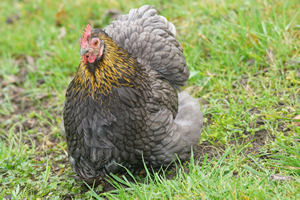
The only hen here now has prepared a hollow in the straw in the nestbox in the brand new chicken coop I have installed for her & her rooster friend. It is a far cry from the disgusting first coop I built 30 or more years ago. Here, there is light, cleanliness, ease of perch access, food, water & sawdust I can scrape out with a home-made rake with ease, to keep it spotless. There is even diatomaceous earth sprinkled under the straw in the boxes & beneath the sawdust on the floor all around the edges under the sawdust, to help control fowl mites, tics & fleas.

She & Birdie the rooster must be very pleased with their new home, now they have a view.  At dusk when I go down the rear of the section to check on & top up rat poison, they chatter away through the netting to me.

The attractive young little rooster we picked up on a farm out in the plains a year back, is a most curious animal. It has no animosity to me at all; unlike roosters past which liked to dominate everything and attack when one’s back is turned. Birdie did mimic a magpie & german owl for a while, but as they are not frequent at our place, he soon ceased.

He has become very friendly & interested in what happens around here. I think all this has come about (apart from him having a very pleasant little personality) from being able to wander freely for most of the time & come over to me to investigate my ‘doings’. (He was living in crowded conditions in a large, low, netting cage with other fowls.) I talk to him often & stop occasionally to give him small-bird seed & sunflower seeds also & he enjoys investigating the inner rear garage whether I am in there working, or not. Most of all, both birds enjoy me breaking up a walnut for them.

The noises he makes, are what alert me to his efforts to communicate. Mostly there is an urgent distinct short ‘chit chit’ & frequent cocking-of-the-head glances in my direction, asking me to share in the ‘news’. This is the same communicative noise roosters give to hens when inviting them over to where they have discovered some tasty morsel & wish to give them ‘first taste’.

This was confirmed today, as he was going on at some determined length before I dropped what I was doing & ventured over to see what was on offing. He was walking around the edge of a shallow depression in the earth, (sand, here at our place) picking up any tiny stick or bit of rubbish that was already on the ground & dropping them, all the time periodically cocking his head & looking up at me. He was telling me something to do with nesting, I’m sure.

Upon inspection in the new coop 80 feet away down the rear of the section, I found the hen sitting in the prepared hollow in the straw. I think there may be an egg in there today regardless of this cooler time of year. Her last egg was 4 weeks back. After checking much later in the day, I see yes, there is an egg! I’ve got to get to know this curious rooster better.

Two days later…

The same procedure of walking around the edge of a separate shallow depression & chattering occurred today & another egg laid. This makes me wonder quite what I have missed over the decades, simply because I was perhaps not listening & observing well enough.

Something else I found out :- I discovered the netting I had put up on one side of the coop on the floor-to-ceiling doors, was difficult to see past, so I painted both sides black & now the two occupants inside have a view not possible before. Also, painting the outside allows me to see them siting on the perches whereas before it was nigh impossible. Tricks to the eyes. Just like light & dark painted trellis work atop fences.

Thanks again,
Graham East,
Christchurch, New Zealand.

Death Defying and Prophesising – Famous Performing Chickens

Tadah!

There has never been a shortage of people prepared to tell you their predictions – particularly around election time – but it doesn’t happen often that a chicken gets taken seriously as a prophet. However in 1806 in Leeds, England, when a hen started laying eggs with the words ‘Christ is coming’ her fame quickly grew as word of the miracle spread, and quite a lot of the locals believed that doomsday was nearly upon them. Of course it turned out to be a hoax. Unfortunately for the hen her ‘predictions’ had been written on the egg in acid by her owner Mary Bateman (an alleged witch and professional fortune teller) and then pushed back up into her vent for her to lay again. Ouch!

That hen was not the first to find herself thrust into the world of showbiz, the oldest trick in the book (quite literally) is commonly performed with a chicken and involves the magician appearing to separate the head and body and then join them back together again.


Please do not try that on your own chickens! Most are not as resilient as another famous chicken called ‘Mike’ who managed to make his living touring sideshows for 18 months after his head had been chopped off and is still quite the celebrity in Fruita, Colorado where there is an annual “Mike the Headless Chicken Day” (https://en.wikipedia.org/wiki/Mike_the_Headless_Chicken)

It seems that a life in the spotlight can be good for a chickens health. The oldest living chicken of a few years ago lived to the ripe old age of 16 years and had been a magicians assistant for most of her life – as well as having enjoyed the ocassional tv appearance.

Bad Banty

Nancy : Dear Gina and Readers, I could tell many stories of my hens’ ability to communicate with their keeper (me) but I’d like to share one dramatic one which happened just a few minutes ago.

My ranchette consists of a chicken yard, 3 coops, about 50 hens, an occasional coyote visitor, and a mixed dog named Cookie who barks from her boudoir in the garage when we get these unwelcome guests. As long as the girls are in their coops, they are pretty secure. However, they are at their most vulnerable when they spend the night perched on a roof or a branch and then, at daylight, let themselves down to forage. Every night I do my best to put everyone in but sometimes one or two evade me.

Well, this morning at 5:30 (prime coyote time) Cookie barked so I went to investigate. I let her out of the garage and allowed her to do her search while I did mine. If a coyote had been here, it was already gone, no damage done. Planning to go back to bed, I left the back door to the garage open so Cookie could patrol, thought smugly, “All is well,” and headed into the house.

Not so fast! My attempt to return to bed was arrested by an uncharacteristically loud chorus coming from the yard. Yet this time it was only the chickens making the racket, not the dog. “What is going on?” I mused. “These girls will wake the sheriff!” Out I went again, this time to quiet the birds, and who should I see but Racing Stripes, my barred bantam cochin, sitting atop the roof of her coop, looking sheepish. “Bad banty!” I scolded. “Don’t you know that you could have become someone’s tasty morsel?” Then I scooped up the fluffy, football-shaped fowl, passed her gently into her coop, and the ruckus instantly ceased. “Good hens!” I purred, grateful to them for alerting me to Racing Stripe’s perilous position. By this time it was too late to go back to bed so I wrote down this story to share with you. Nancy, Claremont, CA

Chicken Bailout Plan

Before you jump to conclusions, let me assure you that extravagant executive bonuses will not be a concern; the Happiest Chicken CEO (fondly known as Big Mama, No Feathers or less respectfully as Mother Clucker) doesn’t even get a salary, let alone an annual bonus. Transparency won’t be a problem either; we will gladly open both the hen house and our books to anyone. Finally, we are pretty sure that toxic debt is not an issue either, but since we’re not altogether certain what it is, we hate to make a promise we can’t keep. Owing to the heat and humidity in Kansas, August in the coop can veer a little toward the toxic.

Please bear in mind that we are trying to avoid national publicity. Several of the most vociferous chicken groups – notably the proud and financially savvy P.A.R. (Poultry of the American Revolution), whose President, Parmentia Pilgrim, is a Barred Plymouth Rock supposedly in a direct line of descent from the flock of Captain Myles Standish – have argued that the bailout needn’t be a high-profile federal matter or even a state-level concern. Miss Pilgrim suggests that if every member of the labor force in Chase County kicked in about 13 cents, we could promise a prompt recovery.

costs of raising chickens
Captain Myles Standish & the Barred Plymouth Rock breed. Uncanny resemblance?

There’s no question that the pension plan is to blame for the bulk of our economic woes. The six most elderly chickens were born in 2004 and are now officially retired, living quite comfortably on the poultry version of Social Security and Medicare. I spent the first two years of nervous chicken-rearing trying to keep my small flock alive, and now that I’ve gained confidence and relaxed my vigilance considerably, these unproductive old farts refuse to expire gracefully of natural causes. I can already see the problem about to be compounded in the next generation of the flock, born in 2006. Normally, you can expect periodic mortality – a chickhood disease, a predator attack, a random chicken heart-attack – but no, I haven’t lost a single bird out of the 2006 batch. These hens will become eligible for retirement sometime next year, at which point over half of my flock will be on the dole.

Then there’s the strike. With absolutely no fanfare – no picket lines, no signs, no bullhorns, no written demands – all four of my working-age Ameraucanas abruptly ceased laying their blue-green eggs about two months ago. I have no explanation and no idea what they want.

Finally, I must bring up the unpleasant matter of the mix-up at the feed store this spring. I ordered two buff Brahmas to keep the Gandhi line going. The tiny yellow chicks with downy slippers on their feet arrived with punky purple stripes spray-painted on their heads, apparently to keep them sorted. The system failed. Instead of two full-sized Brahma hens, I ended up with a matched pair of junior-sized, strutting, crowing bantam roosters.

brahma chick

Elsewhere in Chase County (and I think I’ve figured out where), are the two big, beautiful Brahma hens I ordered. I’d love to work out a trade, but unfortunately (or fortunately, depending on how you look at it), one of the roosters died mysteriously this summer while we were away on vacation. The remaining rooster is called Mister, which is always italicized when you say it, as in “Listen here, Mister” and “Where do you think you’re going, Mister?” I have absolutely nothing against him aside from the fact that he does not lay eggs – he is a handsome fellow with a reasonable disposition and only a few minor, over-compensatory Napoleonic tendencies.

When I mentioned the possibility of a bailout plan while I was at the Hitchin Post for a burger the other day, one fellow was quick to bring up a time-honored solution. “I can tell you what you need,” he matter-of-factly informed me. “It’s called the Chicken and Dumpling Plan.”

I’ll be honest; I’ve never been hungry enough to consider eating an animal I know by name. Call me a panty-waist or a candy-ass. Call me a city slicker cleverly camouflaged in Carhartt. If I have friends for dinner, it is safe to assume they will not be the main course.

The helpful gentleman at the Hitchin Post turned out to have another idea as well: feathers for fancy fly-tying. The right kind of exotic feathers are worth inordinate sums of money to hobbyists and sportsmen with inordinate amounts of disposable income. Unfortunately, there is not much of a market for the type of feather we happen to have on hand at present. If, however, I could successfully raise a Kori Bustard or a Great Argus Pheasant alongside my chickens, we’d cover all our expenses and actually turn a profit. One pair of matched secondary wing feathers from the Great Argus, for example, retails for $90 to enthusiasts who enjoy tying Atlantic salmon flies either to cater to or engage in one of the most expensive habits on the planet. I found an extreme example of what this market will bear: a fishing fly – the centerpiece of which is a diamond-studded 14-karat gold hook – that sells for $9,000.

Kori Bustard, Ardeotiskori. Burchell, Etoscha National Park, Namibia Photo by Winfried / Bruenken, 2004

Here’s the problem: Kori Bustards are native to African grasslands and Great Argus Pheasants hail from the jungles of Borneo, Sumatra and Malay Peninsula. I’m not sure either species would do all that well in Kansas, especially in winter. Kori Bustards are among the so-called big bustards, the largest land birds that can still fly, sort of. They really prefer to walk or run, which they do the minute they notice a human being in the vicinity.

I can already see how this could be a serious problem in our operation. In their favor, bustards are usually stately and silent, but when they do have something to communicate – like alarm when they spy a human – they bark loudly. This would undoubtedly scare the ever-living you-know-what out of a chicken, which is only about one-eighth the size of a big bustard to start with. All in all, as you can readily see, this is not a very practical economic recovery plan. Still, I appreciate the creativity behind the suggestion.

Another bailout strategy suggests itself whenever chicken-coop-cleaning time arrives. Chickens produce prodigious quantities of…well…let’s just call it fertilizer. I know that this waste material is valuable, because we use it to boost soil fertility in our vegetable gardens, but until I did a little research and found “Cockadoodle DOO” brand organic fertilizer, I had no idea it could be worth 75 cents a pound. Three hundred or so pounds of the stuff and we could be out of debt! I am a little concerned by Cockadoodle DOO’s prominent label claim that the product is “safe for kids and pets.” I can personally attest to the fact that chicken droppings are perfectly safe for pets, because for some unfathomable reason, both of our dogs hold them in high esteem as irresistible delicacies (in the winter months, we refer to them as poopsicles). As to kids, however, I’m afraid labeling really needs to be more explicit in these litigious times. We’ve gotten terribly accustomed to being told more about what not to do with a product than about its actual use, which is why you can scarcely see the deck of your new lawnmower for all the warning stickers.

I hope you’ll forgive me for making light of a very serious topic. The Happiest Chickens in Kansas really have nothing to worry about by comparison with many individuals, families and communities right now. I was talking to my father on the phone the other day. Both he and my younger brother serve on the staff of a church in Michigan. I asked him how the auto industry crisis was affecting their congregation. “Well, it’s an interesting irony that when finances are tight, giving to the church is one of the first expenditures to get cut,” he told me, “and yet, when families find themselves in trouble, the church is one of the first places they turn for help.”

Originally published in Tallgrass Tales, reprinted here with kind permission of Marva L. Weigelt.

The Puppy Sitting Pullet

Willie & Barbara Bell : Gina attached are shots of a pullet puppy sitting 6 Great Pyrineese puppies, she has been with them since three days old. They are now 28 days old and was moved to a new location on the 28th December 2011.

chicken sitting on puppy

hen looking after puppies

This hen was attacked by guineas where the skin was pealed from her head. After caging her up for four days we let her out in the barn where the puppies was born. For some strange season the bitch did not go after her and she got closer and closer to the pups. At this point no other animal could go near this area, only the puppy sitter was allowed in the area. This gave the mother a well deserved break and she took advantage of it as she was always outside. She knew she had a credible sitter. The pullets food was in the cage where she would go to eat and drink.

puppy sitting pullet

When the both of them are away from the pups, she eating or drinking, the bitch outside resting, and the pups start to yap the hen would go to their aid or if we were to walk toward the stall when she is out she would rush ahead of us to protect the pups, the mother was off some where resting. See Attachments. From day 3 To day 28.

Their eyes open fully at day 20 and they start to move around more, but she is still there with them even after moving them to a new location two days ago.

day 28 - still with them

Go to Top