Keeping Chickens Newsletter February / March 2018
Chicken Nurse

I never thought I’d be a chicken nurse, but I certainly have learned a lot. I can’t believe that in almost a year of chicken-rearing, I never noticed that a chicken’s eyelid closes from the bottom up. Then again, I’ve never been around a chicken who is injured and weary enough to fall asleep right in front of me in broad daylight. For a minute I had the strangest feeling that one or the other of us was upside down, but no, the eyelid, complete with tiny red eyelashes, closed upward.

Hey, wait a minute! The other day I was watching Little Red and I swear I saw her eyelid drop down from the top.

The time had definitely come for some research, which was harder than I expected. There simply was not very much information on the Internet about chicken eyelids. Fancy that! It was actually easier to find out about the development of a woodpecker’s tongue than about a chicken’s eye. Once I got on the right track, I found out several fascinating facts :

* All birds, not just chickens, have three eyelids; they do not have tear ducts, so one of the eyelids serves that function.

* Avian eyes make up 15{b0ded004bdc346b73b2f7c5643ec4b44c0fd04baf547e743db44006f5c758b8f} of the head, while human eyes are only 1{b0ded004bdc346b73b2f7c5643ec4b44c0fd04baf547e743db44006f5c758b8f} of the head. Avian and human vision is very similar.

* Birds can be literally half-asleep, with one brain hemisphere alert and the other taking a siesta. How handy! The hemispheres take turns sinking into the slow-brain-waves sleep stage; the eye controlled by the sleeping hemisphere droops shut, while the wakeful hemisphere’s eye stays open and vigilant (birds can also, thank heavens, sleep with both hemispheres resting at once).

* A bird on the outside edge of a flock tends to keep its outer-facing eye open while resting. This rather intriguing skill evolved as a protection against predators. Interestingly, it has only been found in birds and such aquatic mammals as dolphins, whales, seals and manatees. I can’t help thinking how useful this trick would be in business meetings.

I have learned other valuable things in the course of my nursing. Triple antibiotic ointment is the wonder-drug of the century, for either humans or chickens. I will never be without it again. Little Red prefers green beans to apples, but she loves cheese (of all things!) better than anything else I’ve tried.

After she spent three days here in the house in an extra-large dog crate lined with soft cottonseed hulls, I built my convalescing chicken a temporary daytime shelter outside so the sun and breezes can help her to heal and lift her spirits. She’s also right behind the chicken house so she can hear her flock and they can come to call during visiting hours in the afternoon. I covered the ground with alfalfa and set her up with water and snacks. In just a few hours, Little Red will have survived for six full days. I can’t help thinking she’s going to make it through this crisis.

I expect most nurses are familiar with the kind of rollercoaster I’ve been riding. There were several mornings I awakened with a heavy heart, expecting to find my chicken dead, and other times that she gave me a feisty little peck on my hand that thrilled me with hope. There were moments in which I wondered if I was doing the wrong thing, merely prolonging her suffering, or if it might have been better if the dog’s attack had been immediately fatal. Then there’s a day like today when her appetite for cheese and green beans makes me feel like dancing a jig.

I never dreamed I’d wash a chicken’s butt or do physical therapy to try to get her to use her legs properly. I had no idea I’d fuss the way I do, checking on her every half hour to make sure she’s safe and comfortable out in the yard. I never thought I’d be a chicken taxi service either, carrying her back and forth between the daytime and night-time wings of our makeshift chicken hospital.

I can’t help recalling again the true meaning of husbandry : bonded to the household. Little Red and I have a bond that makes almost anything possible.

By the way, iHola! I’m Lola just laid her first green egg today. Perhaps everything is going to be all right after all.

Little Reds Chicken Shed

As I write this, Little Red Harvey, my convalescing chicken, is taking an afternoon snooze in a patch of March sunlight, her beak tucked under her sparsely feathered wing. I got very sleepy watching her. A napping chicken, I’ve discovered, is a powerful soporific.

After seventeen days of living in an extra-large dog crate here in the house, she was relocated yesterday afternoon to Little Red’s Chicken Shed, a rehabilitation institute of sorts. For ten days she couldn’t even use her legs; she did a weird sort of scooting crab-walk to get around. Now she can walk, but she tends to step on her own feet. I’m pleased that she hardly ever tips over anymore, but she still hasn’t quite remastered using her wings to fly up to a perch.

The new chicken annex, which is right next door to the regular-size chicken coop, came into being because we are getting ready to go out of town for a few days. For the life of me I could not figure out how to explain to our three-part relay team of house sitters that they’d be caring for two cats, two dogs, eighteen busy chickens and oh, by the way, there’s a wounded chicken in a crate next to the woodstove who needs to be taken outside for physical therapy every afternoon.

I spent two-and-a-half days building this miniature chicken coop out of scrap lumber. Little Red’s Chicken Shed has a small outdoor pen, a chicken-sized door that opens by wire and pulley from outside, a round screen window, a roost/nesting shelf, a hinged panel on the back that allows me to reach inside to do maintenance and Little Red to come out to play in the afternoons, and a little tiny calendar on the wall so she can count the days it takes to heal and grow back her feathers. She has a nice crop of quarter-inch stubble coming in, which is a great relief. I found it tremendously disconcerting to be rendering care to a chicken whose back looked a little too much like the plucked poultry I like to roast with rosemary and garlic.

The most sophisticated computer program in the world, I realized this morning, could not impress me more than the complex DNA instructions according to which Little Red’s cells are crafting these exquisite, intricate feathers to replace what was so swiftly and thoughtlessly purloined by a dog.

I have been trying a few social experiments, but Little Red is just not ready to be reintegrated into the flock yet. This is the first time I have really seen the dark side of chickens. With her puncture wounds, missing feathers and lameness, Little Red is practically wearing a Peck Me sign on her back. The other chickens just will not leave her in peace when she’s this vulnerable; they go into attack mode. Much as I am dismayed by their uncivil behavior, I must accept that it’s simply part of the instinctive pecking order system and the survival of the fittest. Little Red, by the rest of the flock’s standards, is not very fit at present.

Without my intervention, she would almost certainly not be alive, so there’s little doubt I’ve messed with the natural order of things. I still do not know if I have done her any favors by my acts of mercy. Now she’s much more acclimated to humans, dogs and cats, which may not be to her best advantage. The dogs enjoyed sleeping with their noses up by the door of her crate while she sat just inside and pecked at vegetables. The cats crawled all over the crate and tried to stick their paws in the vents. She seemed to enjoy being with us, interjecting little comments from time to time, staying up late and watching us play cards in the evening.

Chances are, now that Little Red has a place of her own, I miss her more than she misses me, which is the same dynamic as when your kid goes off to college. She appeared to be pleased with her Chicken Shed. I designed it to mirror in miniature the features of the big coop in which she grew up, so she’d know where to go and what to do. Sure enough, just after sunset last night, she went inside. This morning, the minute I opened the door, she walked proudly down her little ramp.

As for me, I found myself missing her this afternoon as I was vacuuming up seeds and feathers by the woodstove. Have I ever mentioned that we clean our house with a 12-gallon shop vac? A first I thought this was a little strange, but now it makes a great deal of sense. Life on a ranch tends to be, well, chunky. Feathers, fur, grass, seeds, pebbles, mud, all species of dung (or dung of all species), you name it, it ends up in the house. Anyway, I was cleaning house when I got to thinking about Little Red and missing her. I went out to sit on an old milk crate next to her pen in the warm sunlight. I talked sweetly to her, a mix of Chickenese and English (which I guess would be Chicklish), telling her I’d been thinking of her fondly, which is exactly when she hunkered down in the opposite corner of the pen, tucked her beak under her wing and promptly fell asleep.

Maybe she was bored with me. Maybe the sound of my voice is like a lullaby to her. Maybe she was just plumb tuckered. No matter the reason, Little Red seems pretty darn happy with her Chicken Shed, which pleases me enormously.

Frostbite on Comb and Wattles

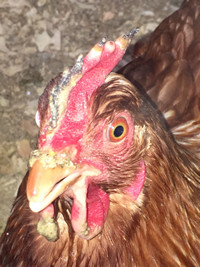
Brad : Noticed this on one of my girls comb / wattle. It is winter here (Ottawa, ON) and it could be frostbite? or do you think something more serious? An infection possibly? Are her eggs still ok to eat?

My Reply : It is not something I have dealt with personally but it looks to me like it is frostbite. Usually with frostbite the tips will lighten and then go black. Often in cases of frostbite the worst affected areas will blacken and drop off completely and eventually the comb should heal up. Very often a case of frostbite will sort itself out but frostbite damage is similar to any other kind of flesh wound and so if it does become infected you will probably need antibiotics (I can’t tell from the photo if it is infected or not – usually there will be puss if there is infection). Her eggs should still be ok to eat but if you do have to give her some antibiotics in the future you probably should not eat her eggs for the time she is treated and at least two weeks after the treatment finishes (or as advised by your vet).


Photo By JoAnn Kasper

Heated Chicken Water

Christina : I don’t know if Gina will be able to get this into the next publication, but there is plenty more cold weather coming down the pike before spring gets here… This is a very cheap way to heat small chicken watering sources. I found this idea on YouTube.

Materials:

  • ½ Cinder Block, which you get at your Discount Hardware Store. Mine cost $1.50
  • “MonkeyJack Declining Heat Basking Lamp Holder Reptile Infrared Heater Light Socket Base” $4.99 through Amazon.com
  • An electrical cord (cut from another small appliance that was broken)
  • 60 watt incandescent bulb – non-incandescent bulbs won’t provide the needed heat
  • Power strip/surge suppressor 

I used the end of a claw hammer to gouge out the channel on the bottom of the cinder block; it wasn’t hard. This channel is for the cord. Then I did a little electrical wiring of the socket base. Plugged things in and tested everything. *Note* do not set this contraption on flammable straw or wood chips.

Now when it is going to freeze, I simply set the chicken’s water on top, flip the switch, and vióla! I’ve got a freezing weather water heater for less than ten dollars. The commercial ones cost $50. Like any good farmer, I am now keeping my eye on the weather prediction.

P.S. I should add that this is just for use overnight, as I set the water back down in the morning. I’m not sure my chickens are smart enough to drink when the water is elevated!

Never Underestimate the Power of a Chicken

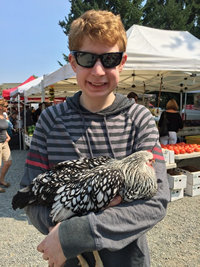
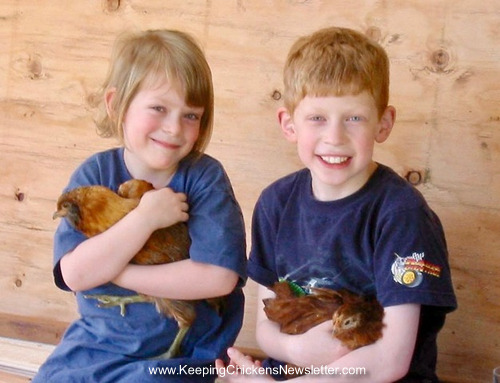
Kristin Jarvis Adams : When my son was in the third grade, he brought home a baby chick. That day Andrew, who has autism, had his first real conversation. But it wasn’t with me. It was with the little mottled chick he named Frightful.
“You are my new friend,” he told her. “You know my heart.”

For the first time he was able to string words together that revealed his hopes and dreams, and all the scary feelings that had no name. Stuffed into his jacket and zippered up to her beak, the scrappy little hen went everywhere.  It was clear that I was no longer the most important chick in town.

When I asked Andrew why he would only to talk to the little bird, he said, “Frightful makes me feel safe.” I was heartbroken. Didn’t I make him feel safe? Why couldn’t he communicate with the people in his life: his peers, his teachers, his own family?

Andrew told me I wasn’t as interesting as poultry. Worse, I didn’t play by his rules. I made him wear shoes, eat vegetables, and go to school – all the things he didn’t like to do. I asked him to look me in the eye, but he said it was too painful. When I asked him why, he told me I wouldn’t understand.

But the tiny bird did. When he spoke, she would turn her head, blinking at him with a single yellow eye. She would perch on his shoulder, leaving his hands free to roam. She crooned a melody in his ear, telling him he was enough – he was perfect just the way he was. That chirping ball of feathers with yellow raptor-eyes had performed a mind-meld on my autistic son and captured his heart.

One afternoon I decided to make friends with the chicken.

“Is Frightful hungry?” I asked when the two were sitting on a kitchen stool.

“Yes, she wants a peanut butter sandwich and one of those cookies,” Andrew said, pointing the little hen’s beak in the direction of the oven.

This was my moment to be Andrew’s necessary human, so I made lunch for the two of us and joined Andrew and Frightful on the front porch. We ate in silence mostly, stopping only to comment on Frightful’s new feathers and the fact that she had just begun to lay eggs.

“Frightful is happy,” Andrew mused as she pecked at the crumbs on his plate.

“Me, too,” I said.

That afternoon I chose to join Andrew’s world – even if it was by communing with poultry. His little bird had given him a voice, and all she required in return was his company. I could do that, too. When we finished lunch, Andrew reached for my hand and squeezed, a wordless statement of love.

I squeezed back: Me, too.

——————

(Based on an article originally published in the Washington Post) Kristin Jarvis Adams is the author of The Chicken Who Saved Us: The Remarkable Story of Andrew and Frightful. She can be found at www.kristinjarvisadams.com, or on Facebook at Kristin Jarvis Adams, Author.

Constructing a Simple Chicken Wire Fence

Paul : I chose to construct a wire fence for my chickens as I thought it would be a relatively easy (though not necessarily cheap) alternative to having to dig and set posts etc. I also figured that if I did decide in the future to change to a wooden framed pen, or increase the size etc the materials purchased now could be reused in the new project. I am clearly not an expert on constructing any kind of fence but I am sending this in in case it might be helpful to someone else. If anyone is thinking of doing the same, before starting it is probably wise to check if there are any restrictions that might apply to you such as if permission is needed, or if there are guidelines for height or proximity to neighbours.

Chicken wire is quite pliable so although it will keep your chickens in, if it is the only thing between your chickens and any potential predators they will get almost no protection from it. They would be much safer if welded wire is used as it is much harder to bite or break through.

Steps

Locate the area of your property you want to fence in and mark it out. Landscaping paint is a great way to do this. If possible, try to get a rough estimate of your fenced-in area’s perimeter. Don’t forget to mark a space for a gate

Purchase or gather your supplies. From my research on the internet it seems that a fence for chickens should be at least 6 feet (especially if it is their only protection and/or it is to be covered and you want to be able to do your chores without being bent over double the whole time).

Fence posts can be wooden, but for the sake of simplicity and to save digging post holes and putting concrete around them etc. my preferred choice were ‘T’ posts which could just be banged in with a sledge hammer. I used wire ties to attach the wire to the posts so I wouldn’t have to mess around with trying to hook the fence onto the t-post hooks.

I later read that it would have made the fence stronger if the four corner posts were wooden ones, I’m going to leave it as is for now, but if it proves necessary I think additional supportive corner wooden posts could quite easily be put in place even at this late stage. I did use wooden posts to support the gate and hinges and latch for it and just made a simple one by constructing a wooden frame and attaching some of the wire to it.

A fenced area like mine of 30 feet by 15 feet would take 100 feet of welded wire (with a little bit left over in case of error). It would also use 18 ‘T’ posts spaced at 5 foot intervals (or 14 if you make the four corner posts wooden ones). That results in quite a spacious fenced area for my 6 chickens and their coop but I know I probably won’t be letting them out into the main garden very often so I wanted to make sure they could still be comfortable if confined there on a semi-permanent basis.

The first chicken pen I made for my original three chickens was never very successful at keeping rats out so with this one I wanted to try the ‘wire skirt’ method (which should keep out all digging predators as well as rats hopefully) and used an additional 100ft of 3ft wire so that I could give the fence a 2ft ‘skirt’ all the way around. It added additional costs, but if it works will have been an easier solution than one of the alternatives such as digging down 2 feet all the way around and pouring in concrete.


Go to Top