Keeping Chickens Newsletter March 2017

Some Ideas For Plants Which Can Be Grown Near / Eaten By Your Chickens

Below are some crops which can be grown for chickens – the plan was written with a larger operation in mind than most of us have, but may still be worth considering even on a smaller scale if you have some space. 

A system of crop rotation can be used in the yards for the matured fowls. Plow the yards the previous fall and sow rye (not recommended for growing chickens [such as broilers and pullets] or Turkeys), or plow them very early in the Spring and sow oats first. Allow them to get up about three or four inches high before letting the birds out onto them. A system of alternate yards will greatly add to the efficiency of yarding layers and breeders, as one yard can be growing a green crop while the other yard is being ranged over by the birds. Use oats as a yard green crop until in late May. Then plow the yards and sow soy beans. Soy beans can, and I believe, should be used much more extensively for poultry. They grow quickly, producing a wide-leafed plant that is palatable and very satisfactory to the birds. If allowed to get about five or six inches high before the birds are turned onto it, soy beans will keep ahead of the birds and will soon afford shade as well as a source of green food. In August when the soy beans have been eaten down or have dried, plant the yards in buckwheat. Buckwheat make a good growth and will usually keep so far ahead of the hens that some straw will be furnished for bedding purposes. It might have been said that in the case of soy beans, that usually the birds will not destroy the bean pods, but only the leaves so that a fair crop of beans can be harvested for use in the poultry rations ground up as a part of the dry mash, or for other farm animals. After the buckwheat is harvested, plow once more and sow rye, and another year’s cycle is commenced. — W. C. Thompson

On a related issue I had an email from Denise Keith who said

Hello, Gina.  I just got my first chickens this year (they are 9 months old now and laying well).  I have 6 Rhode Island Red hens.  I try to feed them as much organic foods as I can, and try to resource free as much as possible.  My question is this – can chickens eat the berries from pyricantha bushes.  I know that wild birds do, so was hoping chickens could also.  I have a neighbor who has a large hedge and can get all I want.  I get the leaves from the market when they “clean” up their produce as well as bruised fruits and vegetables sometimes.  I am on a fixed income so need to look for cheap as much as I can.  I enjoy reading your newsletter and have learned so much. Keep up the good work.

My Reply : I have seen pyricantha on a couple of ‘do not feed to your chickens’ kinds of lists but the FDA tested them and concluded they were not harmful http://www.accessdata.fda.gov/scripts/plantox/detail.cfm?id=1349 and on the Royal Society for the Protection of Birds site http://www.rspb.org.uk/birds-and-wildlife/read-and-learn/fun-facts-and-articles/features/berries.aspx they say “pyracantha and berberis are especially good for a wide range of birds” so my own personal conclusion would be that they should be ok.
Elvis Chickens?

Pam : My husband was told about Elvis chickens that lay all year round. I have tried looking them up and cannot find their technical name, or anything about them. Can you help?

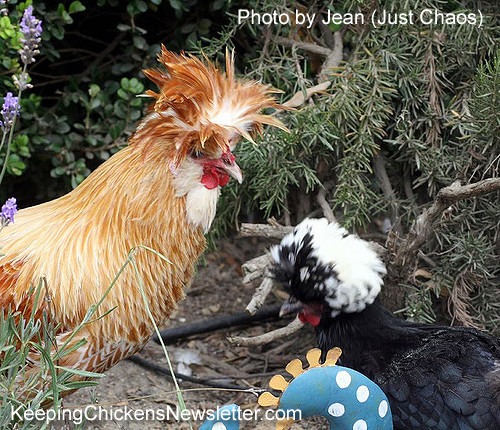
My Reply : I haven’t heard of that as a particular breed before although it could perhaps be a new strain being bred by a breeder local to you. Elvis is quite a common name for roosters that are of the Polish breed (or similar) as the feathers over the eyes make them look a bit like they have a quiff, so it may be possible that they are something along those lines and are being sold as ‘elvis chickens’ although as far as I know the Polish breed itself is not particularly well known for being good layers all year round.

Coping with the Bird Flu Prevention Measures

DEFRA has told Poultry owners in the UK to keep their chickens and other poultry away from wild birds to help prevent the spread of Avian Influenza (bird flu). What started out as a 30 day restriction has had extensions which for many has meant their normally free ranging chickens have been confined for over 3 months now.

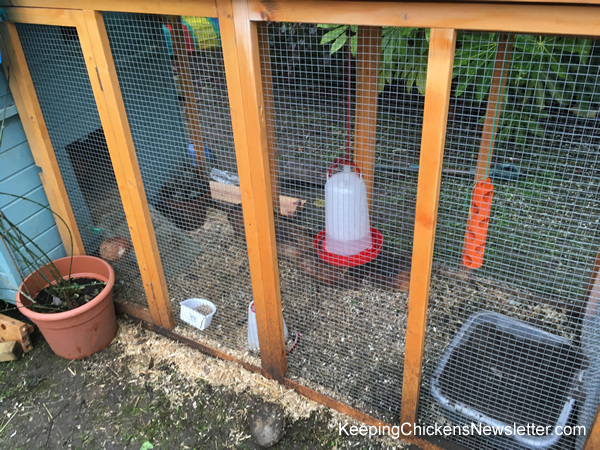
inside the coop

Paula : We now have a different issue here in England as Avian Influenza has taken hold in Europe and the north of Scotland. There is a 30 day restriction in which we need to keep our hens inside. Mine are used to free ranging so it will be very stressful for them (and me), to be confined until the 6th January.

I have cobbled together an additional run using: old garden tables; plastic fence trellis and tarpaulin at the rear of the coop. At the front I have attached a run from the first coop I bought in May. I make sure they have lots to scratch in and boredom busters etc.

Run made from garden tables

My Reply : It looks like they are going to have quite a fun time in there 🙂 I feel bad for my chickens being restricted too but so far there haven’t been too many complaints from them. Defra does say that if it is not practical to keep them confined to their housing then there must be complete separation from wild birds (in addition to good biosecurity) so there may be other ways to achieve that but in most cases it probably will be easiest just to keep them in their housing and runs.

You can get full information about bird flu and the measures currently in force from the uk government website here : https://www.gov.uk/guidance/avian-influenza-bird-flu including a pdf guide aimed at people with backyard flocks “How to keep your birds safe from avian influenza (bird flu)“, a guide about the extra biosecurity measures needed “Biosecurity and preventing disease in captive birds” and “Detailed advice on the Prevention Zone controls in England from 28 February 2017” (the most recent guidelines at the time of writing).

How To Spot Avian Influenza

There are 2 types of avian influenza.

Highly pathogenic avian influenza (HPAI) is the more serious type. It is often fatal in birds. The main clinical signs of HPAI in birds are:

    swollen head
    blue discolouration of neck and throat
    loss of appetite
    respiratory distress such as gaping beak, coughing, sneezing, gurgling, rattling
    diarrhoea
    fewer eggs laid
    increased mortality

Clinical signs can vary between species of bird and some species may show minimal clinical signs (ducks and geese).

Low pathogenic avian influenza (LPAI) is usually less serious. It can cause mild breathing problems, but affected birds will not always show clear signs of infection.

H5N8 is a notifiable avian disease. It remains the case that anyone who suspects their birds of having avian influenza should discuss this as a matter of urgency with a private veterinarian. If suspicion of AI cannot be ruled out then it must be reported to Defra/APHA

Funny (not funny) Neck Twisting Disorder

Ken : I have been an enthusiastic reader of your newsletter for more years than we both would like to admit to probably and thanks so much for what you do! I recently had the strangest experience with one of my hens and I really feel compelled to write to you so you can share this information with the community. My hen came down with something odd and I couldn’t find much on it so I thought I’d share.

My 8 year old Black Rock hen was in her usual happy, healthy state of well being until suddenly, without apparent cause, on a cold, wet January morning a few weeks ago, she started to show a weird craning of her neck, twisting to the right with her left eye skyward. She was spinning in circles as she tried to walk and stay with the flock for breakfast but she was losing balance and could not stand up. At first I thought she was looking up for a hawk predator, as she seemed fixated on looking up or around but quickly realized this was something bad as none of the other hens were looking up or otherwise concerned. It was about to storm, and I had to go to work, so I gathered her up, put in a hospital cage in the shed, placed a warming lamp, food and water and left.

In my 14 years of keeping backyard chickens this illness was a first. I googled the symptoms, couldn’t really find much except something called Marek’s disease. Didn’t seem to fit. There were also heart wrenching blogs by folks who seemed to have the same problem with their hen and none of those stories ended well.

I’m happy to report my story ends well. After 2 weeks the little lady is back with the flock, looks normal and no worse for wear. Here’s how it went: When I got home that first night she looked done-for, as are most of my hens who are placed in the “hospital” cage. Head was craning uncontrollably, dehydrated, weak, couldn’t stand or dream of eating or drinking. Over the next few days it just got worse and she looked uncomfortable, really suffering. I have a 22 caliber for these situations that I’ve had to use a few times and I was dreading the prospect of putting her down. It was the mid week and I got home late and didn’t take any action. She hung on and after 1 week, the head tilt and twisting seemed to slow. I did not observe her eating or drinking anything, and not much food, and only a slightly perceptible amount of water seemed to be consumed for more than a week. Then one night, the head tilt was back, she was down. Prostrate. Barely breathing, barely alive. The next morning I came with a disposal bag to do the grim duty we chicken keepers have to do and to my amazement she was alive, standing, with only the mere remnants of the neck disorder! She still didn’t seem to be eating. I tried to coax her with everything from regular crumbles, to scratch, to cooked rice, scrambled egg, bread, berries…….etc, but never observed her eating anything. She continued to strengthen and I placed a perch which she gladly used. After a few days it was obvious she wanted to join the flock. I did use Sulmet at first and when nothing happened, I used doxycycline sprinkled into the food and water during the first few days, but then stopped that. Also I did put some de-worming pellets in her food mix, but pretty sure that made no difference.

So all in all, an amazing stroke of luck. This lady gets to see at least one more spring!

So that’s my tale of the twisting neck disease.

All the best to you and your readers. I would love to hear your thoughts on this malady.

Sincerely,
Ken Passeri
San Ramon, Ca. U.S.A.


My Reply : I have heard of a similar sounding issue which is more common in Silkies, but can also affect other breeds and seems to be caused by some kind of brain injury. It has a few names such as crook neck (or wry neck, twisted neck etc.) and may possibly be what was affecting your hen http://www.browneggblueegg.com/Article/Crookneck/Crookneck.html  I am glad she has recovered so well.  She is obviously one determined little lady 


Still Not Laying

Elaine : When I lost my sweet hen in a terrible heat wave last year (she went into the egg box without my knowing and died in there of heat), I got a 8-week old Cuckoo Maran chick to keep my Barred Rock company. She grew – and grew and grew — and I love her dearly. But Rhetta (that’s her name) hasn’t laid an egg yet, Also, her comb is super small. I think that winter has stopped her forward momentum and I’m hoping she’ll lay her first egg this spring. But I was wondering, is it ever possible that a chicken never lays at all? Of course, if that’s the case she’ll be a pet for the rest of her life. But I would like to get an occasional egg, if that’s possible.

My Reply : It doesn’t happen very often but it is possible for a hen to never lay any eggs. If that was the case it could be that she has no eggs inside her at all, or she may be laying internally. Some hens are just naturally poor layers and any eggs they do lay are few and far between. Pullets that get started laying before winter sets in usually will continue throughout the cold weather but those that don’t start in time do then tend to wait until Spring, so it is most likely to just be that her timing is a little off and she will join your Barred Rock in the nest box when it gets a bit warmer.

Go to Top