Keeping Chickens Newsletter May / June 2018

Did This Hen Suffer A Stroke

Mario : I have two girls who at time of writing (3rd week in June) are 8 years and 4 months old, not a bad age and still very healthy looking. They’ve both had a few problems over the years, thankfully mainly minor injuries, and Anastasia (black one) has every year become stubbornly broody so needed a lot of attention to keep her fit as none of the tricks to keep her off a nest ever work.
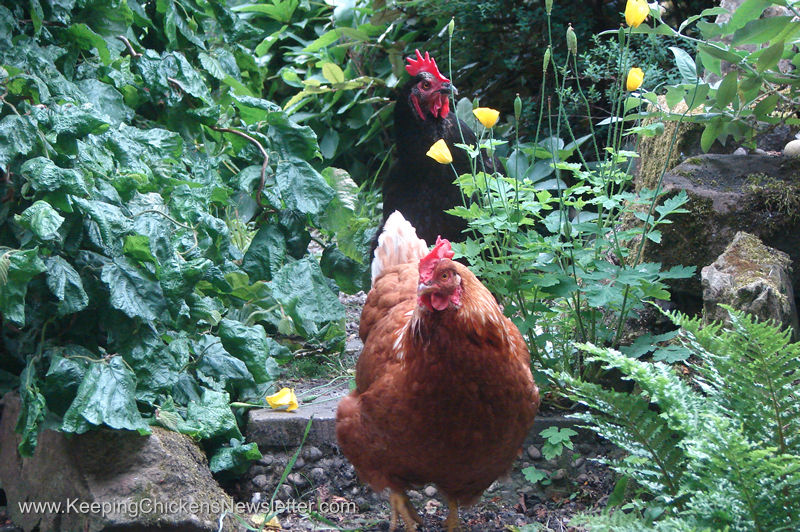
However, back in February, Jethro (the brown one and so named because of her habit to stand on one leg like Ian Anderson from Jethro Tull) suffered what seemed to be a stroke. One morning she almost fell out of the hen house when trying to walk down the ramp, her head was quite literally sitting at 90 degrees, resting on her left ‘shoulder’, and when eating she missed the food by a country mile. I asked the vet if it could be a stroke and he said ‘yes’ and that she could get better … could stay the same … or could get worse and die.
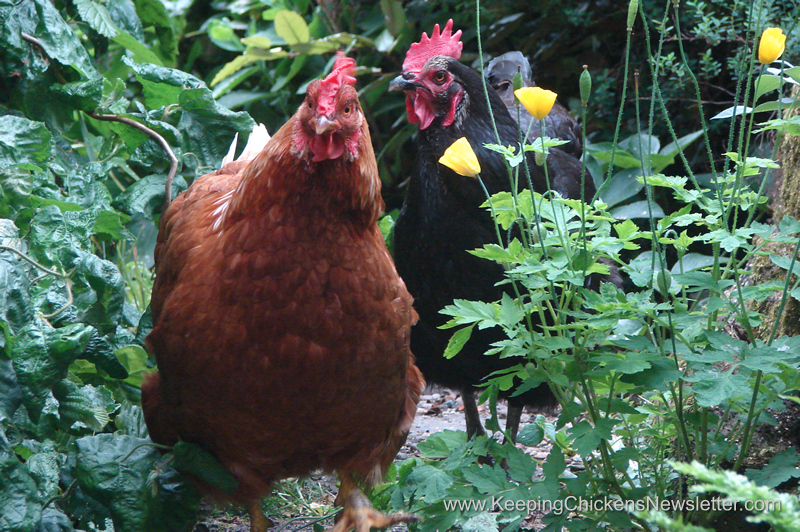
For the next week I fed her by hand up to 15 times a day, and moved the two old girls from the hen house to a storeroom in the main house. After a week she was managing to feed herself, her head was now only at 45 degrees, and she chose to go back to the hen house (except for a couple of very cold days). After three weeks she seemed to have completely recovered and now looks as healthy as she ever has. The only things that have changed are that she seems to have stopped laying (even up to last year she was a prolific layer, and had just started to lay agai this year when she had her incident), and since getting better every morning she has started to crow (almost like a cockerel) either from the hen house doorway or she comes to the house and stands by the kitchen door.
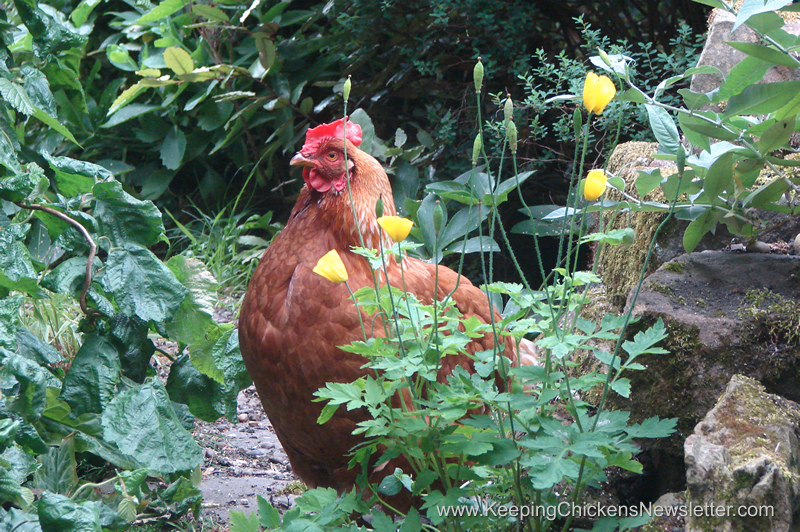
We’ll never know whether it was a stroke or something else, but her recovery was something to marvel at.
Many thanks for your fantastic Newsletter!
Mario (Derbyshire)
Mother Nature and Human Cultivation Working in Harmony

Sally : Many organic farmers understand the interconnectedness of life and so they not only don’t use pesticides, but they have other farming practices that also work to protect life on earth rather than defeat, tame or damage it. One of the best stories I’ve heard of late was from a friend who is an organic farmer in Sebastopol, CA.

Paul has a friend who raises cattle and chickens, both free range, grass fed. He starts his cows out on a pasture until the grass is short. He then moves the cows to the next pasture, while leaving the old pasture to fallow (cow dung and all) for about a week (the time it takes fly eggs to hatch and grow into larvae). He then moves his chickens into the pasture. They scratch through the cow dung to eat some nice protein filled larvae, poop on the grass (chicken poo is an awesome fertilizer) and they eat a little grass (calcium, omega 3s and more). After he moves the chickens on to the next pasture the grass grows thick, green and tall — making it perfect for the next round of cattle grazing. No pesticides, added fertilizers or feeds involved. Just mother nature and human cultivation working in harmony!

Chickens and Dogs

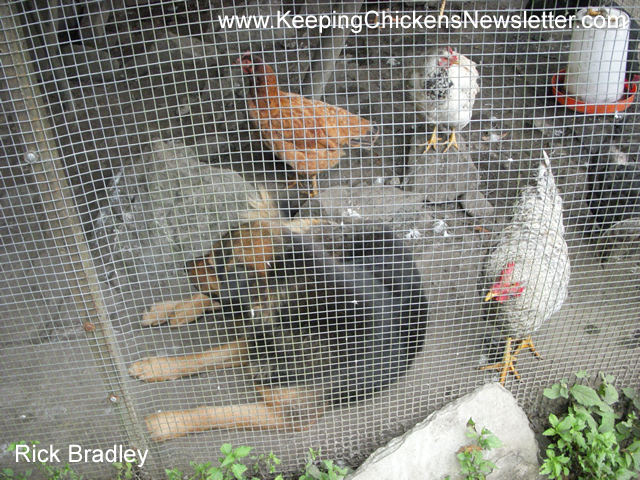
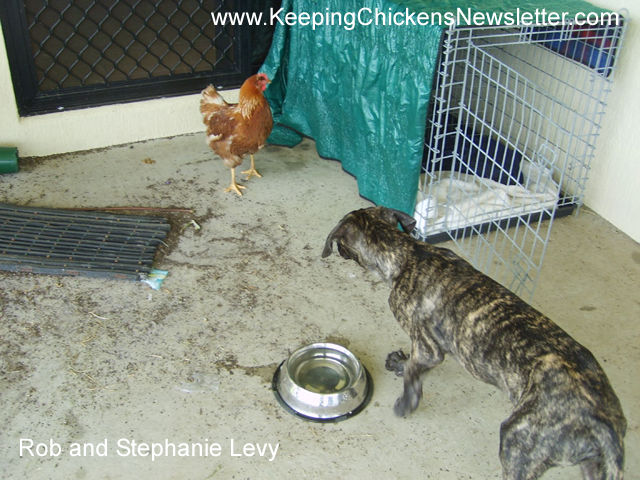
Allowing your dog to mix with your chickens is not something to take lightly. A lot rests on the early introductions and also some luck with your dogs natural temperament. A flock of chickens will usually run off in all directions if a dog (particularly one they are not used to) comes bounding over to them and that can easily start a game of chase. If the first time your dog meets your chickens it has a great time chasing them it will be harder to persuade your dog in the future that they are not just a fun game. Sadly for the chickens it is far from fun and can easily turn deadly.

First introductions can start with chicks. In Tyler Edwards video below they explain how they introduced their dog to their chickens as chicks and got her used to them as they grew. They were never left alone together. Once grown and placed outside they were again carefully introduced under supervision.

Chickens and Cat Food

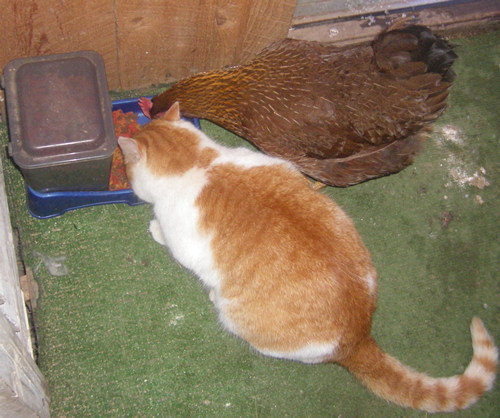
Melissa Hello, I have a question, my chickens love cat food and I was wondering if this is okay for them to eat? We have a barn cat that moved in so we had him neutered and he happily lives outside. We have tried to bring him in but he won’t stay. Anyway we feed him on our back porch and the chickens come and eat the cat food. Our chickens are free to roam wherever they want so I want to make sure the cat food isn’t going to harm them. Thank you so much for your time and help. I would also like to say your newsletter is awesome! Thank you again, Melissa


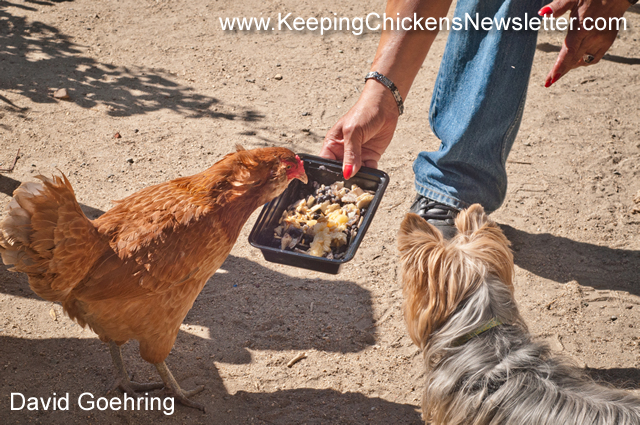
Many chickens enjoy cat food as an occasional treat – just be sure
you have an understanding cat! 

My Reply : Chickens love variety in their diets and will eat all sorts of food and scraps. The general rule with any ‘treats’ (i.e. something not part of their nutritionally balanced diet) is that they should not be more than 10{d5282123537f4ae2af101911d100f16a2c80c27049f1391c1ab6ea474c1bc6e6} of their daily intake. Treats should also not be sugary or salty etc. Cat food is relatively high in fat and protein and so is not the most ideal treat, but it will not hurt as an occasional treat, and some chicken owners find it useful to offer a little as a protein boost for times such as when they are going through a moult.

Chicken Coop and Run with Awning

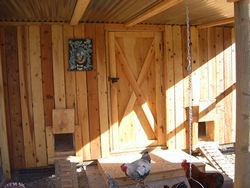
Ley Gorrell : I’ve attached some photos of our chicken coop and run. We backed it up to our old tool barn, and put the same cedar siding on it (its actually privacy fencing). The coop is 9′ x 12′, and the run is currently 12′ x 32′ (it can be easily expanded). There’s an 8′ awning for loafing under when it’s raining/snowing, and in our hot summers.

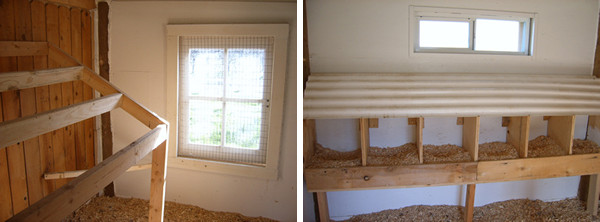
The coop is painted plywood on the inside, with linoleum floor for ease of cleaning. I have a droppings pit under the roosts for the same reason.

The big window is one I found in the garage and refurbished. It swings out. The small one is a bathroom window that slides open. I have a remarkably bright solar light inside, and that’s the little solar panel you see on the south roof. It looks like the chickens are watching TV at night! There’s also a 4′ x 6′ storage closet for feed and supplies.

I’ve also included photos of my favorite hen, Anise, a Silver Spangled Spitzhauben, and my favorite rooster, Fennel, a gray bantam Silky, with the cutest little crow you’ve ever heard. All the chickens are named for spices and flavorings (don’t tell them!) We’re currently getting about a dozen eggs a day, including pretty blue ones from the Americaunas. We have the chickens for the eggs, not to eat. I make all of my own dog and cat food, so everyone gets eggs for breakfast.

We also have ducks, guineas, and a pair of Toulouse geese. We have another batch of babies getting shipped in next month. The next big project is going to be a wild duck aviary. We will be building that over the summer, in anticipation of the ducks arrival in October. I connected with a gentleman in Oregon who is going to ship me breeding pairs of Wood Ducks, Mandarins, White Mandarins, Northern Pintails, Green Winged Teals, Cinnamons Teals, Spotted Teals, and Hooded Mergansers. Very exciting!

I would like to hear from anyone with wild duck aviary/breeding experience, particularly help on containment. My plan is to do the same thing that we did with the coop, with heavy-duty steel wire, sunk in concrete trenches. However, the chickens are locked in the coop at night, the waterfowl will not be. We have plenty of predators (coyotes, hawks, owls, racoons, bobcats), so trying to decide what would be best for overhead. The chicken run just has lightweight plastic netting on top. I’d like to make the size of the aviary approximately 60′ x 100′, and we have several mature oaks to fence around. It would not be advisable for us to use hot wires, as it is a major fire hazard here in our arid summers.

We are on the eastern side of California, in the lower Sierra Nevadas, with King’s Canyon and Sequoia National Parks just above us with the big mountains.

Traumatized by a Predator Attack

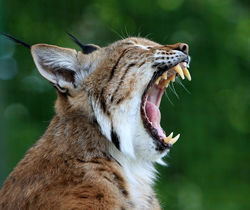
Liz  : I wanted to comment on the folks who lost hens to predators. I am certified in the treatment of Post Traumatic Stress Disorder in people and was very curious to see how my hens would react after a wicked bobcat made a meal of 3 of my hens. The rest of the hens were extremely traumatized and stayed up on a very high roost for several days. I chopped down the tree that pierced the top of the coop wire and covered over the hole (only about 10″–I don’t know how the cat got in–had to squeeze in.) and then took each hen out to see the covered hole. All the feathers were removed from the hen house and the dead girls were buried appropriately with lime put over them prior to the dirt.

It took about 6 weeks for the hens to settle down and come out to forage during the day. I added 7 red comets to the flock shortly after that. When I go into the hen house at night, all the comets are sleeping on the floor–relaxed and lolly-gagging without a care in the world. The older girls who witnessed the massacre are still roosting way up next to the roof. I doubt they will ever quite recover. We give them lots of pets and some good scratching to reassure them. They did not lay for 2 months but are making up for it–one a day from each, even the auracanas!

As for adding hens to a flock, I am no expert but have had success as long as I put them in when they are fairly mature. The big hens will be quite territorial about the food so the little ones have to get it while the big girls are out shopping for their earthworms and grubs. They keep to themselves, as though a separate flock, until they get almost fully grown and then they all seem to just flock together! Thanks again for all your help and I do love the newsletter! Liz in Prescott, Az.

Go to Top