Keeping Chickens Newsletter May 2014 Vol. 1
Method for Sexing Chicks

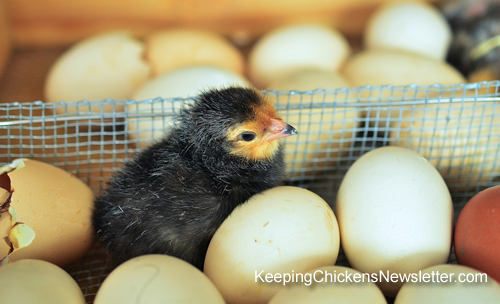
Ann : I enjoy reading your newsletter. I’m new at raising chicken, although my mother had chickens when I was a child. I have three buff orpingtons and two black sex-links. I decided I wanted chickens for the fresh eggs. They are very friendly chickens. I wanted to share something. I heard my mother say the way to tell the sex of a baby chicken. (hen or rooster). Gently pick up the baby chick by the neck and hold between two fingers for a few seconds. If the chick is a hen, she will draw her legs up to her belly, if the chick is a rooster the chick will hold the feet straight out.

===A variation of this method is given here https://www.keepingchickensnewsletter.com/may14v2/telling-the-sex-of-chickens.htm

Introducing chicks into a house with established hens

Jacqueline : This is a response to the gal who wanted to know how/when to introduce baby chicks into a house with established hens. I have done this many times successfully. When the day old chicks come home, I put them into a wooden box about 6 inches high with wire on the bottom, and several wired windows on the top. The box needs to be big enough to put a food bowl and water inside. I put this box into the hen house. The babies can hear the adults and vice versa and I can keep their food separate. When they start to get too big for the box (after several weeks) I transfer them to a dog crate. Now everyone can see and hear each other and food is kept separate. When they get bigger I open a door on the dog crate just far enough that the babies can get out but the adults can’t get in. The babies wander out but can escape from the adults if necessary by running back into their crate. I usually leave the crate in the henhouse until they are on layer mash, but, the babies do get into the adult food as they stop hanging out much in their crate once they feel entirely safe. The babies seem to work their way into the hierarchy quite naturally with this system. I have never had fights in the henhouse, and have never had a baby injured. Maybe this system will work for others. Thanks for a great newsletter. It is always an informative and enjoyable read. Jacqueline Colyer

Nancy : In response to Victoria’s question about expanding the flock, I have only tried the following once but it seemed to work. I raised my chicks in a separate coop in the adult chicken yard so they were in plain view as they developed. At around 10 wks I started letting them out and they were not warmly welcomed at all. I waited a week or so more and tried again only this time I let the juveniles out first and gave them some time to forage alone before letting out the adults. I cannot be sure, but this seemed to bestow some status on the youngsters and they are integrating nicely. Best, Nancy, Claremont, CA

Some more experiences of adding to your flock are here : https://www.keepingchickensnewsletter.com/site/mixingflocks.htm

The last hen

Last hen Kay

Sarah : This is for Julie, regarding the re-homing of her one chicken “Kay”. If you have to choose between company and space for your beloved hen you have made the right choice, she needs the other chickens. But you obviously miss her very much. You said you couldn’t have more chickens at this time, but could you take her back and get just one other hen for company for her? Then she could have the space she is used to and a friend, and you could have your chook back. If not, then you will have to comfort yourself with the knowledge that she is safe in her new home and living with other chickens as she should. Sincerely, Sarah

Teresa : This is to Julie, after re-homing her only remaining hen, Kay: Julie, I commend you for making the tough decision to re-home your sweet little Kay after the death of your other hens. I would, as you do, feel concerned about her new home situation with less space. Of course, without seeing her new surroundings, I cannot fully develop an opinion. However, I would tend to think that as long as she has adjusted, is eating, sleeping and laying, that all is well and you’ve made the best decision for your girl. I don’t think there is a thing wrong with you considering bringing her back home – that shows your sincere care and concern for her. But, be encouraged that since you do care for her so much, the ultimate decision that you’ve made is truly the best one for her. Blessings, Teresa

Kathy : This is for Julie, who just has one hen now : Julie, it is hard to make this kind of decision, but I would keep Kay rather than rehoming her. I’ve had single chickens in the past, and they seem to do fine.

Cathy : This is in reply to Julie, who has just parted with her remaining hen Kay : Dear Julie – You’ve just made a very difficult decision about the best welfare of your remaining hen while mourning the loss of her companion, and it’s apparent that you researched and weighed up all factors before making this decision to rehome her. Her new home doesn’t give her the same very desirable environmental benefits that you were able to provide, and its only apparent advantage is the company of other chickens. I feel for you, as one of my two young hens recently had to be euthanased and the remaining one, who was fretting on her own, needed a new companion which fortunately I was able to provide. In your place, I would continue to monitor Kay’s progress and welfare in her new home while keeping options open for bringing her back if her new situation becomes unreasonably difficult or untenable. You don’t mention why you were unable to bring in a new companion for her, and I wonder firstly whether or not your company and the bond with you would be enough to maintain her (as might be the case if you hand-raised her and she thinks you are Mum) if her new situation did become untenable, or if there is another way of providing her with companionship, not necessarily another chicken, when you are not in attendance. In any case, you could not do any better than you have already done: that is, to make an informed and humane decision for the best benefit of Kay. I wish you (and Kay) all the best. Kindest regards.

Tiny Eggs

Katie : Today while feeding the flock we noticed Sandy staring blankly at nothing. After a while she starting crouching like she needed to poop or lay a egg. Apparently she had to lay an egg! But this egg was like no other egg I have seen. It was a inch long a pale white, kinda transparent, had no yolk, had a very soft undeveloped shell, and was very small. Sandy had laid a egg already today so we didn’t know why this one had been laid. My guess is that it is a partly developed egg but I don’t know why she laid it!

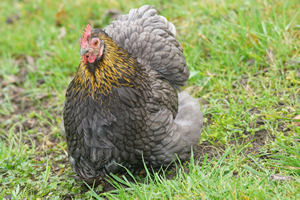
Sandy the hen that laid the egg

Loretta : I enjoy your newsletter. I have a question for you. I have 3 adult hens that lay eggs regularly. I added 4 new chicks in February they are all getting along fine. The young girls are a about 2 ½ months old. Twice now I have found a very small egg in with the rest of the regular eggs. By small I mean 3/4″. Who is laying the small egg? Could it be the young girls or could it be one of the adult hens? We broke it open and there was no yolk.

normal and small egg next to each other

My Reply : I don’t think it could be the new ones, they sound too young. It probably is what is known as a ‘fart’ or ‘wind’ egg being laid by one of your older girls. Perhaps one has done it both times, or it could be a different hen each time. If it was done regularly by the same hen, then it may indicate an issue but it is normal for an unusual egg to be laid occasionally and is probably just that one of your hens has gotten a little out of sync with herself (which can be due to stress, age, changes in length of daylight hours etc.)

Is it true Americaunas only lay for one year?

Thea : I’ve been raising Americauna chickens for a few years now. This winter it seems they’ve molted late, having had people I’d never seen come to buy my eggs. But now I can’t recall how long its been since I was getting no eggs to one per day and I couldn’t understand what the problem is. Then I met up a couple days ago with a friend who used to Americaunas… they only lay eggs for one year! Those I incubator-hatched start next month. Next year, a new breed! Thea in Coombs

===There are some responses regarding Americauna chickens here : https://www.keepingchickensnewsletter.com/may14v2/experiences-of-americauna-chickens.htm

Increasing Calcium Intake

Cathy : This is a thankyou to Bernice, who responded to my question about ISA Browns and their dietary requirements. I was very interested to read this reply and had not considered the idea that the diet of my hens during their growing period before entering their laying period might have affected their ongoing health, but it makes sense that it would, especially given that the hens rely on the calcium already laid down in their medullary bones to support egg-laying in maturity. I acquired these hens as point-of-lay pullets and assumed that they had been fed to meet all their dietary requirements, and perhaps this was true as far as the grower was able to ascertain.

Looking at the condition of both my young hens once they had gone through an extended laying period, I was convinced that they had very low bone density as well as low body weight, and I have been looking at ways to add loading to calcium intake and uptake, even to the extent of treating the soil in their enclosure so that the vegetation growing within will have maximum possible calcium value.

As an ageing female human who is taking both calcium and Vit D supplements to counteract medically diagnosed low bone density, I have been advised that these supplements can only halt the advance towards osteoporosis and not restore bone density already lost. So my thinking is that I can’t restore lost bone density to my hens either, only do my best to keep them in as good a condition as possible through all means available to me, from the start of their time under my care. Meanwhile, the vet suggested changing to another breed of hen altogether, and a gradual changeover to Australorps (which might also cope with the extreme summer heat here) is looking likely. With thanks and kind regards, Cathy O’Driscoll

Bad Banty

Nancy : Dear Gina and Readers, I could tell many stories of my hens’ ability to communicate with their keeper (me) but I’d like to share one dramatic one which happened just a few minutes ago.

My ranchette consists of a chicken yard, 3 coops, about 50 hens, an occasional coyote visitor, and a mixed dog named Cookie who barks from her boudoir in the garage when we get these unwelcome guests. As long as the girls are in their coops, they are pretty secure. However, they are at their most vulnerable when they spend the night perched on a roof or a branch and then, at daylight, let themselves down to forage. Every night I do my best to put everyone in but sometimes one or two evade me.

Well, this morning at 5:30 (prime coyote time) Cookie barked so I went to investigate. I let her out of the garage and allowed her to do her search while I did mine. If a coyote had been here, it was already gone, no damage done. Planning to go back to bed, I left the back door to the garage open so Cookie could patrol, thought smugly, “All is well,” and headed into the house.

Not so fast! My attempt to return to bed was arrested by an uncharacteristically loud chorus coming from the yard. Yet this time it was only the chickens making the racket, not the dog. “What is going on?” I mused. “These girls will wake the sheriff!” Out I went again, this time to quiet the birds, and who should I see but Racing Stripes, my barred bantam cochin, sitting atop the roof of her coop, looking sheepish. “Bad banty!” I scolded. “Don’t you know that you could have become someone’s tasty morsel?” Then I scooped up the fluffy, football-shaped fowl, passed her gently into her coop, and the ruckus instantly ceased. “Good hens!” I purred, grateful to them for alerting me to Racing Stripe’s perilous position. By this time it was too late to go back to bed so I wrote down this story to share with you. Nancy, Claremont, CA

Polish chicken with Scissor Beak

Rebecca : Hi. I wanted to know if you or any of your newsletters have any info on scissor beak. I have a six week old Polish Chicken that has a SEVERE scissor beak. I have taken him to an Avian Vet, and they are getting another Vet’s opinion from someone out in California to see if there is anything they can do. I was hoping maybe they could at least trim it or something. “Edward” is on the skinny side, but he is obviously getting enough food and water to survive, but I am very concerned about his eating and drinking. Any suggestions or advise on what or how to feed him differently or anything I can do would be greatly appreciated. I have attached a picture of my sweetie, Edward.

My Reply : There have been a few subscribers with crossed beaks in the past but not as severe as that as far as I can remember. Beaks can sometimes be trimmed and shaped a little which does seem to help in some cases so hopefully your avian vet will be able to do something to help Edward. Practical things that might help are deep and wide food and water dishes and feeding mash instead of pellets. Does anyone have any info on helping scissor beak?

===Some subscriber responses are here : https://www.keepingchickensnewsletter.com/may14v2/scissor-beak.htm

Go to Top