Keeping Chickens Newsletter May 2017

Chickens Are Amazing

Carol : Yesterday my step daughter graduated from high school. We had family over for a cookout, and one of the grandkids let the chickens out. I figured…well that’s fine as I usually let them out anyway. Here my stepson decided to bring his dog out and I even said to him, the chickens are out so the dog can’t be running loose. My stepson said, oh he’ll be ok….nope, about 5 minutes later the dog went after them.

There were feathers everywhere, the rooster lost a spur fighting, people were running, trying to catch the dog, etc. the hens all scattered and hid. My husband found one under a rhubarb plant. I found my one rooster hunkered down under a pine. We walked through the woods several times, but I did say once it quiets down they’ll come back. I have 11 chickens and had only 4 back, but the one rooster made a sound when he got by our gate and low and behold 5 hens come out of the woods. Then right before dark another hen came forth. I was still missing one hen, the one the dog attacked and I searched and searched. There was no sign of her. I figured she died somewhere in the woods.

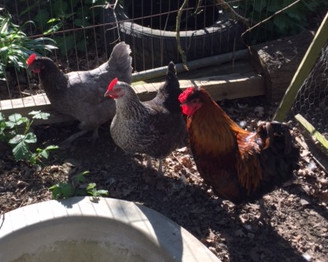
Today, the next morning, there was still no sign of her. My husband and I went to a graduation party this evening and I made a comment as we pulled into the driveway, no gray poo poo (I call them that poo poo instead of chickens, and she’s a gray hen). We came in the house and I heard a rooster crowing. They are like watch dogs, when my husband comes home the rooster always crows too. Anyway I looked out the door and there she was standing by the fence looking in and the rooster was looking at her crowing, as if to say…let her in! We opened the gate and she waddled back in by the rest of them, (she’s a real fluffy bottomed hen). What amazed us was the fact that she was gone a whole day and survived or wasn’t eaten by a fox or a coyote, and also when she went in the run, all of the hens surrounded her and cackled as if to say, where’ve you been? Even the rooster came over by her. It was really neat to see that, how they surrounded her and talked to her and they cocked their heads. I wished I would have video taped that. Just wanted to share.

Chick with Spraddle Leg

Sheila : Hi Gina! I’m having a difficult time trying to correct the spraddle leg. I have had it taped with the vet tape for a week. The pullet is 4 weeks old now. Sometimes she sleeps on her side. She is so tired from trying to walk. This picture is when she was about a week old. We tried the bandaids for a week and she kept taking them off. Any suggestions?

My Reply : There is a page of information about many different variations of chick leg issues and some treatments which might help here :
https://sites.google.com/a/poultrypedia.com/poultrypedia/poultry-podiatry
Vitamin b is mentioned on that page several times and so is probably worth a try in addition to anything else you might be doing (if you aren’t giving it already). If no poultry vitamin/nutrient supplement is available a little Marmite or Vegemite mixed in with some scrambled egg could be one way of giving her a little vitamin b boost.

Peeling Hard Boiled Eggs

By Christina Raving

It never fails. A person is new to keeping backyard chickens with their daily laid eggs. They love hard boiled eggs, and just know that the freshest eggs will taste so much better than store-bought. So they boil some up right from the hen’s nest. And when it comes to peeling them, to getting at the tastiest eggs they could ever imagine- it’s darn near impossible without utter carnage!

A diagram of the parts of the egg. a, The blastoderm. b, The shell. c, The outer shell membrane. d, The inner shell membrane. e, The air-sac at the large end of the egg. f, The albumin. g, The chalaza. h, The yellow layers of yolk. i, The white layers of yolk. k, The flask-shaped portion of white yolk. l, The vitelliac membrane.

There is a biological reason behind this. When you look at a diagram of the anatomy of an egg, there are two membranes between the shell on the outside and the albumen, or egg white. When an egg is good and fresh, the gas-permeable membranes between the shell and the albumen are tightly adherent to allow the developing embryo to breathe. It takes 7-10 days after laying for the egg to die.

Did you ever notice that all store-bought eggs are easily peeled when they are hard-boiled? That’s because they are all at least two weeks old. I remember an expose long ago of a large grocery chain that had the practice of taking eggs past their stale date, putting them in new cartons, and putting them back out for sale. Even when you buy premium, free-range, organic eggs, they will never have printed on the carton the date they were laid. It will always say, “Date processed”. You simply cannot buy eggs as fresh as your backyard hens can produce for you. And don’t even get me started on the industry definition of “cage free”. My hens roam freely throughout my yard; they’ve never seen a cage in their life!

So forget all those remedies for peeling an egg. Don’t waste vinegar or an ice bath. Simply hold those eggs in your refrigerator for 10 days before hard boiling. You are still going to be ahead of the game in freshness and taste. Then one last technique I would want to impart is to crack then roll them gently on the counter before you peel them. After that, you should have no problem.

How to boil the perfect egg every time:

1. Immerse the eggs in cold water in a pot.
2. Discard any eggs that float to the surface.
3. Cover the pot and bring it just to a rolling boil.
4. Turn off the heat and move the pot to the side.
5. Immediately set your kitchen timer for 15 minutes.
6. At the end of 15 minutes, drain the eggs, peel and eat.

Chicken Diet Supplements

Rin : Happy healthy chickens! We treat our girls and two boys (who’ve lived together since they were chicks – they don’t fight each other and actually are quite close ❤️) to diet supplements of natural yoghurt, live maggots, lots of greens (lettuce, cucumber, spinach, cabbage, cauliflower) and a tablespoon of apple cider (Hic) vinegar every so often in their water to improve their general health and gizzard digestive health!

Anyone else got any diet supplement tips?

Rin
Heron way Community Allotment – Feltham

Rooster Talk

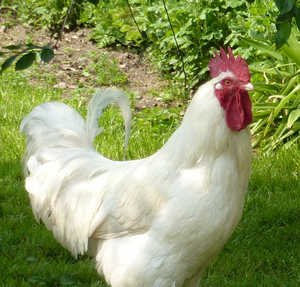
rooster and hen standing on pathway Graham : I had an interesting observance here recently. I usually work on the premise that whatever happens to come my way, be it detrimental or beneficial, has undoubtedly happened to thousands of others also, so you may have heard this all before. I hope you enjoy reading about my new little companion.
The only hen here now has prepared a hollow in the straw in the nestbox in the brand new chicken coop I have installed for her & her rooster friend. It is a far cry from the disgusting first coop I built 30 or more years ago. Here, there is light, cleanliness, ease of perch access, food, water & sawdust I can scrape out with a home-made rake with ease, to keep it spotless. There is even diatomaceous earth sprinkled under the straw in the boxes & beneath the sawdust on the floor all around the edges under the sawdust, to help control fowl mites, tics & fleas.

She & Birdie the rooster must be very pleased with their new home, now they have a view.  At dusk when I go down the rear of the section to check on & top up rat poison, they chatter away through the netting to me.

The attractive young little rooster we picked up on a farm out in the plains a year back, is a most curious animal. It has no animosity to me at all; unlike roosters past which liked to dominate everything and attack when one’s back is turned. Birdie did mimic a magpie & german owl for a while, but as they are not frequent at our place, he soon ceased.

He has become very friendly & interested in what happens around here. I think all this has come about (apart from him having a very pleasant little personality) from being able to wander freely for most of the time & come over to me to investigate my ‘doings’. (He was living in crowded conditions in a large, low, netting cage with other fowls.) I talk to him often & stop occasionally to give him small-bird seed & sunflower seeds also & he enjoys investigating the inner rear garage whether I am in there working, or not. Most of all, both birds enjoy me breaking up a walnut for them.

The noises he makes, are what alert me to his efforts to communicate. Mostly there is an urgent distinct short ‘chit chit’ & frequent cocking-of-the-head glances in my direction, asking me to share in the ‘news’. This is the same communicative noise roosters give to hens when inviting them over to where they have discovered some tasty morsel & wish to give them ‘first taste’.

This was confirmed today, as he was going on at some determined length before I dropped what I was doing & ventured over to see what was on offing. He was walking around the edge of a shallow depression in the earth, (sand, here at our place) picking up any tiny stick or bit of rubbish that was already on the ground & dropping them, all the time periodically cocking his head & looking up at me. He was telling me something to do with nesting, I’m sure.

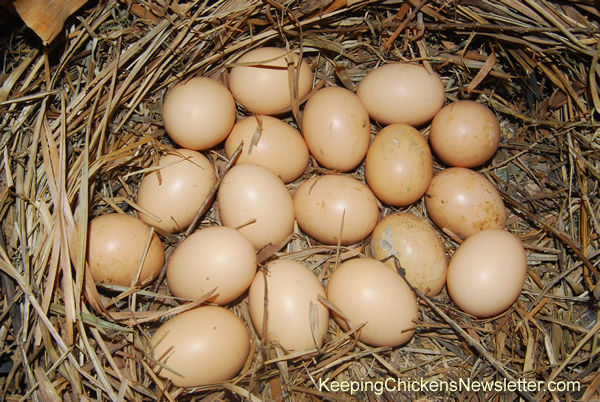
Upon inspection in the new coop 80 feet away down the rear of the section, I found the hen sitting in the prepared hollow in the straw. I think there may be an egg in there today regardless of this cooler time of year. Her last egg was 4 weeks back. After checking much later in the day, I see yes, there is an egg! I’ve got to get to know this curious rooster better.

Two days later…

The same procedure of walking around the edge of a separate shallow depression & chattering occurred today & another egg laid. This makes me wonder quite what I have missed over the decades, simply because I was perhaps not listening & observing well enough.

Something else I found out :- I discovered the netting I had put up on one side of the coop on the floor-to-ceiling doors, was difficult to see past, so I painted both sides black & now the two occupants inside have a view not possible before. Also, painting the outside allows me to see them siting on the perches whereas before it was nigh impossible. Tricks to the eyes. Just like light & dark painted trellis work atop fences.

Thanks again,
Graham East,
Christchurch, New Zealand.

Mixing Chicks of Different Ages

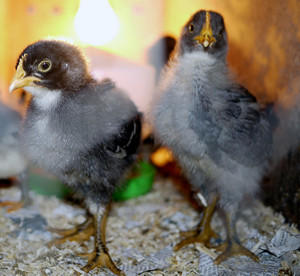
Carol : I have four 2 week old chicks and I’m getting two more today. Will there be a problem mixing the two in with the 2 week old chicks? I really don’t care to have 2 brooders going.

My Reply : When only a week or so apart they usually can be mixed without too much bother (there is potential for pecking order types of squabbles but unless blood is drawn any should pass). If there were issues and the brooder is big enough you may be able to divide it using something like hardware cloth for a few days to get them more used to each other before trying again.

Update from Carol : Thanks…I have a large box and I put cardboard between. When I got home from work the day old babies were gone! Here they snuck around the back of the cardboard and went in by the big girls! It has been so cute….the 3 week old chicks are very protective of them. Yesterday I moved them all into a smaller box so I could clean their box, of course they weren’t under a light, and the babies were snuggled under the bigger chicks. I’m glad they’ve accepted them so well. The babies watch what they do. It’s really cute.


2 week old chicks

A Mystery and a Coop

Bill : I didn’t have any luck trying to find the answer to my question on your website. Here is my situation. I have six adult chickens, about one year old, and since they have started laying they have given us 5-6 eggs on a daily basis and then yesterday we only got one egg. What went wrong? Any ideas you can share would be greatly appreciated.
Thanks, Bill McChain

My Reply : It is very strange that they (nearly) all stopped on the same day – perhaps there was a noise or disturbance nearby that put them off, or they had laid some but something stole the eggs. If it continues then there may be some sort of nutritional/health issue (or egg thieves) but usually if there was a health reason they wouldn’t all stop on exactly the same day so most likely it is just a temporary blip which could have been due to a disturbance or egg thief.


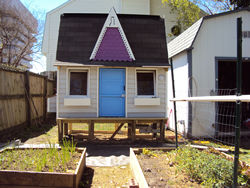
John Vertigan : Chicken House


Marking Eggs With A Lead Pencil

Aaron : I have a white Silkie. We call her Mrs fluff and the rooster Mr fluff. We have 60 chickens of all breeds ( 4 roosters and 56 hens ) 2 guineas and 2 Peking ducks. Free range. Mrs fluff is sitting on 10-12 eggs. I noticed a few days ago that there are now 18 eggs. For future sittings what should I do? Isolate her? Mark the eggs? If I mark them what should I use? My Dad said to not use a lead pencil. Thank you. Aaron in Monrovia, Indiana Love the newsletter

My Reply : I have seen a lot of people in the forums mention they use sharpies which are supposed to be non-toxic for ‘normal uses’ and seem to work quite well but in many other places such as here (question 57) they say that a lead pencil is the only thing that should be used to mark eggs. It seems counter intuitive to mark anything with ‘lead’ (worries of lead poisoning etc.) but strangely enough as the following article points out, there isn’t actually any lead in a lead pencil : Ever wondered about the lead in pencils? It can help to keep a broody hen in her own secure area so she can hatch her chicks in peace, and that would ensure that no new eggs were added to her nest. If she is already settled on her nest then moving her could potentially disturb her enough to make her leave them. Depending on the flock it may be worth that risk as if they pester her that in itself could cause her to abandon her eggs and they may even attack the chicks once hatched. Likewise, she can potentially be a menace to them by trying to scare them away from the nests. Often all will get along just fine and the chicks can grow up with the flock  which can be lovely to watch – as ever it can still be handy to have a ‘plan b’ ready in case things don’t continue to go as smoothly as hoped.

Go to Top