Keeping Chickens Newsletter April 2012 Vol. 2
Getting Chickens To Lay Eggs In The Nestboxes

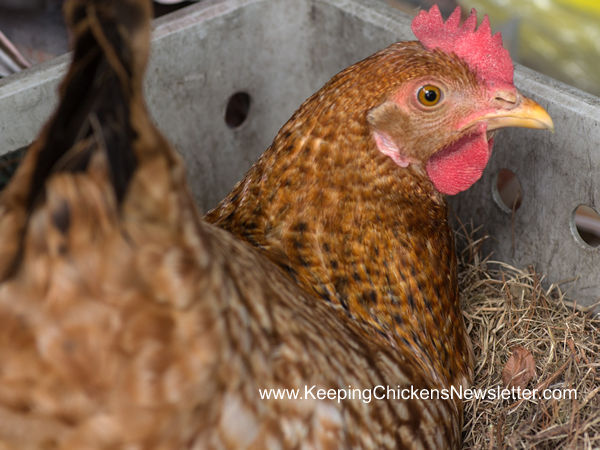
Kay : My first year of raising chickens has been a great one. The story about the ceramic eggs. I had read that the ceramic eggs helped the pullets get started laying eggs. I put one in each nesting box. The girls were laying quite regular so I took them out. I thought “Oh well, they must be getting the hang of it”. Well, the day I took them out my husband found eggs laid outside in a corner by the shed. I guess they didn’t like the ceramic eggs out. They have been in the nesting boxes ever since and will probably remain there.

Chicken Bailout Plan

Before you jump to conclusions, let me assure you that extravagant executive bonuses will not be a concern; the Happiest Chicken CEO (fondly known as Big Mama, No Feathers or less respectfully as Mother Clucker) doesn’t even get a salary, let alone an annual bonus. Transparency won’t be a problem either; we will gladly open both the hen house and our books to anyone. Finally, we are pretty sure that toxic debt is not an issue either, but since we’re not altogether certain what it is, we hate to make a promise we can’t keep. Owing to the heat and humidity in Kansas, August in the coop can veer a little toward the toxic.

Please bear in mind that we are trying to avoid national publicity. Several of the most vociferous chicken groups – notably the proud and financially savvy P.A.R. (Poultry of the American Revolution), whose President, Parmentia Pilgrim, is a Barred Plymouth Rock supposedly in a direct line of descent from the flock of Captain Myles Standish – have argued that the bailout needn’t be a high-profile federal matter or even a state-level concern. Miss Pilgrim suggests that if every member of the labor force in Chase County kicked in about 13 cents, we could promise a prompt recovery.

costs of raising chickens
Captain Myles Standish & the Barred Plymouth Rock breed. Uncanny resemblance?

There’s no question that the pension plan is to blame for the bulk of our economic woes. The six most elderly chickens were born in 2004 and are now officially retired, living quite comfortably on the poultry version of Social Security and Medicare. I spent the first two years of nervous chicken-rearing trying to keep my small flock alive, and now that I’ve gained confidence and relaxed my vigilance considerably, these unproductive old farts refuse to expire gracefully of natural causes. I can already see the problem about to be compounded in the next generation of the flock, born in 2006. Normally, you can expect periodic mortality – a chickhood disease, a predator attack, a random chicken heart-attack – but no, I haven’t lost a single bird out of the 2006 batch. These hens will become eligible for retirement sometime next year, at which point over half of my flock will be on the dole.

Then there’s the strike. With absolutely no fanfare – no picket lines, no signs, no bullhorns, no written demands – all four of my working-age Ameraucanas abruptly ceased laying their blue-green eggs about two months ago. I have no explanation and no idea what they want.

Finally, I must bring up the unpleasant matter of the mix-up at the feed store this spring. I ordered two buff Brahmas to keep the Gandhi line going. The tiny yellow chicks with downy slippers on their feet arrived with punky purple stripes spray-painted on their heads, apparently to keep them sorted. The system failed. Instead of two full-sized Brahma hens, I ended up with a matched pair of junior-sized, strutting, crowing bantam roosters.

brahma chick

Elsewhere in Chase County (and I think I’ve figured out where), are the two big, beautiful Brahma hens I ordered. I’d love to work out a trade, but unfortunately (or fortunately, depending on how you look at it), one of the roosters died mysteriously this summer while we were away on vacation. The remaining rooster is called Mister, which is always italicized when you say it, as in “Listen here, Mister” and “Where do you think you’re going, Mister?” I have absolutely nothing against him aside from the fact that he does not lay eggs – he is a handsome fellow with a reasonable disposition and only a few minor, over-compensatory Napoleonic tendencies.

When I mentioned the possibility of a bailout plan while I was at the Hitchin Post for a burger the other day, one fellow was quick to bring up a time-honored solution. “I can tell you what you need,” he matter-of-factly informed me. “It’s called the Chicken and Dumpling Plan.”

I’ll be honest; I’ve never been hungry enough to consider eating an animal I know by name. Call me a panty-waist or a candy-ass. Call me a city slicker cleverly camouflaged in Carhartt. If I have friends for dinner, it is safe to assume they will not be the main course.

The helpful gentleman at the Hitchin Post turned out to have another idea as well: feathers for fancy fly-tying. The right kind of exotic feathers are worth inordinate sums of money to hobbyists and sportsmen with inordinate amounts of disposable income. Unfortunately, there is not much of a market for the type of feather we happen to have on hand at present. If, however, I could successfully raise a Kori Bustard or a Great Argus Pheasant alongside my chickens, we’d cover all our expenses and actually turn a profit. One pair of matched secondary wing feathers from the Great Argus, for example, retails for $90 to enthusiasts who enjoy tying Atlantic salmon flies either to cater to or engage in one of the most expensive habits on the planet. I found an extreme example of what this market will bear: a fishing fly – the centerpiece of which is a diamond-studded 14-karat gold hook – that sells for $9,000.

Kori Bustard, Ardeotiskori. Burchell, Etoscha National Park, Namibia Photo by Winfried / Bruenken, 2004

Here’s the problem: Kori Bustards are native to African grasslands and Great Argus Pheasants hail from the jungles of Borneo, Sumatra and Malay Peninsula. I’m not sure either species would do all that well in Kansas, especially in winter. Kori Bustards are among the so-called big bustards, the largest land birds that can still fly, sort of. They really prefer to walk or run, which they do the minute they notice a human being in the vicinity.

I can already see how this could be a serious problem in our operation. In their favor, bustards are usually stately and silent, but when they do have something to communicate – like alarm when they spy a human – they bark loudly. This would undoubtedly scare the ever-living you-know-what out of a chicken, which is only about one-eighth the size of a big bustard to start with. All in all, as you can readily see, this is not a very practical economic recovery plan. Still, I appreciate the creativity behind the suggestion.

Another bailout strategy suggests itself whenever chicken-coop-cleaning time arrives. Chickens produce prodigious quantities of…well…let’s just call it fertilizer. I know that this waste material is valuable, because we use it to boost soil fertility in our vegetable gardens, but until I did a little research and found “Cockadoodle DOO” brand organic fertilizer, I had no idea it could be worth 75 cents a pound. Three hundred or so pounds of the stuff and we could be out of debt! I am a little concerned by Cockadoodle DOO’s prominent label claim that the product is “safe for kids and pets.” I can personally attest to the fact that chicken droppings are perfectly safe for pets, because for some unfathomable reason, both of our dogs hold them in high esteem as irresistible delicacies (in the winter months, we refer to them as poopsicles). As to kids, however, I’m afraid labeling really needs to be more explicit in these litigious times. We’ve gotten terribly accustomed to being told more about what not to do with a product than about its actual use, which is why you can scarcely see the deck of your new lawnmower for all the warning stickers.

I hope you’ll forgive me for making light of a very serious topic. The Happiest Chickens in Kansas really have nothing to worry about by comparison with many individuals, families and communities right now. I was talking to my father on the phone the other day. Both he and my younger brother serve on the staff of a church in Michigan. I asked him how the auto industry crisis was affecting their congregation. “Well, it’s an interesting irony that when finances are tight, giving to the church is one of the first expenditures to get cut,” he told me, “and yet, when families find themselves in trouble, the church is one of the first places they turn for help.”

Originally published in Tallgrass Tales, reprinted here with kind permission of Marva L. Weigelt.

Digging Chickens

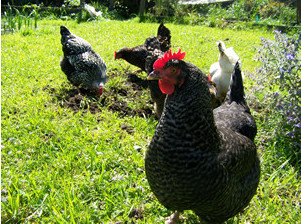
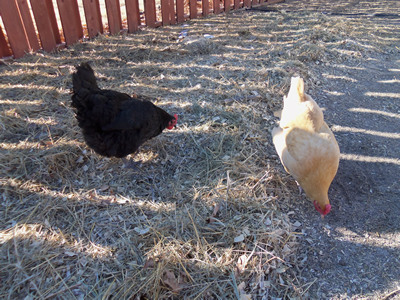
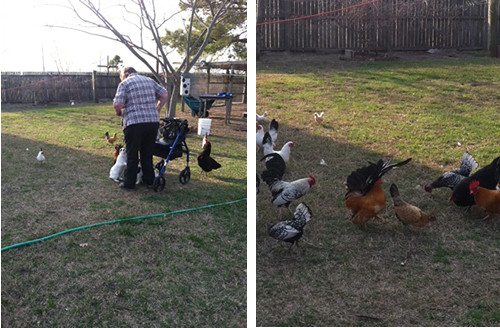
Sunnie : Hi Gina, I have some nice pictures of my girls that I’d like to share: my dog dug a hole looking for a gopher, then the girls came over to eat the worms! My dog is a bullmastiff and has been with these chickens since they were two days old.

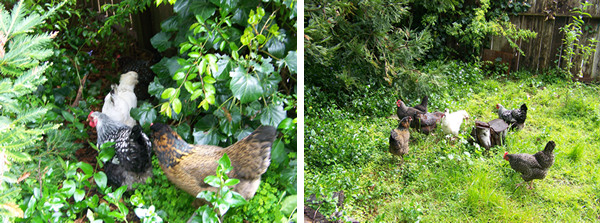
Here are a few more shots to give you all the idea of ‘free range’ within my backyard which is only about ½ acre, maybe ¾ acre.

The problem isn’t skunks or racoons, but trying to find their eggs! (They are completely protected come sunset and in a fully protected coop). I have one chicken, Ruby who likes much privacy and doesn’t like to lay in the nest boxes like the other chickens. She will seek out a secret spot; in fact, she’s the one furthest in leading them. Sunnie in Santa Cruz, CA PS Thank you so much for this wonderful newsletter.

Steam Treatment for Egg Bound Hen

The Hromas Family : I am writing in response to the April newsletter in which one of your readers talked about a hen being egg-bound. I would like to relate our own story about Fritz-Fritz, our Black Australorp, being egg-bound. My wife and I had noticed that Fritz-Fritz was acting strange and being sluggish. I had also realized that Fritz-Fritz had not layed an egg in 2 days and when I observed her sitting on one occasion, it looked as if she was straining (eyes had closed for a few seconds). In any case, we brought Fritz-Fritz inside the house and put her in our chick hutch/brooder. We put a blanket around the hutch, turned on the brooder lamp and put a pan of hot water underneath the wired floor (to provide steam). Within a couple of hours Fritz-Fritz seemed to be doing better and within a two hours after that (total of 4 hours) she passed a soft-shell egg, then seemed “right as rain.”

That happened back in February and since then she has been doing great, producing just about 1 egg every-day. I read that a possible cause for egg binding in backyard hens is dehydration; other causes such as poor diet, genetics, and lack of calcium are more common in “wild” flocks. I’m just happy that our “girl” is doing better! Thanks for keeping this awesome newsletter going! The Hromas Family, York, Nebraska

Enjoying Watermelon as a Treat

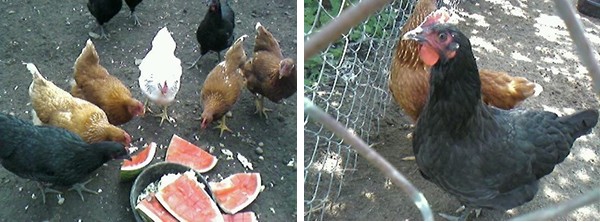
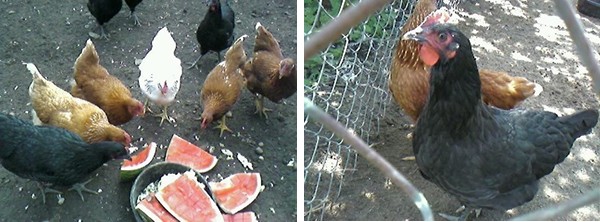
MJ : I enjoy reading all the letters and it helps me a lot about the chickens. This is my first year to take care of chicks and I love it. I have very healthy chicks and I sure don’t want anything to happen to them. As you can see they love the watermelon.

This is Alice she is only one I have with the powder puff on her head, lol. I love her, she comes right up to me when I go in the pen. Fresh eggs are the best – can’t beat it. Once in awhile I get a 2 yolker wow, we love it. Thanks again for you letters. MJ

The Difference Moving To A Place with A2 Zoning Can Make

John : Well it finally happened!!!! After living in the suburbs all my life and having to get rid of my chickens due to zoning. I finally moved to the country!!!! The zoning on the new place is A2. Now I know what A1 means, but what is A2, so when I called and asked the zoning office can I have chickens? They indicated that I could only have 100 chickens! YES! I now have 27 various breeds 5 turkens, 2 Black Stars, 3 New Hampshires, 2 Delawares, 4 Guinea Fowl, 4 Bantamn Roosters, 2 geese and 4 mixed chickens. I am loving life!!!!! Oh I am thinking of building a pond for the geese and any ducks after all I have 73 more birds to go. Thanks for your wonderful newsletter.

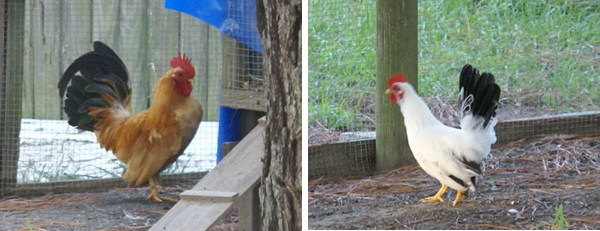
Jessie : Here are two of my roosters and my rabbit and chickens.

Go to Top