Keeping Chickens Newsletter July 2011 Vol. 1
Brooder Invention and a New Coop

Michelle Dickens : Our invention of a brooder. We used a large rabbit cage and put it in the bathtub (we have a shower that is separate and no one ever actually uses the tub) We bought the heat lamp and attached it to the top at one end of the cage so they could go to the other end if too hot. Also it had 2 heat settings. Eventually, a week before they were moved out to their coop, we no longer needed the lamp. The cage fit oh so perfectly into the tub so we did not need to build sides to keep the heat in. Just to mention, we have 4 cats and they were at first curious about the chicks, but after a few days pretty much ignored them. So, no one was harmed.

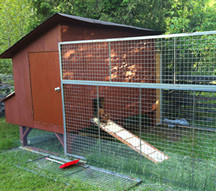
First pic below is the start of the building of the coop. My husband made it. Wish I could say I helped but I didn’t. Powers tools are not my thing. Second pic, is the completed outside. It was stained with the same color we used on our pot bellied piggy barn.(we have one) She squeals for attention when we are paying too much to the girls. The fencing used was obtained from my husbands work as they were not using it anymore and we thought since it was VERY sturdy it would aid in security. The roof which is now on, is made of the same material.

The girls the first time they were let out to explore – I used sandpaper for the first week so they wouldn’t slip on the wood, but no longer need it.

They get lots of shade and there’s lots of room for them to go under the coop as it is fenced with chicken wire that skirts out at the bottom and is staked into the ground.

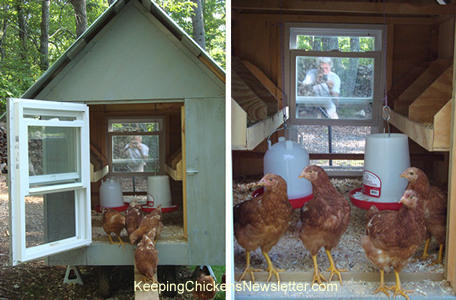
Inside the coop are 2 roosting poles, and four nesting boxes. We used cat litter boxes inside them. There are two windows that open, one on the south side and one on the west.

Their entry door has a closure that slides up and down (it’s on the inside) and their ramp closes up at night and there’s a hinge too high up for predators to reach and too low for them to reach from the roof. The inside door is raised in the morning to let them out. They are used to the routine now. I let them out at 7 am when I also feed the pig, and then close their coop up again at 10pm when I give the pig her supper. At first, the girls would be waiting near the ramp to be lifted into the coop but after a couple weeks they started to put themselves in for the night.

One extra pic attached to this shows my 6yo daughter inside just to show the size of the coop. The wood used was stuff we already had on hand. We got the windows for $3 and $10 at the Habitat for Humanity ReStore, as well as the door for me to use to access inside, for $12

We received our girls on April 27th at one day old. 5 are meat birds that won’t be with us long, so I think the remaining group will have plenty of space. Thank you for your newsletters. We learned lots from them before, during and since this project began. Michelle Dickens

Damaged Wing

Rosemarie : Hi Gina, As usual your newsletter is terrific! I don’t know if this is interesting but something happened to me that may help someone else. If I knew of this possibility beforehand I might not have gotten so upset.

Somehow a few months ago a groundhog must have slipped into and hid in my coop before I closed the door. A few hours later about 2:00 AM I heard a very loud commotion, my girls were screaming like someone was killing them. I could not understand what was going on since I knew I shut their door tight. Armed only with my flashlight, I do not go near the coop when there might be a dangerous critter inside, I shown the light on the nest box and suddenly the groundhog pushed his way out of the top and ran away. I know groundhogs are not meat eaters, or he would have eaten my girls, but he did scare them so much that one emerged with what I thought was a broken wing. She is not the friendly one so she would not let me catch her without causing more pain so I just let her be. Her wing was hanging on the ground and I actually thought of culling her.

I am glad I waited. About 6 weeks later I noticed her wing was not dragging, then a few days later I caught her “FLY” from the top step and she was using her both wings to do it. She now is fine: no sign of a broken wing, I was sure it was broken but she healed perfectly now and looks totally normal.

Tips for Cooling Down in Hot Weather

Cheves : Thank you for the newsletter. I’ve passed it on to several other people in the lowcountry. One thing some of my hens like is a shallow water dish (about 12in by 12in) in which they stand when it is hot. It was intended as an extra water source and they do drink out of it, but I’ve also seen several of them simply standing in it when it’s hot – it’s been over 90 for some time and over 100 degrees for several days at one point.

I don’t have a way to take a photo, but my chicken yard now also has a peahen in it – I looked up one afternoon while working in my garden while the chickens were in the big yard and there she was. I managed to get her into the chicken yard and she seems content – she roosts on top of one of the coops and eats the rooster mix and pellets and the hens and Alexander now ignore her. No one knows where she came from and I don’t want to let her out of the chicken yard because my dogs or the neighborhood dogs might get her. Thank you, again, for the good information and photographs. Cheves

Joy : In reply to a readers question about ways to help chickens cool down in hot weather, I found giving them frozen figs (the excess off my tree) to peck at helped and they devoured the lot so I keep a bag on the go in my freezer for just giving to the chickens. I would imagine frozen tomatoes would be just as good if you ever have a glut of those to freeze and do the same. Hope this is helps. Joy. New Zealand

Moveable Chicken Coop

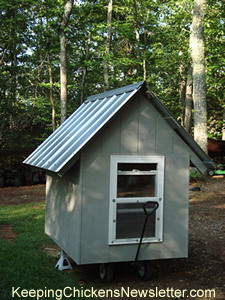
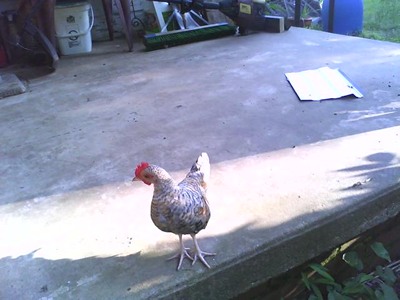
Steve : Attached are some photos of my peepers who are now teenagers. Also their coop which has small doors on either side to get easy access to their eggs, and a large door on one end so I can get in and clean it out. Thanks for your web site which is very helpful. Steve, Floyd, VA
Getting youngsters to roost

J. Johnson : I was having a problem with a new generation of 6 pullets that didn’t want to get on the roost with the older hens. They kept crowding into my nest boxes and spending the night there. They were making a mess of the boxes in spite of my chasing them out every night when I was locking up the pen. I discovered that if I left the access door open over the nests that they did not feel safe in the nests and went to the roost. I did this for a week and they are now trained to go to roost with their older sisters.

Little Bantam Rooster

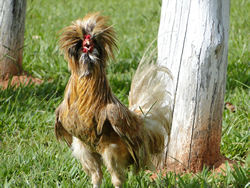
Pennie : I really love the news letters. I have learned a lot from you and other peoples posts. This is my little bantam rooster. He loves the camera. Unfortunately, the chicks I got are all roosters except 2. The RIR rooster I already had is always after the smaller leghorns and the bantam. I had started keeping him in the pen but I discovered we have stray cats stalking the small chickens that are 3 months old. So, I started letting him out again, which is a headache cause I’m always coming to the rescue. But finally, today RC chased the stray cat out of the yard! I’m glad ’cause I was thinking of trading him for a hen. Pennie, N.C.

When Chickens Moult

Dawn : I have been meaning to write to you for ages and send photos of my coop but just haven’t. I enjoy your newsletter very much. I have a question, though. When do chickens moult and what does it indicate? I live in Cape Town, south Africa, so it is just going into winter. I have had chickens for years and they have only moulted mildly but this year, my best layer is losing all her feathers, even though it is already quite cold. We have been told that we are likely to have a severe winter. Is this another indicator? Is there anything I should be doing for my moulting hen other than giving her shelter?

My Reply : Moults can be triggered by stress but usually it is a yearly occurrence, starts at around 18 months old, and often coincides with the colder weather. The yearly moult in hens also signifies the end of that particular laying cycle. With each laying cycle that goes by there is also usually a reduced number of eggs during the following one. It may be that the cold coming earlier has made her body speed up the process so instead of losing a few feathers here and there gradually, a lot more are going a lot quicker. A treat of black oil sunflower seeds can sometimes help with moults as they are a good natural source of the protein needed for feathers to grow (alternatively a poultry nutrient/vitamin supplement would probably help in the same way).

Summer Shade

hen looking at feijoa treeAnn-Marie Smith : Hello Gina, thanks for your latest newsletter! Most of your entries seem to be from the US, so I thought I would send you an item from Christchurch, New Zealand.
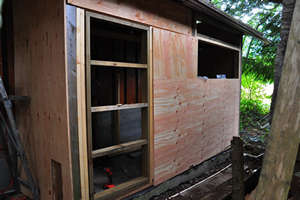
We have had 3 brown shavers which are about one year old now. They have continued to produce three eggs per day faithfully even through our recent devastating earthquakes and continuing aftershocks, and are a real comfort in that the simple pleasures of life continue when so much of our city is destroyed. My son was recently given a feijoa tree as a 21st birthday gift, we have planted it in the centre of our coop to grow to give our chooks shade in the summer, so far they have not pecked at it at all, so we are hopeful that it will be a great success with pavers placed around it’s trunk to protect it’s roots from cultivation!
Kind regards, Ann-Marie Smith

New Chicken Coop Built After Racoons Broke Into Old One

Fred Berg : This is the old coop, you can see the hole where the racoons got in and ate them up.

chicken tractor broken into by racoons

They won’t get in to my new one that easy. I am getting six white leghorns which will be laying in Sept. It needs a coat of stain like the garage wall or solid stain. The labor keeping this one is going to be nothing compared to my old chicken coop. There’s water and elec. right were this one sits.

side view

That big open space to the right of the door will be screened in with heavy screen this time. And shutters for the winter or a big flip down hinged piece of plywood but it won’t be closed till its 10 below or a howling gale in winter.

door opening

It’s four feet wide and 12 feet long. According to the chicken book I can have 10 or 12 chickens in there. The door I made today – just have to hinge it then plywood over. I will be able to close and open the chicken door from our back door when I’m finished. It will be weighted with a box on the inside with a cannon ball in it. It will be framed in with 2×4 and will be like a mini elevator and shaft. No coon will be able to budge it.

cleaning access

This is my poop clean out door (outside and inside views). The poop door lid will be screwed tight on the inside. You will need a power screw driver to take it off but you only have to do it twice a year when you clean and replace pine shavings. I’ll cover all the cracks later.

A Long Island Chicken Story

Pilar : Hi, My name is Pilar Stevens, we live on Long Island, NY and this is our chicken story.

I have wanted chickens for about 3 years but hubby always promised to start working on the coop next week. The children and I volunteer at a local community farm and for Easter they were having a spring fair with and egg hunt and chicks for the kids to pet. Mrs. Degenhardt commented that she had no one to take the chicks after the fair…can you see what happened next? Yes, I volunteered to take the chicks home with me at the end of the day, now to call my husband and break the news. We brought them home in a cardboard box with no clue as to what we were doing.

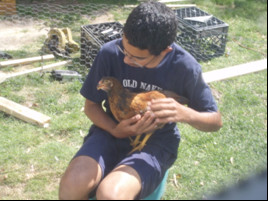
To my surprise, hubby really took to the chicks and actually petted them. The kids and I were elated that we could keep them but knew that it would take a long time for him to be build the coop (no, he would not buy one). A couple of weeks later he settled on the design he like the most (an all-in-one) and set out to build it. To make a long story short, the chicks lived in my kitchen for 6 weeks while he worked on the coop but to my surprise he did a wonderful job. We still don’t know what breeds we have but it does not matter. Everyone, hubby included is happy to have them.

Thank you for your newsletter, as newbies to the joys of chickens, we need all the help and advice we can get!

man sitting holding a chicken

Hubby (Cary) with Speckle

young boy sitting holding a pet chicken

Isaac and Marmalade

Go to Top