About Gina

This author has not yet filled in any details.
So far Gina has created 140 blog entries.

Heated Chicken Water

Christina : I don’t know if Gina will be able to get this into the next publication, but there is plenty more cold weather coming down the pike before spring gets here… This is a very cheap way to heat small chicken watering sources. I found this idea on YouTube.

Materials:

  • ½ Cinder Block, which you get at your Discount Hardware Store. Mine cost $1.50
  • “MonkeyJack Declining Heat Basking Lamp Holder Reptile Infrared Heater Light Socket Base” $4.99 through Amazon.com
  • An electrical cord (cut from another small appliance that was broken)
  • 60 watt incandescent bulb – non-incandescent bulbs won’t provide the needed heat
  • Power strip/surge suppressor 

I used the end of a claw hammer to gouge out the channel on the bottom of the cinder block; it wasn’t hard. This channel is for the cord. Then I did a little electrical wiring of the socket base. Plugged things in and tested everything. *Note* do not set this contraption on flammable straw or wood chips.

Now when it is going to freeze, I simply set the chicken’s water on top, flip the switch, and vióla! I’ve got a freezing weather water heater for less than ten dollars. The commercial ones cost $50. Like any good farmer, I am now keeping my eye on the weather prediction.

P.S. I should add that this is just for use overnight, as I set the water back down in the morning. I’m not sure my chickens are smart enough to drink when the water is elevated!

Never Underestimate the Power of a Chicken

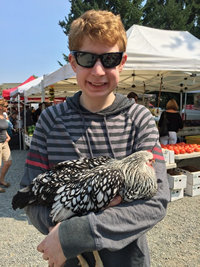
Kristin Jarvis Adams : When my son was in the third grade, he brought home a baby chick. That day Andrew, who has autism, had his first real conversation. But it wasn’t with me. It was with the little mottled chick he named Frightful.
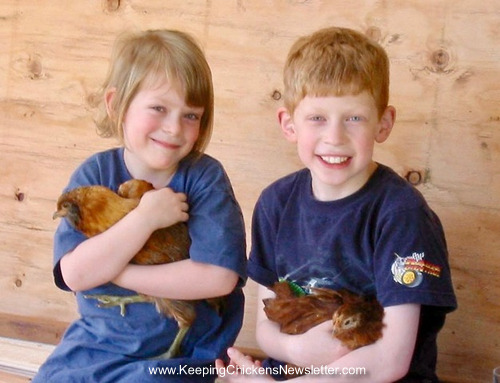
“You are my new friend,” he told her. “You know my heart.”

For the first time he was able to string words together that revealed his hopes and dreams, and all the scary feelings that had no name. Stuffed into his jacket and zippered up to her beak, the scrappy little hen went everywhere.  It was clear that I was no longer the most important chick in town.

When I asked Andrew why he would only to talk to the little bird, he said, “Frightful makes me feel safe.” I was heartbroken. Didn’t I make him feel safe? Why couldn’t he communicate with the people in his life: his peers, his teachers, his own family?

Andrew told me I wasn’t as interesting as poultry. Worse, I didn’t play by his rules. I made him wear shoes, eat vegetables, and go to school – all the things he didn’t like to do. I asked him to look me in the eye, but he said it was too painful. When I asked him why, he told me I wouldn’t understand.

But the tiny bird did. When he spoke, she would turn her head, blinking at him with a single yellow eye. She would perch on his shoulder, leaving his hands free to roam. She crooned a melody in his ear, telling him he was enough – he was perfect just the way he was. That chirping ball of feathers with yellow raptor-eyes had performed a mind-meld on my autistic son and captured his heart.

One afternoon I decided to make friends with the chicken.

“Is Frightful hungry?” I asked when the two were sitting on a kitchen stool.

“Yes, she wants a peanut butter sandwich and one of those cookies,” Andrew said, pointing the little hen’s beak in the direction of the oven.

This was my moment to be Andrew’s necessary human, so I made lunch for the two of us and joined Andrew and Frightful on the front porch. We ate in silence mostly, stopping only to comment on Frightful’s new feathers and the fact that she had just begun to lay eggs.

“Frightful is happy,” Andrew mused as she pecked at the crumbs on his plate.

“Me, too,” I said.

That afternoon I chose to join Andrew’s world – even if it was by communing with poultry. His little bird had given him a voice, and all she required in return was his company. I could do that, too. When we finished lunch, Andrew reached for my hand and squeezed, a wordless statement of love.

I squeezed back: Me, too.

——————

(Based on an article originally published in the Washington Post) Kristin Jarvis Adams is the author of The Chicken Who Saved Us: The Remarkable Story of Andrew and Frightful. She can be found at www.kristinjarvisadams.com, or on Facebook at Kristin Jarvis Adams, Author.

Constructing a Simple Chicken Wire Fence

Paul : I chose to construct a wire fence for my chickens as I thought it would be a relatively easy (though not necessarily cheap) alternative to having to dig and set posts etc. I also figured that if I did decide in the future to change to a wooden framed pen, or increase the size etc the materials purchased now could be reused in the new project. I am clearly not an expert on constructing any kind of fence but I am sending this in in case it might be helpful to someone else. If anyone is thinking of doing the same, before starting it is probably wise to check if there are any restrictions that might apply to you such as if permission is needed, or if there are guidelines for height or proximity to neighbours.

Chicken wire is quite pliable so although it will keep your chickens in, if it is the only thing between your chickens and any potential predators they will get almost no protection from it. They would be much safer if welded wire is used as it is much harder to bite or break through.

Steps

Locate the area of your property you want to fence in and mark it out. Landscaping paint is a great way to do this. If possible, try to get a rough estimate of your fenced-in area’s perimeter. Don’t forget to mark a space for a gate

Purchase or gather your supplies. From my research on the internet it seems that a fence for chickens should be at least 6 feet (especially if it is their only protection and/or it is to be covered and you want to be able to do your chores without being bent over double the whole time).

Fence posts can be wooden, but for the sake of simplicity and to save digging post holes and putting concrete around them etc. my preferred choice were ‘T’ posts which could just be banged in with a sledge hammer. I used wire ties to attach the wire to the posts so I wouldn’t have to mess around with trying to hook the fence onto the t-post hooks.

I later read that it would have made the fence stronger if the four corner posts were wooden ones, I’m going to leave it as is for now, but if it proves necessary I think additional supportive corner wooden posts could quite easily be put in place even at this late stage. I did use wooden posts to support the gate and hinges and latch for it and just made a simple one by constructing a wooden frame and attaching some of the wire to it.

A fenced area like mine of 30 feet by 15 feet would take 100 feet of welded wire (with a little bit left over in case of error). It would also use 18 ‘T’ posts spaced at 5 foot intervals (or 14 if you make the four corner posts wooden ones). That results in quite a spacious fenced area for my 6 chickens and their coop but I know I probably won’t be letting them out into the main garden very often so I wanted to make sure they could still be comfortable if confined there on a semi-permanent basis.

The first chicken pen I made for my original three chickens was never very successful at keeping rats out so with this one I wanted to try the ‘wire skirt’ method (which should keep out all digging predators as well as rats hopefully) and used an additional 100ft of 3ft wire so that I could give the fence a 2ft ‘skirt’ all the way around. It added additional costs, but if it works will have been an easier solution than one of the alternatives such as digging down 2 feet all the way around and pouring in concrete.


Chickens eating the insulation from their coop

Brad : My chickens have pecked some insulation in the coop, and may have ingested some??  they are getting cabin fever ! Should we also not eat the eggs for a few weeks? I always cover over places where they peck to prevent this but sometimes they get at it before I see it. I always feed them certified organic feed.

My Reply : I’m not 100{b0ded004bdc346b73b2f7c5643ec4b44c0fd04baf547e743db44006f5c758b8f} sure about the effects of eating insulation on their eggs – it is something lots of chickens do if they can get access to it and the chickens themselves are usually fine (although obviously try not to let them keep doing it) and I am sure there will have been many people continue to eat their eggs without any adverse effects. There might be no risks at all, but when medicine that has not been lab tested specifically for chickens is prescribed by a vet they will very often recommend leaving the eggs for a couple of weeks to be on the safe side, so as there might be chemicals in the insulation it may be also wise to leave the eggs for a couple of weeks for peace of mind.

Juvenile Red Tailed Hawk and A Favourite Chicken Treat

Kevin & Kashia in Austin, Texas :

“One morning a juvenile, but still quite substantial red tailed hawk was perched on top of our chicken tractor. Fortunately, I had not been out to let the chickens run free in the yard yet. Since the chickens were safe in their tractor, I went and got my camera and took this photo.

When I came outside to shoo the hawk away, he did not go far, he just perched in a tree in the middle of our backyard. Eventually the hawk went away, and we’ve not had any more trouble with him.

Something fun to try with your own backyard chickens: Our chickens really, really love to eat peanuts. They go nuts for peanuts. We buy peanuts still in the shell in bulk from our local feed store, and the hens love nothing more than to gather around our feet as we shell peanuts for them.”

Two Sheriffs In Tiny Town

If  you need a laugh, come out to the ranch during free-range time in the afternoon. Things have changed in the chicken yard, or Tiny Town, as I’ve taken to calling it.

“How are things in Tiny Town?” I like to ask the chickens. Or sometimes I say, when Duda the White Polish rooster has just crowed in my face, “Well, if it isn’t the sheriff of Tiny Town!”

Back in May I suspected that one of the two Polish Crested chicks I picked out on a last-minute impulse at Chick Days might be a rooster. One of the other things I mutter in the chicken yard these days is, “What are the odds?” because both of those Polish chicks turned out to be roosters. And so, as I said, things have changed.

Duda, the self-appointed sheriff of Tiny Town, was the first of the two to begin crowing, which is what earned him his name. Duda is a Polish surname that, according to Polish name expert Professor Kazimierz Rymut, means bagpipes or a bad musician (i.e., one who plays the pipes but isn’t very good at it) or may also be reasonably construed to mean one who goes around making a lot of pointless noise. And there you have it, the perfect name. The final aptness of this choice is affirmed by Jane’s habit of calling anyone or anything whose name she cannot recall, Doo-dah, which assures that even in the event of a memory lapse, she will always call this particular chicken by his rightful name.

Albert “I can’t see a darn thing” Einstein is the default deputy sheriff of Tiny Town. Albert is a stunningly handsome White-Crested Black Polish rooster with an unfortunate chronic orthopedic infirmity that causes his toes to turn up like Aladdin’s slippers, which in turn fosters his tendency to abruptly and frequently sit down whilst in the act of walking (as the preferred and slightly-more-dignified alternative to flat-out tipping over). He’s had the problem since the early days, so I assume it is either a congenital defect or an injury sustained during shipping.

These two boys, who in recent months have revealed themselves as infiltrators in Girls’ Town, are as unalike as black and white, night and day – and yet they exhibit a certain solidarity, bound as they are by breeding, biological imperative, gender and their freaky hair-dos.

The headgear has been a bit of a problem. For one thing, Albert can’t see very well, which contributes to his air of unroosterlike reticence. We trimmed his bangs, but the head feathers responded with an emergency message to his follicles to grow back the finery with even greater density. For another thing, when the girls got bored, the novelty of the boys’ feathery mops made them irresistible for idle plucking. Before long, both fellows had bald spots the size of a half-dollar on the backs of their heads. The good news is, the pine tar that got George Brett into trouble with the Yankees in 1983 got Duda and Allie out of trouble with the Yankers in 2006. Our friend Sherry, a nurse, who pinch-hit as the veterinarian for this procedure, highly recommends the use of rubber gloves. It’s a wonder George was ever able to let loose of the bat before heading round the bases; pine tar is sticky, and – thank heavens – apparently bitter enough to discourage boredom-induced amateur chicken cosmetology.

In August we combined the youngsters of Company B with the older hens in Company A. Suddenly Duda – the bossy, strutting, crowing leader of his small flock – was faced with mature matrons nearly twice his size, all of whom were deeply unimpressed by his antics. Bless his heart, he has one courtly little dance in his limited romantic repertoire, and I find it extraordinarily touching, perhaps all the more so because the girls are so cruelly offhand in response to this overture. He stretches one wing down to the ground and dances in a circle around the hen, for all the world like a Kabuki dancer with a folding fan. At best, the hen just turns and walks away with a disdainful or bored look. At worst, she’ll give him a dismissive peck on the head or simply shoulder him out of the way, or both. He soon learned to hop sideways at the slightest sign of rejection or aggression.

Albert, meanwhile, kept to the margins of the combined groups and sized up the odds. He has, after all, the same basic roosterly instincts as Duda, just not the alpha personality and all the macho posturing that goes with it. Sure, his Aladdin-slipper-toe-syndrome was a challenge, but I could just tell he had the wits and pluck to overcome the obstacle. Sure enough, he began strategically placing himself around corners and behind a screen of foliage, usually on a vantage point of some kind – a rock or concrete block – from which he would hurl himself atop the surprised object of his affection, which is what earned him the nickname, Stealth Lover.

Until recently, all mating rituals taking place in Tiny Town were a sham, just playacting for practice, like little boys using lathered-up bar soap and the back of a comb to emulate their fathers shaving. The roosters were as yet preadolescent. Then, on Labour Day weekend, it became evident that Duda had achieved the fullness of his maturity; the sheriff had earned his spurs, and, Katie, bar the door! Within 48 hours, he was hobbling around the chicken yard like Festus from Gunsmoke or Walter Brennan playing Amos McCoy. Even then, despite the injury he’d sustained during the first two days of the Rooster Olympics, he was not to be deterred. If necessary, he’d hop on one leg to follow a hen to the moon. Almost two weeks later, after an enforced two-day rest in isolation (which distressed him terribly), he still runs across the yard with a pronounced limp, looking not unlike a child cantering on an invisible sick pony. As I mentioned earlier, if you need a laugh, come out to the ranch and watch the roosters.

Albert’s maturation took about ten days longer, but I realized he’d reached the same milestone when he emerged from the fringes of the group and began harassing Duda at center stage. Albert has invented his own Rooster Olympics event, which bears some similarities to bowling, if you assume Duda and the hen of his current favor are the pins and Albert is the bowling ball. He advances himself across the yard at his best rollicking gait and hurls himself at the pair, knocking Duda unceremoniously off his mount, so to speak, and then attempts to take over the conquest of the hen. Perhaps I was wrong about the bowling; it could be a relay.

I can count on one hand the number of times I have heard Albert crow; he has a low and rusty voice. Duda, on the other hand, has a strident and piercing cry that he first flourishes each morning at about an hour before sunrise and reprises at unpredictable intervals until bedtime. Sometimes he even ululates after dark: the full moon may make him crow, and my coming to say goodnight to the chickens through their window is guaranteed to elicit a lusty final refrain.

I blame cartoons and movies with perpetuating the myth that roosters crow only at dawn. In fact, a cockerel will crow when the light changes dramatically, when a hawk flies overhead, when the dog comes near the flock, when he feels the need to reiterate the boundaries of his territory, when a pretty hen takes his fancy, or pretty much whenever he darn well feels like singing. Duda does not have a five-syllable song, as implied by cock-a-doodle-doo, but then again, he’s Polish, and therefore inclined to sing Kukuryku. Of all the linguistic twists on the rooster’s call, I think Turkish gets the closest with üü-ürü-üüü.

Duda’s repertoire is broader than you might think. He has a number of short phrases for different occasions. When he finds a flavorful tidbit in the yard, say, a grasshopper, he’ll let out a series of melodious burbles and chortles to summon the girls, then he’ll play with the insect until some of the hens arrive at the scene, at which point he’ll step back and let them have the snack. This is what a good rooster is supposed to do, take care of his flock.

He’s also learned another song, which requires a bit of an introduction. When I first looked into Polish names for him, I consulted with my friend Leon Goodhart, who grew up in Poland. He informed me that Duda might not be such a good name for a rooster, since in Polish the “a” ending is feminine. The proper masculine name would be Dudy. I scoffed at Leon’s worries about the effect a feminine name would have on the rooster, and then one evening, the first night I isolated Duda in a separate pen after he injured his leg at the Olympics, he caught me entirely off guard. He refused to go into his solitary accommodations at dark. He perched on the outdoor roost and crowed without ceasing, loud and long. How, oh how, he seemed to be lamenting, am I to watch over my girls from here? Then – abruptly – he changed his tune and launched into a tortured, but clearly-recognizable version of the I-just-laid-an-egg anthem, which I think of as exclusively feminine territory. There are three ways of looking at this : (1) the feminine ending on his name has had a deleterious impact on his gender identification; (2) the traditional anthem of the egg-layer, which originates from pre-domestication days and really translates as I’m here – where are you? fit the situation better than I am rooster, hear me roar; or (3) he’s smart enough to attempt disguising himself as a hen so I might take pity and put him back in the henhouse. What I did was bodily remove him from the roost, put him in his own little house and shut the door. Finally he shut up.

The second day of his recuperative isolation, I felt sorry for Duda, and decided to have Albert bunk with him for company, which would also serve the purpose of giving the girls a complete break from masculine company. Great idea, but Albert was a heck of a lot harder to capture out in the chicken yard than one might expect of a fellow whose vision is almost entirely obscured by feathers. I finally hauled out my fishing net, the one reserved for the lunker I haven’t yet landed, and snagged him like a butterfly. At bedtime, like a good little boy, Albert marched straight into the auxiliary chicken house and went to bed. Stubbornly, Duda perched outdoors once again and commenced to wailing. Finally, perturbed, I stalked up to him in the dark and gave him an impassioned, hands-on-hips, motherly speech along the lines of would you please quit singing the blues or you’ll make yourself sick…and please go in to bed now so you’ll be safe from wild animals. At this, believe it or not, he hopped down from the roost and walked straight indoors.

I’m afraid I have been a wee bit slow to recognize that one of the triggers for Duda’s crowing is me. You’d think my runtiest chick, whose tiny toes I cleaned and whose behind I bathed, would be accustomed to my role, as the hens are, of Big Mama, No Feathers. This is what I expected, and so I was surprised – shocked, really – to finally confront the truth. The realization dawned one evening as I headed for the henhouse to gather eggs and realized that a creature the size and shape of a dust mop was persistently and aggressively dogging my every step, and if I slowed my pace, he ran in front of me as if to provoke a showdown. Lordy me, I thought to myself, this goofy-looking bird with a Phyllis Diller wig and all of two pounds’ body weight is challenging me for the position of alpha rooster!

Funny as it may seem at first blush, this behavior can stealthily become a serious matter in the relatively short time it will take Duda to grow his spurs to fighting length. Roosters possess the capacity to create impressive scar tissue or make your mother’s most dire prediction come true : you’ll poke your eye out with that thing. There are two ways to keep your rooster in line, advises one backyard chicken fancier :
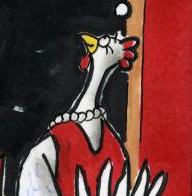
The first way is to develop a deep and sincere love for soup. I love soup. Chicken Noodle, Chicken Vegetable, Chicken and Dumplings, Chicken and Rice, doesn’t matter. I love it all. The second way is to be the Alpha male of your flock.

There is a treasure trove of comical and serious guidance on this topic. Just hop on the Internet and use search terms like managing roosters, taming roosters, aggressive roosters, etc.

I go in the pen with a fly-swatter so at least I could fend him off.

This afternoon, I stood my ground with a spray bottle of water. At first, he just kept coming at me, but then stood down. He then ran about 50 feet and just started crowing non-stop!

You could run up to them real fast and flap your arms at them and act like a rooster yourself, ha-ha. I actually did this to ours and it worked.

I spent a lot of years working in the criminal justice system and a considerable part of that was in jails. We had a saying that “If you’re sweating and the prisoners aren’t, you’re doing something wrong.” You can apply that to a lot of situations, including roosters.

After sorting through voluminous advice, I’ve come up with my own short list of two commandments :

  1. Thou shalt honor thy rooster’s roosterishness. Protecting his hens is Duda’s built-in prime directive. I try to avoid giving him cause to fret or feel threatened; I don’t initiate confrontations or back him into a coroner. I try to cultivate and communicate genuine respect.
  2. Thou shalt not sweat. The criminal justice advice caught my attention, since the awful truth is, I sometimes feel vaguely intimidated by my fierce little rag-mop. Now, if he challenges me, I don’t back down. I stomp my foot and shout, “HEY!” Yes, I even flap my wings and crow.

Perhaps some of you are wondering how the boys have affected the Happiest Chickens in Kansas. So far the older hens, who’ve grown up without a frame of reference for the concept of rooster, manage to be tolerant without compromising their long-standing matriarchal power structure. The overall Boss Chicken at the top of the pecking order is still, I think, one of the older hens. The newest chicks on the block, who just became mature enough to begin laying eggs in late August, have grown up with the boys in their social milieu and consequently adopted decidedly more patriarchal social conventions, chief among which is wives, submit to your husbands. All in all, it’s an intriguing culture to study.

We never, of course, needed those boys for the eggs; in fact, if they were hens instead of cockerels, I’d be getting two more eggs a day. What they offer us instead is another dimension – sort of like what the serpent and the Tree of Knowledge offered Eve. The promise of perfection in the Garden of Eden may have gone straight south with Eve’s first bite of fruit, but boy, howdy! after that there was another side to the story. I guess that’s what I’d say the boys bring us: the rest of the Chicken Story – the full-color, big screen, live-action Chicken Reality Show. Don’t read too much into the theme of good and evil in the metaphor, because that’s not all what I had in mind when evoking the Garden of Eden. I do, however, mean you to understand that the results of this spring’s game of Rooster Roulette signalled the end of a near-idyllic age of innocence.

In the wake of this change, I am undergoing a bit of an identity crisis. The more I educated myself on how to be the alpha rooster, the stronger my sneaking suspicion that I had been suffering under a two-year-long delusion, not of grandeur, but of gender. I don’t know how to sanitize, euphemize or disguise this revelation, so I’ll serve it sunny side up. As it turns out, my chickens have always – even before the arrival of Duda and Albert – perceived me as Big Rooster, No Spurs, rather than Big Mama, No Feathers. This is why, as I walk through the flock on my way to collect eggs, many of the hens drop into a submissive squat and allow me to pet them, after which they ruffle up their feathers and give a little sigh of delight. This, I’m afraid, is exactly how the cooperative hens respond to the roosters. So there you have it, the unfeathered truth. If anyone knows a therapist who would not laugh me right out of the consulting room, I think a few sessions would be a boon.

But speaking of laughs, as I’ve already mentioned a time or two, if you need a good belly-wrenching hoot, come on out to the ranch some afternoon and watch the chickens for a couple of hours. Or stay right where you are and picture me flapping my arms and crowing at Duda. That ought to be good for a chuckle or two.

Winter Chores

Sophie : Things have been rather snowy around here this past week. We got hit with a storm on Friday and then again on Monday and Tuesday. And today we got socked with cold temperatures, too. Gotta love winter! Just when you think she might be gone she comes back with a vengeance. The chickens are doing pretty good in this cold weather. They just hunker right down to keep their feet warm and they are good.

They do go out into the snow some. However, if they have a bit of bare ground or if it is sunny they are more likely to go out.

Since it is really, really cold (-14 with the windchill) this morning, I thought I would let you walk with me as I do chores. Normally chores are easy and enjoyable. But when winter hits they become more labor intensive and more challenging. The morning I took these pictures it was cold but not as cold as it is today.

I make sure everyone has fresh water to start with. I use mostly these little rubber bowls because the ice is easy to break out of them. I will start bringing warm water out from the house so the water stays free of ice for longer. In the winter, I have to carry the water by buckets from the house because we don’t have a hydrant in the barn. Hopefully we can remedy that this summer.

I have a few metal pans that I use and I hate them. The ice builds up and it is hard to get it out without ruining the pan. I am slowly switching everything to rubber.

Once water is taken care of I let the chickens out of the big coop. I also have a few that always roost in the barn and every morning they wait to be let into the coop. It cracks me up every morning because there is always a little traffic jam. The chickens all have big 25 lb feeders that are filled about once a week. I just check them to make sure that there is plenty to get them to the next day. And yes, I have a pullet or 2 that always lays on the floor of the coop.

They really love it when they get new straw. There are all sorts of things to eat in it! This keeps them occupied for a very long time. They also get warm water to drink. Not only is it warm but it has also been through the water softener. Nothing but the best for our girls!

This all makes for happy hens that lay more eggs than we know what to do with! This spring will bring even more eggs. I am formulating a plan as to how to sell them all!

Go to Top