About Gina

This author has not yet filled in any details.
So far Gina has created 140 blog entries.

Did This Hen Suffer A Stroke

Mario : I have two girls who at time of writing (3rd week in June) are 8 years and 4 months old, not a bad age and still very healthy looking. They’ve both had a few problems over the years, thankfully mainly minor injuries, and Anastasia (black one) has every year become stubbornly broody so needed a lot of attention to keep her fit as none of the tricks to keep her off a nest ever work.
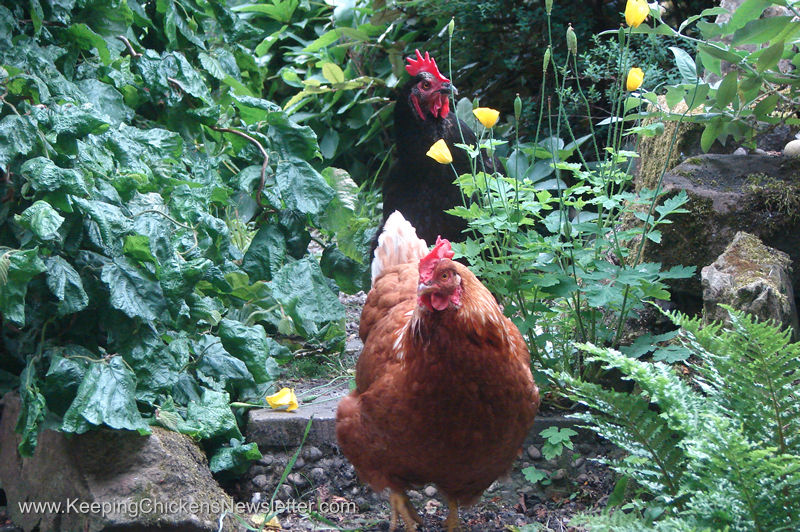
However, back in February, Jethro (the brown one and so named because of her habit to stand on one leg like Ian Anderson from Jethro Tull) suffered what seemed to be a stroke. One morning she almost fell out of the hen house when trying to walk down the ramp, her head was quite literally sitting at 90 degrees, resting on her left ‘shoulder’, and when eating she missed the food by a country mile. I asked the vet if it could be a stroke and he said ‘yes’ and that she could get better … could stay the same … or could get worse and die.
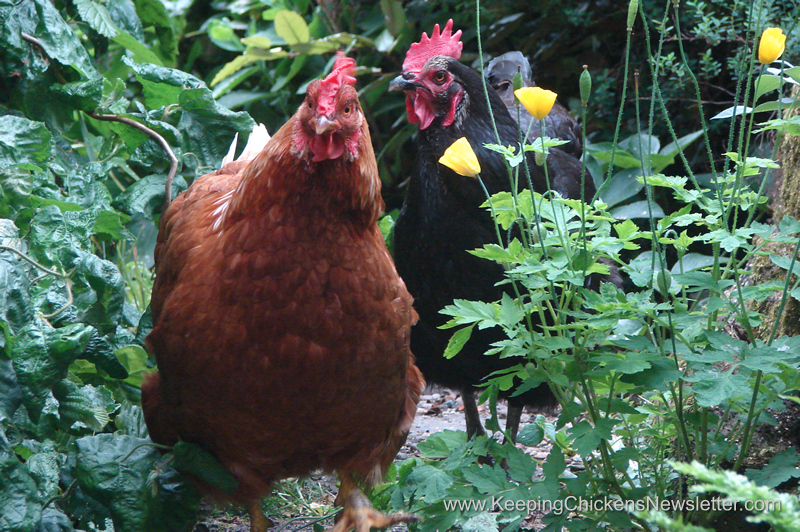
For the next week I fed her by hand up to 15 times a day, and moved the two old girls from the hen house to a storeroom in the main house. After a week she was managing to feed herself, her head was now only at 45 degrees, and she chose to go back to the hen house (except for a couple of very cold days). After three weeks she seemed to have completely recovered and now looks as healthy as she ever has. The only things that have changed are that she seems to have stopped laying (even up to last year she was a prolific layer, and had just started to lay agai this year when she had her incident), and since getting better every morning she has started to crow (almost like a cockerel) either from the hen house doorway or she comes to the house and stands by the kitchen door.
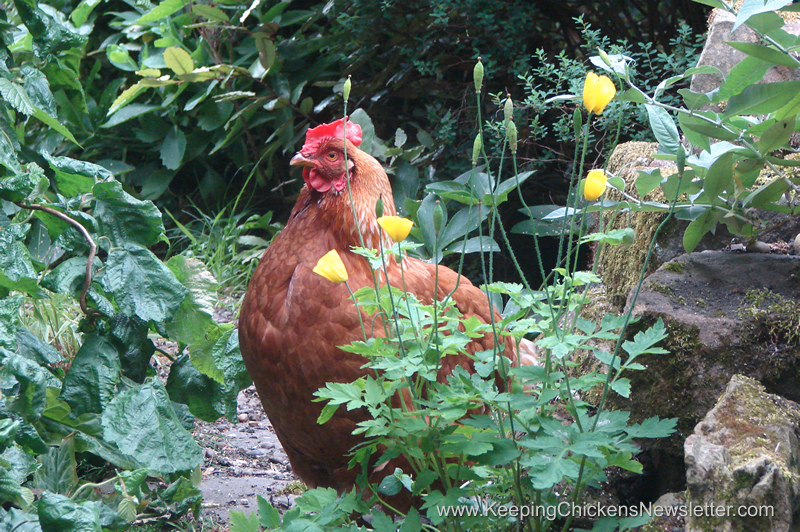
We’ll never know whether it was a stroke or something else, but her recovery was something to marvel at.
Many thanks for your fantastic Newsletter!
Mario (Derbyshire)
Mother Nature and Human Cultivation Working in Harmony

Sally : Many organic farmers understand the interconnectedness of life and so they not only don’t use pesticides, but they have other farming practices that also work to protect life on earth rather than defeat, tame or damage it. One of the best stories I’ve heard of late was from a friend who is an organic farmer in Sebastopol, CA.

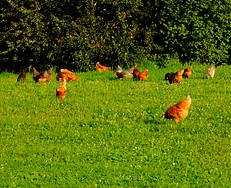
Paul has a friend who raises cattle and chickens, both free range, grass fed. He starts his cows out on a pasture until the grass is short. He then moves the cows to the next pasture, while leaving the old pasture to fallow (cow dung and all) for about a week (the time it takes fly eggs to hatch and grow into larvae). He then moves his chickens into the pasture. They scratch through the cow dung to eat some nice protein filled larvae, poop on the grass (chicken poo is an awesome fertilizer) and they eat a little grass (calcium, omega 3s and more). After he moves the chickens on to the next pasture the grass grows thick, green and tall — making it perfect for the next round of cattle grazing. No pesticides, added fertilizers or feeds involved. Just mother nature and human cultivation working in harmony!

Chickens and Dogs

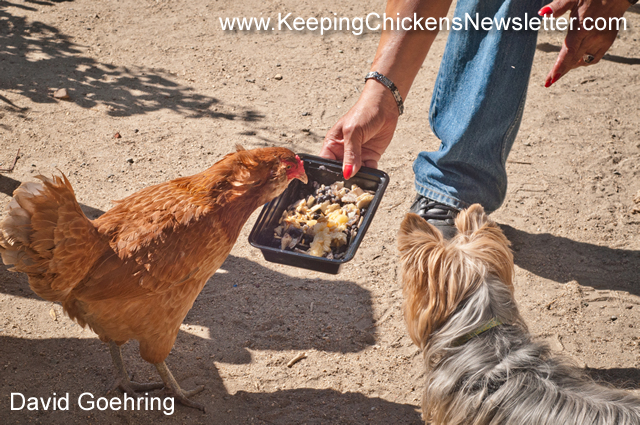
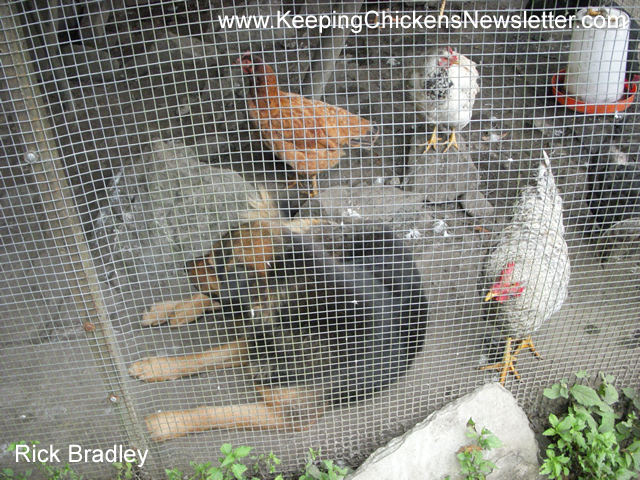
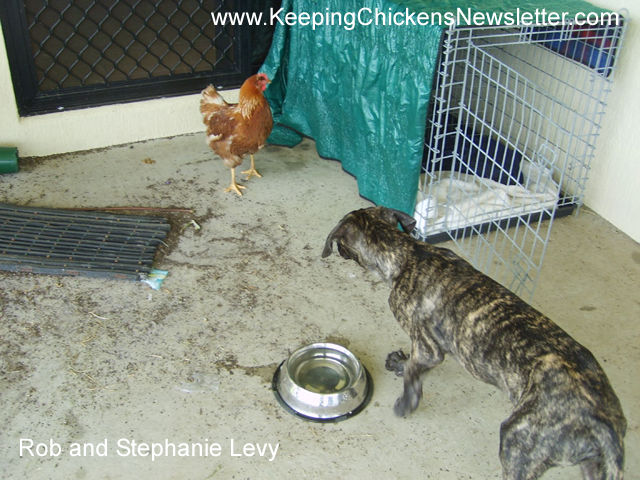
Allowing your dog to mix with your chickens is not something to take lightly. A lot rests on the early introductions and also some luck with your dogs natural temperament. A flock of chickens will usually run off in all directions if a dog (particularly one they are not used to) comes bounding over to them and that can easily start a game of chase. If the first time your dog meets your chickens it has a great time chasing them it will be harder to persuade your dog in the future that they are not just a fun game. Sadly for the chickens it is far from fun and can easily turn deadly.

First introductions can start with chicks. In Tyler Edwards video below they explain how they introduced their dog to their chickens as chicks and got her used to them as they grew. They were never left alone together. Once grown and placed outside they were again carefully introduced under supervision.

Chickens and Cat Food

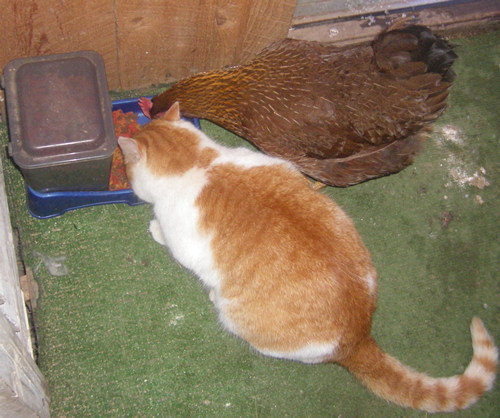
Melissa Hello, I have a question, my chickens love cat food and I was wondering if this is okay for them to eat? We have a barn cat that moved in so we had him neutered and he happily lives outside. We have tried to bring him in but he won’t stay. Anyway we feed him on our back porch and the chickens come and eat the cat food. Our chickens are free to roam wherever they want so I want to make sure the cat food isn’t going to harm them. Thank you so much for your time and help. I would also like to say your newsletter is awesome! Thank you again, Melissa


Many chickens enjoy cat food as an occasional treat – just be sure
you have an understanding cat! 

My Reply : Chickens love variety in their diets and will eat all sorts of food and scraps. The general rule with any ‘treats’ (i.e. something not part of their nutritionally balanced diet) is that they should not be more than 10{d5282123537f4ae2af101911d100f16a2c80c27049f1391c1ab6ea474c1bc6e6} of their daily intake. Treats should also not be sugary or salty etc. Cat food is relatively high in fat and protein and so is not the most ideal treat, but it will not hurt as an occasional treat, and some chicken owners find it useful to offer a little as a protein boost for times such as when they are going through a moult.

Chicken Coop and Run with Awning

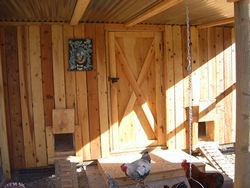
Ley Gorrell : I’ve attached some photos of our chicken coop and run. We backed it up to our old tool barn, and put the same cedar siding on it (its actually privacy fencing). The coop is 9′ x 12′, and the run is currently 12′ x 32′ (it can be easily expanded). There’s an 8′ awning for loafing under when it’s raining/snowing, and in our hot summers.

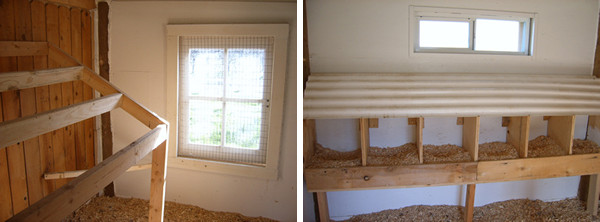
The coop is painted plywood on the inside, with linoleum floor for ease of cleaning. I have a droppings pit under the roosts for the same reason.

The big window is one I found in the garage and refurbished. It swings out. The small one is a bathroom window that slides open. I have a remarkably bright solar light inside, and that’s the little solar panel you see on the south roof. It looks like the chickens are watching TV at night! There’s also a 4′ x 6′ storage closet for feed and supplies.

I’ve also included photos of my favorite hen, Anise, a Silver Spangled Spitzhauben, and my favorite rooster, Fennel, a gray bantam Silky, with the cutest little crow you’ve ever heard. All the chickens are named for spices and flavorings (don’t tell them!) We’re currently getting about a dozen eggs a day, including pretty blue ones from the Americaunas. We have the chickens for the eggs, not to eat. I make all of my own dog and cat food, so everyone gets eggs for breakfast.

We also have ducks, guineas, and a pair of Toulouse geese. We have another batch of babies getting shipped in next month. The next big project is going to be a wild duck aviary. We will be building that over the summer, in anticipation of the ducks arrival in October. I connected with a gentleman in Oregon who is going to ship me breeding pairs of Wood Ducks, Mandarins, White Mandarins, Northern Pintails, Green Winged Teals, Cinnamons Teals, Spotted Teals, and Hooded Mergansers. Very exciting!

I would like to hear from anyone with wild duck aviary/breeding experience, particularly help on containment. My plan is to do the same thing that we did with the coop, with heavy-duty steel wire, sunk in concrete trenches. However, the chickens are locked in the coop at night, the waterfowl will not be. We have plenty of predators (coyotes, hawks, owls, racoons, bobcats), so trying to decide what would be best for overhead. The chicken run just has lightweight plastic netting on top. I’d like to make the size of the aviary approximately 60′ x 100′, and we have several mature oaks to fence around. It would not be advisable for us to use hot wires, as it is a major fire hazard here in our arid summers.

We are on the eastern side of California, in the lower Sierra Nevadas, with King’s Canyon and Sequoia National Parks just above us with the big mountains.

Traumatized by a Predator Attack

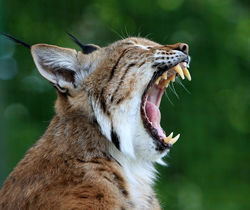
Liz  : I wanted to comment on the folks who lost hens to predators. I am certified in the treatment of Post Traumatic Stress Disorder in people and was very curious to see how my hens would react after a wicked bobcat made a meal of 3 of my hens. The rest of the hens were extremely traumatized and stayed up on a very high roost for several days. I chopped down the tree that pierced the top of the coop wire and covered over the hole (only about 10″–I don’t know how the cat got in–had to squeeze in.) and then took each hen out to see the covered hole. All the feathers were removed from the hen house and the dead girls were buried appropriately with lime put over them prior to the dirt.

It took about 6 weeks for the hens to settle down and come out to forage during the day. I added 7 red comets to the flock shortly after that. When I go into the hen house at night, all the comets are sleeping on the floor–relaxed and lolly-gagging without a care in the world. The older girls who witnessed the massacre are still roosting way up next to the roof. I doubt they will ever quite recover. We give them lots of pets and some good scratching to reassure them. They did not lay for 2 months but are making up for it–one a day from each, even the auracanas!

As for adding hens to a flock, I am no expert but have had success as long as I put them in when they are fairly mature. The big hens will be quite territorial about the food so the little ones have to get it while the big girls are out shopping for their earthworms and grubs. They keep to themselves, as though a separate flock, until they get almost fully grown and then they all seem to just flock together! Thanks again for all your help and I do love the newsletter! Liz in Prescott, Az.

Chicken Nurse

I never thought I’d be a chicken nurse, but I certainly have learned a lot. I can’t believe that in almost a year of chicken-rearing, I never noticed that a chicken’s eyelid closes from the bottom up. Then again, I’ve never been around a chicken who is injured and weary enough to fall asleep right in front of me in broad daylight. For a minute I had the strangest feeling that one or the other of us was upside down, but no, the eyelid, complete with tiny red eyelashes, closed upward.

Hey, wait a minute! The other day I was watching Little Red and I swear I saw her eyelid drop down from the top.

The time had definitely come for some research, which was harder than I expected. There simply was not very much information on the Internet about chicken eyelids. Fancy that! It was actually easier to find out about the development of a woodpecker’s tongue than about a chicken’s eye. Once I got on the right track, I found out several fascinating facts :

* All birds, not just chickens, have three eyelids; they do not have tear ducts, so one of the eyelids serves that function.

* Avian eyes make up 15{b0ded004bdc346b73b2f7c5643ec4b44c0fd04baf547e743db44006f5c758b8f} of the head, while human eyes are only 1{b0ded004bdc346b73b2f7c5643ec4b44c0fd04baf547e743db44006f5c758b8f} of the head. Avian and human vision is very similar.

* Birds can be literally half-asleep, with one brain hemisphere alert and the other taking a siesta. How handy! The hemispheres take turns sinking into the slow-brain-waves sleep stage; the eye controlled by the sleeping hemisphere droops shut, while the wakeful hemisphere’s eye stays open and vigilant (birds can also, thank heavens, sleep with both hemispheres resting at once).

* A bird on the outside edge of a flock tends to keep its outer-facing eye open while resting. This rather intriguing skill evolved as a protection against predators. Interestingly, it has only been found in birds and such aquatic mammals as dolphins, whales, seals and manatees. I can’t help thinking how useful this trick would be in business meetings.

I have learned other valuable things in the course of my nursing. Triple antibiotic ointment is the wonder-drug of the century, for either humans or chickens. I will never be without it again. Little Red prefers green beans to apples, but she loves cheese (of all things!) better than anything else I’ve tried.

After she spent three days here in the house in an extra-large dog crate lined with soft cottonseed hulls, I built my convalescing chicken a temporary daytime shelter outside so the sun and breezes can help her to heal and lift her spirits. She’s also right behind the chicken house so she can hear her flock and they can come to call during visiting hours in the afternoon. I covered the ground with alfalfa and set her up with water and snacks. In just a few hours, Little Red will have survived for six full days. I can’t help thinking she’s going to make it through this crisis.

I expect most nurses are familiar with the kind of rollercoaster I’ve been riding. There were several mornings I awakened with a heavy heart, expecting to find my chicken dead, and other times that she gave me a feisty little peck on my hand that thrilled me with hope. There were moments in which I wondered if I was doing the wrong thing, merely prolonging her suffering, or if it might have been better if the dog’s attack had been immediately fatal. Then there’s a day like today when her appetite for cheese and green beans makes me feel like dancing a jig.

I never dreamed I’d wash a chicken’s butt or do physical therapy to try to get her to use her legs properly. I had no idea I’d fuss the way I do, checking on her every half hour to make sure she’s safe and comfortable out in the yard. I never thought I’d be a chicken taxi service either, carrying her back and forth between the daytime and night-time wings of our makeshift chicken hospital.

I can’t help recalling again the true meaning of husbandry : bonded to the household. Little Red and I have a bond that makes almost anything possible.

By the way, iHola! I’m Lola just laid her first green egg today. Perhaps everything is going to be all right after all.

Little Reds Chicken Shed

As I write this, Little Red Harvey, my convalescing chicken, is taking an afternoon snooze in a patch of March sunlight, her beak tucked under her sparsely feathered wing. I got very sleepy watching her. A napping chicken, I’ve discovered, is a powerful soporific.

After seventeen days of living in an extra-large dog crate here in the house, she was relocated yesterday afternoon to Little Red’s Chicken Shed, a rehabilitation institute of sorts. For ten days she couldn’t even use her legs; she did a weird sort of scooting crab-walk to get around. Now she can walk, but she tends to step on her own feet. I’m pleased that she hardly ever tips over anymore, but she still hasn’t quite remastered using her wings to fly up to a perch.

The new chicken annex, which is right next door to the regular-size chicken coop, came into being because we are getting ready to go out of town for a few days. For the life of me I could not figure out how to explain to our three-part relay team of house sitters that they’d be caring for two cats, two dogs, eighteen busy chickens and oh, by the way, there’s a wounded chicken in a crate next to the woodstove who needs to be taken outside for physical therapy every afternoon.

I spent two-and-a-half days building this miniature chicken coop out of scrap lumber. Little Red’s Chicken Shed has a small outdoor pen, a chicken-sized door that opens by wire and pulley from outside, a round screen window, a roost/nesting shelf, a hinged panel on the back that allows me to reach inside to do maintenance and Little Red to come out to play in the afternoons, and a little tiny calendar on the wall so she can count the days it takes to heal and grow back her feathers. She has a nice crop of quarter-inch stubble coming in, which is a great relief. I found it tremendously disconcerting to be rendering care to a chicken whose back looked a little too much like the plucked poultry I like to roast with rosemary and garlic.

The most sophisticated computer program in the world, I realized this morning, could not impress me more than the complex DNA instructions according to which Little Red’s cells are crafting these exquisite, intricate feathers to replace what was so swiftly and thoughtlessly purloined by a dog.

I have been trying a few social experiments, but Little Red is just not ready to be reintegrated into the flock yet. This is the first time I have really seen the dark side of chickens. With her puncture wounds, missing feathers and lameness, Little Red is practically wearing a Peck Me sign on her back. The other chickens just will not leave her in peace when she’s this vulnerable; they go into attack mode. Much as I am dismayed by their uncivil behavior, I must accept that it’s simply part of the instinctive pecking order system and the survival of the fittest. Little Red, by the rest of the flock’s standards, is not very fit at present.

Without my intervention, she would almost certainly not be alive, so there’s little doubt I’ve messed with the natural order of things. I still do not know if I have done her any favors by my acts of mercy. Now she’s much more acclimated to humans, dogs and cats, which may not be to her best advantage. The dogs enjoyed sleeping with their noses up by the door of her crate while she sat just inside and pecked at vegetables. The cats crawled all over the crate and tried to stick their paws in the vents. She seemed to enjoy being with us, interjecting little comments from time to time, staying up late and watching us play cards in the evening.

Chances are, now that Little Red has a place of her own, I miss her more than she misses me, which is the same dynamic as when your kid goes off to college. She appeared to be pleased with her Chicken Shed. I designed it to mirror in miniature the features of the big coop in which she grew up, so she’d know where to go and what to do. Sure enough, just after sunset last night, she went inside. This morning, the minute I opened the door, she walked proudly down her little ramp.

As for me, I found myself missing her this afternoon as I was vacuuming up seeds and feathers by the woodstove. Have I ever mentioned that we clean our house with a 12-gallon shop vac? A first I thought this was a little strange, but now it makes a great deal of sense. Life on a ranch tends to be, well, chunky. Feathers, fur, grass, seeds, pebbles, mud, all species of dung (or dung of all species), you name it, it ends up in the house. Anyway, I was cleaning house when I got to thinking about Little Red and missing her. I went out to sit on an old milk crate next to her pen in the warm sunlight. I talked sweetly to her, a mix of Chickenese and English (which I guess would be Chicklish), telling her I’d been thinking of her fondly, which is exactly when she hunkered down in the opposite corner of the pen, tucked her beak under her wing and promptly fell asleep.

Maybe she was bored with me. Maybe the sound of my voice is like a lullaby to her. Maybe she was just plumb tuckered. No matter the reason, Little Red seems pretty darn happy with her Chicken Shed, which pleases me enormously.

Frostbite on Comb and Wattles

Brad : Noticed this on one of my girls comb / wattle. It is winter here (Ottawa, ON) and it could be frostbite? or do you think something more serious? An infection possibly? Are her eggs still ok to eat?

My Reply : It is not something I have dealt with personally but it looks to me like it is frostbite. Usually with frostbite the tips will lighten and then go black. Often in cases of frostbite the worst affected areas will blacken and drop off completely and eventually the comb should heal up. Very often a case of frostbite will sort itself out but frostbite damage is similar to any other kind of flesh wound and so if it does become infected you will probably need antibiotics (I can’t tell from the photo if it is infected or not – usually there will be puss if there is infection). Her eggs should still be ok to eat but if you do have to give her some antibiotics in the future you probably should not eat her eggs for the time she is treated and at least two weeks after the treatment finishes (or as advised by your vet).


Photo By JoAnn Kasper

Go to Top