About Gina

This author has not yet filled in any details.
So far Gina has created 140 blog entries.

Fall Birds

Sophie : We are about a month into our new business venture – well if you can call raising meat chickens that. I am not sure that we will make enough money on them to even call it a business! Nonetheless, we are raising another round of 38 chicks. Some are already sold and some are for our own freezer.

We have never grown them out at then end of the season like this. Normally we buy them in the spring. It will be interesting to see if they grow out faster since they don’t have the heat to deal with. I am hoping that is the case. It seems that they literally grow overnight. We are hoping to butcher these at about 10 weeks. That puts us in the middle of November. We are hoping that the weather will still be mild enough that we won’t have to deal with cold hands or snow! Sunny 40 degree days without any wind would be ideal. We’ll see if we get that.

I am anxious to get some chickens in our freezer! Especially since our garden didn’t give us enough to can or freeze this year. I am feeling a bit nervous about our stocks of food. I suppose we can live on chicken and rice all winter if we have to.

Back in September we got in a batch of meat chicks. This is the first time that we have raised and butchered meat birds in the fall. We have learned some things along the way. I think that we can actually get them earlier. We were worried about the heat of summer in August. That is really a silly thing because chicks need it to be warm those first few weeks. Getting them earlier would also result in butchering earlier. Butchering at the end of November could be a bit chilly most years. I also think that it takes a bit more feed to get them to the weight we want them. I haven’t put the pencil to it yet but it’s my gut feeling. I just don’t feel like they gained as quickly. I know that we will try raising fall birds again as long as people want to buy them. We will just think about doing things a little differently.
Automatic Chicken Door HOWTO by Adam Monsen

the original flock of four chickens

This is the story of four chickens who meet a hungry little furball and quickly become a flock of one.

This is the story of … The Chicken Who Lived.

predator

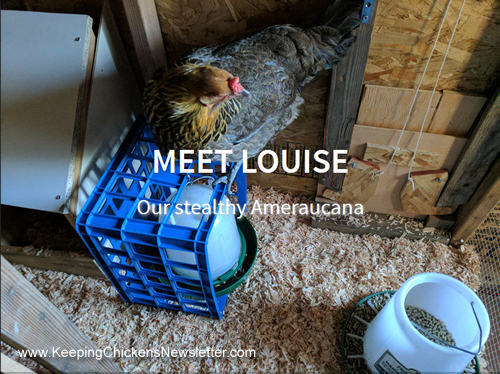
Louise the Ameraucana in her coop

In the video further down this page Adam explains how he created a raspberry pi-powered chicken door using only Free Software. The basic outline is that he is using a Raspberry Pi and light sensor to trigger the door to open and shut. A Raspberry Pi is essentially a small computer with built in wifi etc that has been created to promote the teaching of basic computer science in schools and is used to learn programming through fun, practical projects – the basic Raspberry Pi startup kit costs around $50.  It checks in with a light sensor every 10 minutes before triggering the door to shut (or open) if the light level has gone below the level he set. He also uses a Fisheye night vision camera (which itself only costs $25) to take video inside the coop, even at night, and has it take and send a photo to give a visual confirmation when the door has been opened or shut. In his talk he mentioned that it can be logged into seperately and forced to shut, and can be used offline. The Raspberry Pi itself is very flexible and this is almost more a case study of how it can be used to create your own automated hardware+software systems than a how to build an automatic chicken coop door.

Parts Summary

1. Raspberry Pi, motor, sensors
2. Scrap wood, string, magnets

More specifically  : Raspberry Pi, Soldering kit, Camera, Wires, 12v DC motor, Fuses & holder, 32gb SD card (not 64gb as it seemed to cause problems), Mag sensors, Test leads, Power supply – His total cost for this project (although some things such as the soldering kit could be reused) was $213

In the talk he covers these features :

  • hardware interleave gravity lock mechanism
  • instant-read photoresistor poll door actuation trigger
  • photoresistor signal analog to digital conversion
  • worm gear 12V DC motor controlled via L9110 motor driver chip
  • dual hall-effect magnetic door position sensors
  • fallback door status mitigating magnetic sensor failure
  • night-vision wide-angle camera with motion-triggered video capture
  • C + bash + python polyglot control code with standardized output convention
  • offline operation with 2.4Ghz wifi for monitoring and maintenance

“I’m a hardware beginner, so this is a beginner talk in terms of hardware. I know just enough about hardware to ask someone smarter how to not make everything start smoking.

I’ve been writing software for about 20 years, so I want to get into some detail about the software.

This talk isn’t about carpentry–you’ll have to ask my wife about that.” ~ Adam Monsen

The Coop was built inside a larger shed – you can just about see the computer sitting on top of the coop on the right.

automatic door operation

The door uses a gravity lock. The strings lower the whole door as one unit and when they get to the bottom the two bottom pieces of wood swivel out and slot into place so the door cannot be forceably opened.

You can watch Adams full 25 minute talk below :

Automatic Chicken Door HOWTO by Adam Monsen is licensed under a Creative Commons Attribution-ShareAlike 4.0 International License. He has provided his source code for this Raspberry Pi project here https://github.com/meonkeys/rpi-chx-code

Links* to Parts Used

Raspberry Pi 3 model B with clear case by Vilros (USA | UK | Canada)

Adeept starter kit (USA | UK | Canada)

Fisheye night-vision camera (USA | UK (the particular one Adam used does not seem to be available on the UK Amazon site but plenty of similar alternatives are) | Canada)

Solid hook-up wire kit – 6 colors dispenser box (USA | UK | Canada)

25rpm 12V DC worm gear motor (USA | UK | Canada)

0.3A glass fuse & holder (USA | UK | Canada)

bag o’ hall effect (magnetic) sensors (USA | UK | Canada)

bag o’ test leads (wires with alligator clips at ends) (USA | UK | Canada)

SanDisk Ultra 32GB microSDHC UHS-I Card (USA | UK | Canada)

12VDC 600mA regulated power supply

* The above are links to the parts Adam used in this project. In some cases it may not be possible or desirable to get exactly the same products due to stock levels, newer releases, price changes or availability in your country but as they are quite standard parts suitable alternatives should be quite easy to find if desired.  www.keepingchickensnewsletter.com is a participant in the Amazon Services LLC Associates Program, an affiliate advertising program designed to provide a means for sites to earn advertising fees by advertising and linking to amazon websites. If you end up purchasing an item after clicking through  one of the links I may receive a small commission. It will not cost you anything extra at all but would be very much appreciated as even small amounts can help offset some of the costs involved in producing and giving away a free online newsletter. Thank you.

Keeping Guineas and Chickens Together

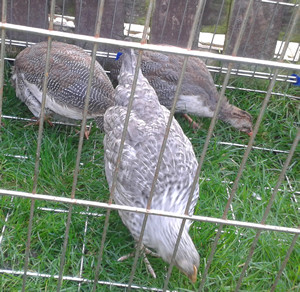
Sue : Hi Gina, I have been given 4 guinea fowl chicks but I think one of them is a chicken, I already sent a message to you but I’m emailing so I can attach some photos. Can you take a look at the photos and let me know what you think about the pale grey bird I think is a chicken, I really hope it’s not a cock, we had to give our other cockerel away to a farm because he was too noisy for the neighbours. We also have 3 old hens, two are 11 years old the third is 7 years old. The 2 older ones don’t lay anymore the 7 year old lays occasionally. They don’t seem to like the guinea fowl chicks at all, is there anything I particularly need to know? The guinea fowl are currently living in a hutch inside the chicken pen so they can get used to each other. I would like to ask everyone if they have any experience of keeping hens with guinea fowl. We’ve put them together a couple of times but the hens weren’t impressed at all and kept pecking the chicks. I guess they’ll get used to each other eventually but has anyone any advice? Thank you

My Reply : Thanks for the photos. Guineas can come in quite a variety of different colours but the body shape and comb does also make me think it is a chicken. With regards to them living happily together it definitely is possible. In the Guide To Guineas ebook there were a couple of examples of some who had done so and I’ve also been searching through a few past newsletters where several readers have mentioned that they have guineas in their flock. I haven’t found any specific integration tips that might be helpful to you – but also no major problems mentioned either. There have been a variety of pecking orders mentioned – one said her young hens are the boss when it comes to the pecking order and who gets priority when roosting, another also had Turkeys in her flock and it was those that were at the top of the pecking order, then the Guineas and then the chickens, whilst another said her Guineas had kept themselves completely separately from her chickens.  Guineas can be a bit more ‘wild’ than chickens and if they are upset for any reason tend to chase down the object of their displeasure as a pack – often this would be along the lines of a chicken rooster getting himself into trouble for trying to mate with a guinea roosters hen (it is possible for Guineas and chickens to breed with each other although any resulting chicks will be sterile). Guineas are more inclined to roam and generally can fly a lot better than chickens so will naturally roost in trees but can be trained to use a coop (and will be safer from predators if they do).  As with probably the majority of all animals and birds the potential for any problems is a lot less when there is plenty of room to segregate themselves if they wish to and also if there are no hormonal males trying to compete for their girls attentions.

Does anyone have any advice?

2 Old Chickens and 4 Ducks Named Bob

Angie : We have been raising chickens for the last 6 or 7 years. All of our chickens from our first year are gone. But we still have 2 chickens from our second year. These 2 chickens were 2 of 3 survivors of the Great Massacre. We lost over 30 chickens to some foxes in 1 weekend. Two of my roosters survived. I thought that was all I was left with. And then out of the weeds comes a Barred Rock hen with several baby chicks trailing behind her! She had been brooding eggs so she wasn’t even present when those foxes raided our hen house.

Today, she still lays eggs on occasion. They are a beautiful light brown egg with a few speckles. In fact, this is the same hen that laid the very first egg we ever got. She will always have a home here with us no matter how old and unproductive she gets! Our other old chicken is a big Australorp rooster named Kevin. He is the king of the hen house and just about the sweetest rooster there is and the one that will cause a lot of broken hearts when he is no longer with us. We all just love his sweet, loving temperament.

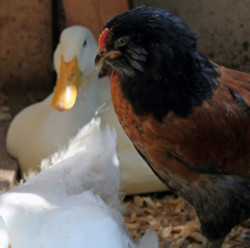
I have been wanting to tell you that we were given 4 ducks by our neighbors. At one point this summer, we lost all of our ducks. So being gifted with 3 hens and a drake is marvelous! We have not named them yet. They all came named Bob. I think we will be a little more original than that. There are 2 Pekin hens and a pair of Rouens.

These ducks are not used to free-ranging. We have started leaving their pen door open. Slowly they are starting to venture out into the world. It has been odd not to have ducks foraging in the yard. I look forward to the day when they venture that far out of the barn!

George and his Girls

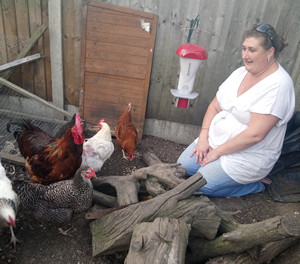
Alice: I have had chickens for the last 5 yrs, but grew up with chickens and animals at home. I have 12 chickens and 3 ducks. They are a brilliant way to help combat depression and generally make you laugh, with their antics and silliness. I love all my girls and my boy George, so called when he was younger all the girls used to run away from him! My children think that my girls get more spoiled than them.

This year I have had an increasing problem with rats pinching my chook’s food and we had a few bites to legs to have to deal with. I recently found this new chicken feeder called the Roamwild PestOff Chicken Feeder Kit – since using these feeders (I have 3!) not only have I not had rats, my birds are happier.

We don’t need to put traps or poison down which is great considering I live in an area with lots of cats and wouldn’t want any of them getting ill or worse! and my husband is very grateful he doesn’t have to sit up on rat patrol anymore! If it is raining the chicken feeder keeps it nice and dry and I have found that I waste so much less food. Also the 3 ducks can use them just as easily too. I hope you enjoy my pictures of my chooks, I have told them all about why I was taking their pictures, and they clucked in response! Alice, Maidstone, Kent, UK

Forces of Chicken Keeping

Kelson : A friend in Australia has a Rhode Island Red chicken named Elaine. Elaine is a particularly inquisitive and mischievous hen, with a big personality. She has worked out how to open cat-flaps and dog doors, and she can solve problems. She is particularly fond of exploring where she should not be, and she particularly loves the kitchen and dining rooms in the house. One of the most memorable of her antics is now known as Elaine’s Famous Tomato Heist, where she flew up onto the house roof, walked right over to the other side of the house, and jumped down into the tomato garden which was surrounded by a 6 foot high chicken wire fence. Needless to say, Elaine had pecked every single tomato before she was finally caught. She obviously felt like some lovely ripe tomatoes, and she figured out exactly how to get them.

When it’s time to feed the chickens, Elaine’s owner has to be very careful to close all doors on the house. Elaine is a so naughty, that she will swim against the tide and often she will decide to miss out on the feed outside if she thinks she can sneak into the house and find something better inside. So, while the other hens, ducks, geese, turkeys, etc are all running madly for the feed shed at the bottom of the hill, Elaine will often be found sneaking back up to the house to see if she can find a way inside while all the commotion is going on. Sadly, for Elaine’s owner, she often succeeds.

Another of Elaine’s favourite tricks is to jump inside the car while the shopping is being taken inside the house. As fast as lightning she pecks through plastic bags to sample as much bread, tomatoes, fruit, and anything else she can before she is discovered. She has also been spotted dragging entire loaves of bread out of the car and into the garden. One of her cronies, Shirley, is almost as naughty, and together they make a terrible duo. Life is never dull when Elaine and Shirley are on the rampage.

These are the forces you are up against when you keep chickens!

Hurricane Chickens

For many, preparations in anticipation of the arrival of the devastating hurricane Irma included securing their chickens and other livestock as best they could. For those able to bring their chickens inside, garages, bathrooms and bedrooms became temporary chicken shelters.

Carol Nevius : Makeshift chicken hurricane shelter.

and the following day : All is well, but my roo got loose during the transfer back to their regular coop. Oh well…most likely he will want to come back to his girls at dusk.

I shared a photo to the keeping chickens facebook page showing the efforts of one Florida Keys resident (one of the worst hit areas) to rescue some of the Key West Chickens. The large free-roaming chicken population causes both delight and despair to the locals and tourists of Key West (a lot of roosters = a lot of crowing) but generally they are a much loved feature of the area.

In North Fort Myers a local news report told how one woman was saving as many of her neighbors chickens as she could.

Anyone For Chicken Sexing?

George Anderson : We all have wobbly bits. Clear differences between our wobbly bits make it easy – for those interested in that sort of thing – to tell man from woman. This is not true in the world of chickens.

I don’t know whether you can study to become a professor of chicken sexing. What I do know is that determining chicken gender is far more difficult a task that you might imagine.

Does chicken sexing matter? Yes, if you are commercially involved in rearing chickens. In fact the practice will be essential to the success of your enterprise. If you are breeding for eggs you will have no need of male birds and their early identification allows you to eliminate them as soon as possible. If you are breeding for meat as well as eggs then you’ll want to know as soon as possible how to separate the two so that you can treat them differently within your supply chain.

There are two main methods for sexing chickens: feather and vent. In feather sexing, the length of wing feathers is considered a reliable means to determine gender. The wing tip feathers are noticeably larger in hens.

The vent method is less glamorous by a country mile. This involves a two-step process. First squeeze the poop out of a young bird. Then look for a pimple sized bump which would indicate maleness. Apparently this is still difficult, even for professors of chicken sexing (if there are any).

Pinned down by people bigger than me and forced to choose, I know which method I’d prefer. Mainly because if I were down the pub of a lunchtime and asked what I did for a living I would be comfortable saying “I compare evolutionary gender differences in the feathers of now flightless birds.” This has to be more appealing than saying “Me? I squeeze poop out of chickens”

In the science-free past, it fell to folklore to offer methods for chicken sexing. Here’s my top half dozen.

1. Guessing: This gives you a 50-50 chance of being right but is no basis for running a commercial poultry business.

2. Penny Rubbing: Rub a penny on the back of a chicken. Toss it (that’s the penny, not the chicken). Heads it’s a rooster, tails a hen. Hmmm.

3. Shape: Round egg = hen. Pointy egg = rooster

4. Hat method: Wave a hat over a bunch of chickens then throw it to the ground. Only hens will run away. Personally this is simply an abuse of a perfectly good hat.

5 Ring dangling: Put a gold ring on a chain and dangle it over a chicken. If the ring starts a circular motion it’s a hen. In a line, it’s a rooster.

6. Water Method:
Two bowls, one with water, the other with water to which has been added a teaspoon of vinegar. Roosters will drink only from the plain water bowl.

7. Mischief Method: Select a chicken. Dip your partner’s head into a horse trough when they least expect it. If they’re angry when they emerge gasping for air, it’s a rooster. This method has been largely abandoned since it led to skewed results and a spike in the divorce rate.

Go to Top