Some handy tips and good ideas.

Introducing chicks into a house with established hens

Jacqueline : This is a response to the gal who wanted to know how/when to introduce baby chicks into a house with established hens. I have done this many times successfully. When the day old chicks come home, I put them into a wooden box about 6 inches high with wire on the bottom, and several wired windows on the top. The box needs to be big enough to put a food bowl and water inside. I put this box into the hen house. The babies can hear the adults and vice versa and I can keep their food separate. When they start to get too big for the box (after several weeks) I transfer them to a dog crate. Now everyone can see and hear each other and food is kept separate. When they get bigger I open a door on the dog crate just far enough that the babies can get out but the adults can’t get in. The babies wander out but can escape from the adults if necessary by running back into their crate. I usually leave the crate in the henhouse until they are on layer mash, but, the babies do get into the adult food as they stop hanging out much in their crate once they feel entirely safe. The babies seem to work their way into the hierarchy quite naturally with this system. I have never had fights in the henhouse, and have never had a baby injured. Maybe this system will work for others. Thanks for a great newsletter. It is always an informative and enjoyable read. Jacqueline Colyer

Nancy : In response to Victoria’s question about expanding the flock, I have only tried the following once but it seemed to work. I raised my chicks in a separate coop in the adult chicken yard so they were in plain view as they developed. At around 10 wks I started letting them out and they were not warmly welcomed at all. I waited a week or so more and tried again only this time I let the juveniles out first and gave them some time to forage alone before letting out the adults. I cannot be sure, but this seemed to bestow some status on the youngsters and they are integrating nicely. Best, Nancy, Claremont, CA

Some more experiences of adding to your flock are here : https://www.keepingchickensnewsletter.com/site/mixingflocks.htm

The Dangers Of Heat Lamps

Kristi : I’ve enjoyed reading your newsletter and seeing the great stories, tips, and photos your readers share. I have a tragic story that I want to share with your readers in hopes that it doesn’t happen to anyone else. My husband and I live in a suburban neighborhood in Nebraska and wanted to raise chickens. We love animals (we have two cats and a dog) and the idea of humanely raising chickens for eggs appealed to us. We bought six wonderful little chicks. We enjoyed watching them roam in the backyard during the afternoons. After a couple of months, their feathers were in, and they were ready to live outside full-time in their coop. My husband had researched coop plans and built a lovely one. The first night our chickens spent outside was chilly, so we turned on the heat lamp for them. Somehow, in the middle of the night, the clamp came loose, and the lamp fell and started a coop fire, which spread to the house. Sadly, our girls didn’t make it.

heat lamp fire

Needless to say, we are devastated. We hope to someday try our hand at raising chickens again. If we do, we will definitely rig up a more secure hook for the heat lamp and perhaps use a lower wattage. Thanks again for letting me tell my story. Kristi Evans

Getting Chickens To Lay Eggs In The Nestboxes

Kay : My first year of raising chickens has been a great one. The story about the ceramic eggs. I had read that the ceramic eggs helped the pullets get started laying eggs. I put one in each nesting box. The girls were laying quite regular so I took them out. I thought “Oh well, they must be getting the hang of it”. Well, the day I took them out my husband found eggs laid outside in a corner by the shed. I guess they didn’t like the ceramic eggs out. They have been in the nesting boxes ever since and will probably remain there.

Predators, Roosters and Frozen Water – Some tips and experiences

Jackie : Gina, Thank you for the Keeping Chickens Newsletter. It is a joy to read and I learn from other people’s experience. I haven’t learned to include photos, nevertheless, I hope that even without pictures, my experience on some of the recent subjects may give other chicken-lovers an idea or two for solutions that will fit their situations.

PREDATORS
Predators abound here in rural Texas — chicken snakes, rats, raccoons, coyotes, chicken hawks, wild bobcats, abandoned dogs.

  • Chicken snakes in the hen house. — you probably will not see the snake (your first hint will be the sudden absence of any eggs). Chicken snakes are not dangerous to the hens or to people, but they will eat all your eggs. The only cure is find the snake and kill it. If you can’t shoot it, attack with your hoe. (The snake will be hiding in the litter/bedding or along the edges where the walls meet the floor)
  • Chicken Hawks in the sky. My chickens are free-ranging. In three years we have lost only one hen to hawk. Our solution is (1) to provide cover (bushes) where the hens can hide when they are free-ranging and (2) build the chicken-yard short and narrow and high-fenced — to deprive the hawks of the glide path they need to regain the sky with a hen in-tow. (This eliminates the need to make a lid on the chicken yard.)
  • Racoons, Coyotes, Bobcats, feral Dogs Get yourself a good dog. A terrier or terrier-mix is not a big dog but he will be fierce in defence of you and yours. If the animal does not back down and try to escape when faced with a barking terrier, you should consider that animal may be rabid. In that case, get yourself into a safe place and call Animal Control. If you do shoot a rabid animal, you must bury the carcass at least six feet deep to prevent its being dug up by other wild animals, thus spreading hydrophobia.

ROOSTERS
In my experience, the presence of a good rooster not only provides complete, fertile eggs, he helps keep the peace, sometimes chastises the occasional straggler at the end of the day when the hens return to their chicken yard.

FROZEN WATER
I am not willing to install electricity in the hen house. Instead, I have a really, really long extension cord that lets me use a $15-dollar “utility heater. Because the heater was made for use in barns, it is rugged (ugly) and has a thermostat. When set to 50 degrees Fahrenheit it does not run all the time and does not cost much electricity. Also this extension cord gives me the chance to use a timer for light. Since hens need 14 hours of light per day in order to make eggs the timer helps me have eggs throughout the dark days of winter.

Tips for Cooling Down in Hot Weather

Cheves : Thank you for the newsletter. I’ve passed it on to several other people in the lowcountry. One thing some of my hens like is a shallow water dish (about 12in by 12in) in which they stand when it is hot. It was intended as an extra water source and they do drink out of it, but I’ve also seen several of them simply standing in it when it’s hot – it’s been over 90 for some time and over 100 degrees for several days at one point.

I don’t have a way to take a photo, but my chicken yard now also has a peahen in it – I looked up one afternoon while working in my garden while the chickens were in the big yard and there she was. I managed to get her into the chicken yard and she seems content – she roosts on top of one of the coops and eats the rooster mix and pellets and the hens and Alexander now ignore her. No one knows where she came from and I don’t want to let her out of the chicken yard because my dogs or the neighborhood dogs might get her. Thank you, again, for the good information and photographs. Cheves

Joy : In reply to a readers question about ways to help chickens cool down in hot weather, I found giving them frozen figs (the excess off my tree) to peck at helped and they devoured the lot so I keep a bag on the go in my freezer for just giving to the chickens. I would imagine frozen tomatoes would be just as good if you ever have a glut of those to freeze and do the same. Hope this is helps. Joy. New Zealand
Getting youngsters to roost

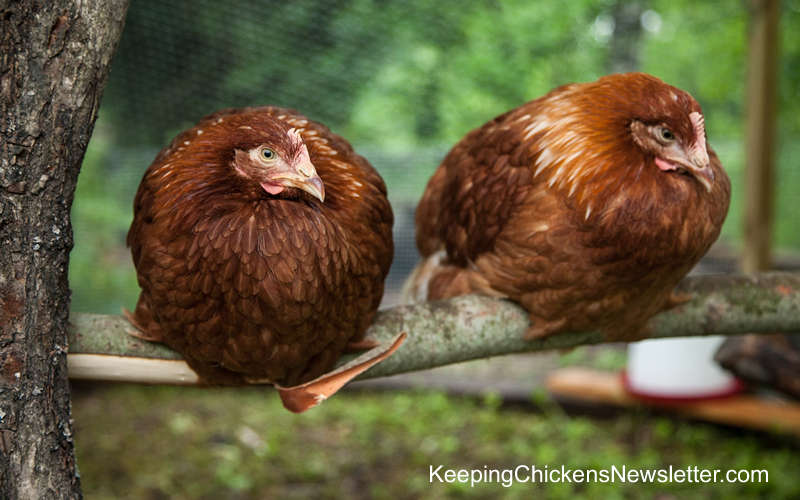
J. Johnson : I was having a problem with a new generation of 6 pullets that didn’t want to get on the roost with the older hens. They kept crowding into my nest boxes and spending the night there. They were making a mess of the boxes in spite of my chasing them out every night when I was locking up the pen. I discovered that if I left the access door open over the nests that they did not feel safe in the nests and went to the roost. I did this for a week and they are now trained to go to roost with their older sisters.

Adding New Chickens To An Existing Flock

There is no one right or wrong way to add to an existing flock but it can sometimes be easier to mix new chickens if they are of a similar size (chicks will also have a bit more resilience against any bacteria etc. they might pick up from the flock by then aswell) . If the new chickens are coming from someone else as opposed to chicks bought and raised yourself then it is usually wise to have at least a 30 days quarantine period. This is because a flock will tend to build up immunities to its own environment, and even seemingly healthy chickens can ‘catch something’ (or give something) when mixed together straight away. If the new additions are ex battery hens then keeping them seperate for a while will also help them regain their strength and confidence as they get used to their new way of life.

When it is time to mix the flocks it seems to help if they can be seperated but seen and heard by the other ones – in practice this could mean a partition in the coop itself or it could be free ranging in a nearby area. That way they can get used to each other. After a week or so you might try to mix them in together and see how it goes – this is best done at night. Waking up together seems to make integration easier. Some people just go straight to the mixing them in together at night.

It is usually wise to have a quarantine period of at least 30 days when adding new chickens to your flock.

However you do it, there will probably be a little bit of scuffling for a pecking order, but that is quite normal. In the majority of cases integrating new additions to an existing flock can go very smoothly but you will need to keep an eye on things to make sure that there is no one being singled out particularly and picked on and everyone is getting a chance to eat and drink (if that is a problem having an extra food and water container in a different area may help everyone to get what they need). If any squabbles result in bleeding then the blood in itself can attract pecking attacks from the rest of the flock and so the injured chicken(s) should be seperated until healed.

Below are the mixing flocks experiences of two keeping chickens newsletter subscribers.

5 weeks old and 12 weeks old chicks

These RIRs are half the size of the Barred Plymouth Rock chicks.

Christy Weick : “12th June I’m thinking about introducing our two flocks (Barred Plymouth Rocks are 11 weeks old and the Rhode Island Reds are 4 weeks old) together next week. The RIRs are climbing the recycle green chicken fence that I have around an oak tree for them during the day. The cat, Gre-Gre, has an eye out for them. The dog, Lay-Lay, has left the chickens along since the 10 BPR got out the other day and jumped her. La-La weights as much as a BPR. No matter how I look at the calender the two flocks will be 7 weeks apart. The RIRs are half the size of Patrick’s BPRs and they are gaining weight fast. Any suggestions on introducing them to each other or should I hold off another week or two?”

15th June “Well we put the two flocks together Friday night in the rain. When they woke up Patrick and I let them out into their 30′ pen. We took a cleaned mineral barrel and cut an entrance hole and several small vent holes around the top of the barrel (so that all 7 chicks could get into it when the rooster BPR goes on the attack). The older group is going after the male RIR and leaving the hens alone.

hideaway for the younger chicks

Christy Weick’s tan mineral tub turned into a hiding place for the RIRs

Patrick kept a close eye on them yesterday. When night came we put the BPR into the coop first and then around 9:00 we put the RIR into a cat taxis cage without the gate and placed the cage into the coop (In case they need protection). We place several water tanks and feed bins for the chicks to get a bite while they work things out. We throw a lot of garden scraps for the bigger ones to eat. The BPR seem to dig the red tomatoes and cucumbers and they leave the lemon (yellow) tomatoes alone. So far so good and I hope the cat doesn’t get in the mix, while they are working things out.”

20th June “Well it’s been a week since we put our two flocks together. They have their scuffles every now and then. To say that they have totally accepted each other would be telling a lie. The BPRs seem to single out the male in the RIRs. They each have their own “country” in the yard and the only ones who are aloud to cross the imaginary line is the humans. The only neutral ground is the coop and when we first put them in for the evening they have to get the pecking order just right. We still have a lot of hiding places (in the yard) for the RIRs because of their size. Patrick put together another perch for those who like to get up high. In a few more months Patrick will have to decided which on of the males he will keep and we will set the other free with his Uncle Gordan’s free range group (about 3 miles through the woods) from our house.”

chicken coop by fence under trees

The RIRs getting used to their new home (the Barred Plymouth Rocks are in the shade behind the coop).

8th July “Just recently Patrick and I took most of the extra hiding places out of the yard.

  • Reason 1 . . . in dry weather snakes will find cool places (and lucky the other day in the chicken yard when I turned over the tan tub, like I do every morning, it was a King Snake (non-poisonous). We’ve had a string of copper heads (poisonous) lately under our house (which is off the ground).
  • Reason 2 . . . the RIRs are getting bigger (they are almost the same sizes as the BPRs and they are starting to fly).
  • Reason 3 . . . during the day the BPRs take turns flying over the yard fence to chase grasshoppers (leaving the RIRs to the yard and dealing with the 1 BPR that was elected somehow to stay behind and give them a run for their money).

Do they really eat the grasshoppers or do they just “play” with them? I’ve noticed that when one get a hold of a grasshopper, they spend more time running from the others (like watching football).

This week the BPRs are 15 wks old and the RIRs are 8 wks old. Gre-Gre (cat) will walk with La-La (dog) and I to the chicken yard. She gives them space (but keeps a close eye on any of them that are not paired together) and La-La has gotten braver and is walking in the yard with me. Sean (my husband) says that I am the “mother hen”.

The chickens are slowly accepting the bulls in the Pecan Field. They found out that if we feed the bulls, they have a chance to get some left over corn and other grains once the bulls leave the feeding trough.”

Another Method Of Mixing Flocks

Another ‘Soft Release’ method – this comes from Linda

29th June “I have a situation that is something I have never seen in all the years I’ve been around chickens, and for sure never in raising our own.

Seven hens, one or two days old, purchased. Raised together, on ”starter lay mash”……..introduced to scratch at 2 or 3 weeks old, and yes calcium/gravel/grit added in that same time frame. Still on starter lay mash too. A month and a half now. Very healthy looking, and seemed to grow faster than the first ones we purchased in early April.

The 7 lived quite happily together in the house on the heating pad, when they were very very little, graduated to larger cages, to much larger and at a month old, put in even larger housing, and on the enclosed porch. This is how we introduce them gradually from inside, to outside, to the real outside, by degrees.

This method has never failed.

So today was graduation day to go to the main enclosure/coops/hen house, etc. Took them all together in a large cage out to the enclosure. As usual, we left them in the cage for a couple of hours, in the shade so they could look/listen, and the others could look/listen.

Again, this method has never failed us.

Then, towards later afternoon, we opened the cage door and left it that way. This ”soft release” allows them to come and go……if they want to.

I went out to check them, as usual, every three minutes (worried mom here) and all was well. The one young one has bloody tail feathers! I grabbed her up and brought her in, since I have heard horrible stories of ”once they see blood they keep on a pecking at it”…….and got her washed off, dried up, ”quick-stop” on the area. I put her into a cage on the porch. After she was all seemingly okay, I put on ”anti-peck” and some other stuff along the same line, for chickens, that is suppose to keep the chickens from going near that spot OR wanting to.

I put her back in w/the group. It wasn’t a minute and her own cohorts were going after her tail again, AND she was bleeding again! She is back inside the porch now.

I did bring in her cohort (another same age leghorn gal pal) and the two have been happily staying safe and sound back on our porch. Getting spoiled rotten too:)”

6th July “On a fluke, chickie all healed, and doing very well with her leghorn cohort, I mucked and yucked the tail feathers with VICKS. The minor wounds were well healed.

I took her w/her cohort out, in a carrier. I observed for 99{b0ded004bdc346b73b2f7c5643ec4b44c0fd04baf547e743db44006f5c758b8f} of the day…….(leaving the carrier there, in case I had to pull them again). Had I had to pull them I would have returned them back at night, as suggested.
Again, it was not the oldest, nor the newer, but her very own lot she had been raised with, minus the leghorn I pulled out to be with her.

Well, lets just say, ONE COULD READ the minds of the two that went after her tail feathers, tasting the Vicks! Problem solved. Everyone is happy and involved again.

The one thing I did find a bit interesting: These little ones were only separated from the original ones (5 others) less than a week! Yet, back in w/the tribe, and although ”accepted” by all, the two leghorns stay to themselves, rather than pecking around with the ones they were raised with. HOW SOON THEY FORGET!”

Go to Top