Chicken Coop and Run with Awning

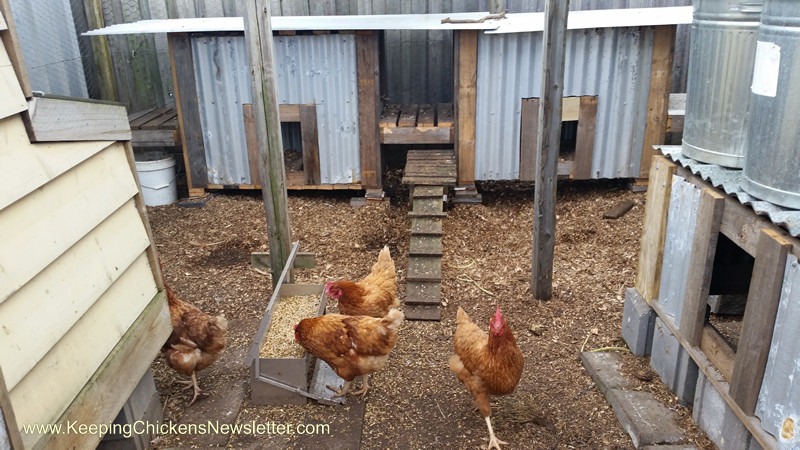
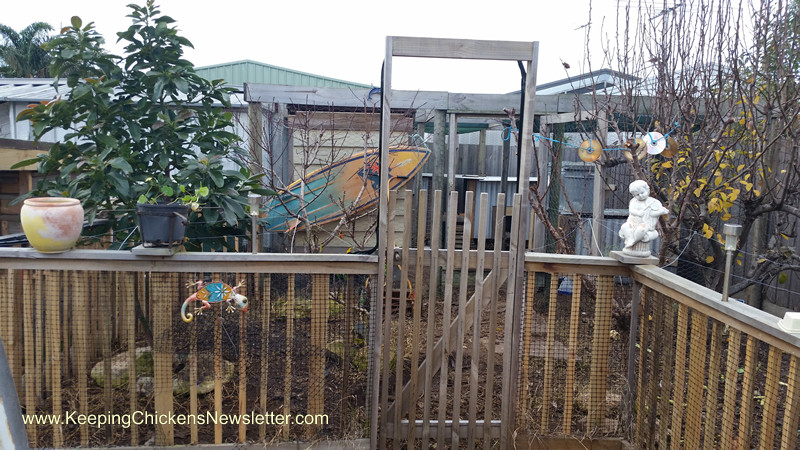
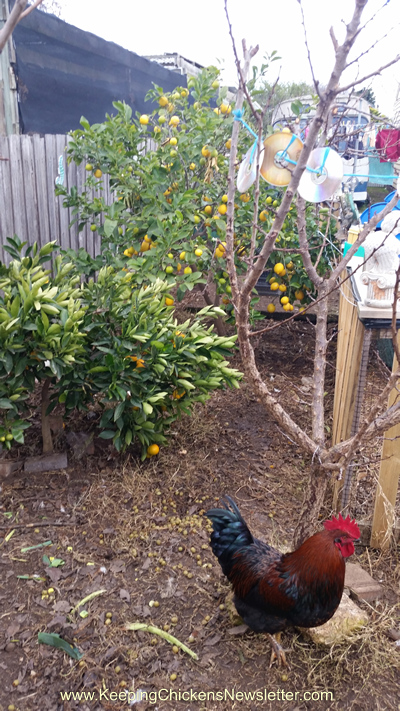
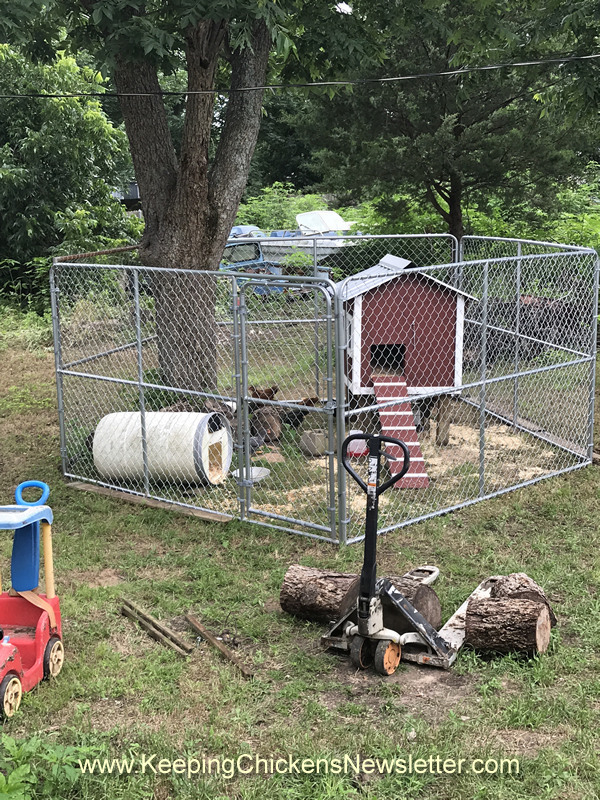
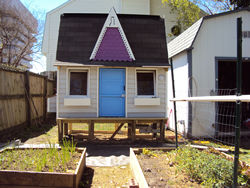
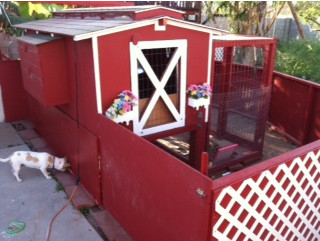
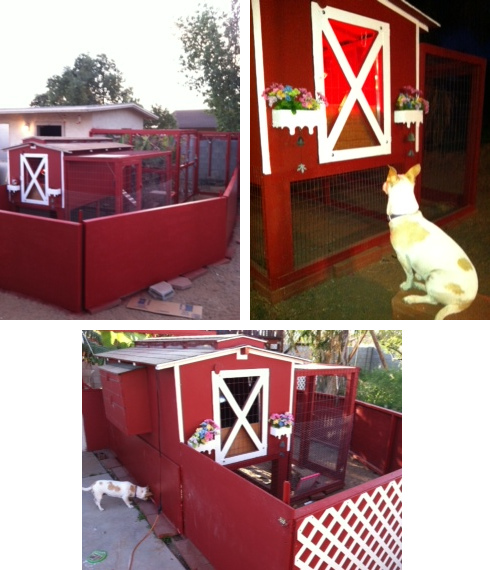
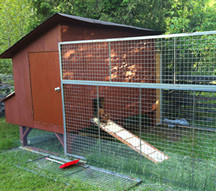
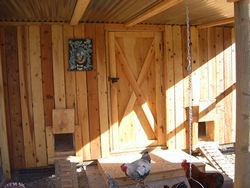
Ley Gorrell : I’ve attached some photos of our chicken coop and run. We backed it up to our old tool barn, and put the same cedar siding on it (its actually privacy fencing). The coop is 9′ x 12′, and the run is currently 12′ x 32′ (it can be easily expanded). There’s an 8′ awning for loafing under when it’s raining/snowing, and in our hot summers.

The coop is painted plywood on the inside, with linoleum floor for ease of cleaning. I have a droppings pit under the roosts for the same reason.
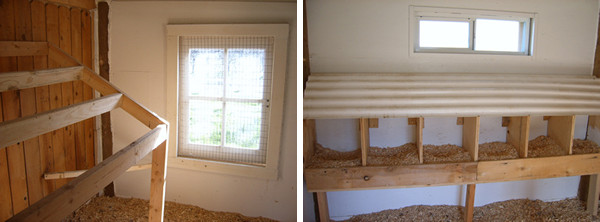
The big window is one I found in the garage and refurbished. It swings out. The small one is a bathroom window that slides open. I have a remarkably bright solar light inside, and that’s the little solar panel you see on the south roof. It looks like the chickens are watching TV at night! There’s also a 4′ x 6′ storage closet for feed and supplies.

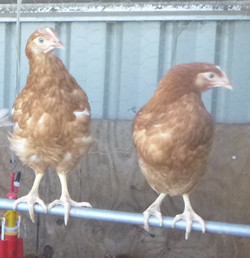
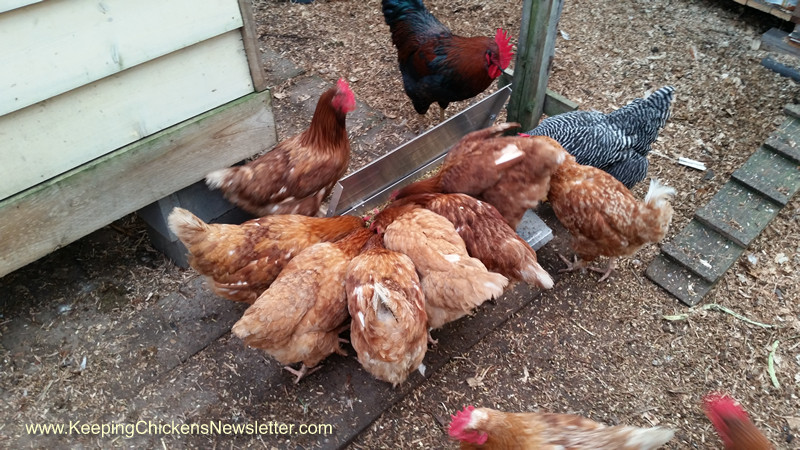
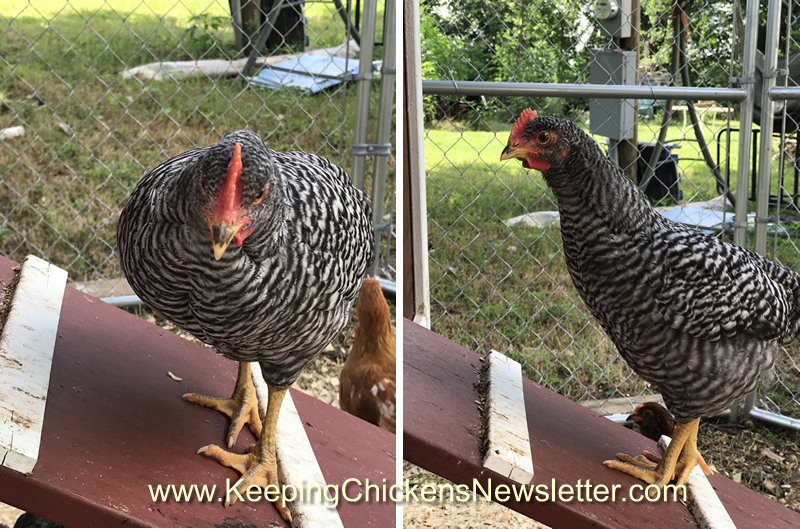
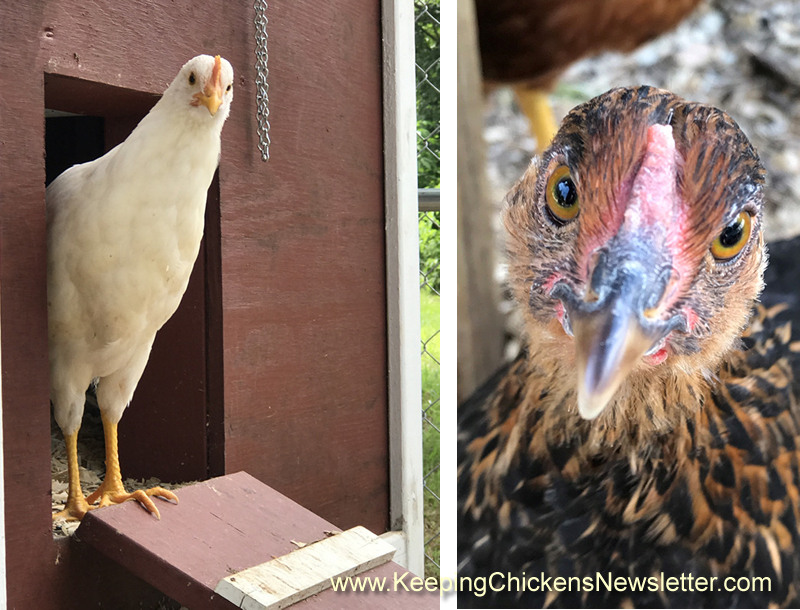
I’ve also included photos of my favorite hen, Anise, a Silver Spangled Spitzhauben, and my favorite rooster, Fennel, a gray bantam Silky, with the cutest little crow you’ve ever heard. All the chickens are named for spices and flavorings (don’t tell them!) We’re currently getting about a dozen eggs a day, including pretty blue ones from the Americaunas. We have the chickens for the eggs, not to eat. I make all of my own dog and cat food, so everyone gets eggs for breakfast.

We also have ducks, guineas, and a pair of Toulouse geese. We have another batch of babies getting shipped in next month. The next big project is going to be a wild duck aviary. We will be building that over the summer, in anticipation of the ducks arrival in October. I connected with a gentleman in Oregon who is going to ship me breeding pairs of Wood Ducks, Mandarins, White Mandarins, Northern Pintails, Green Winged Teals, Cinnamons Teals, Spotted Teals, and Hooded Mergansers. Very exciting!

I would like to hear from anyone with wild duck aviary/breeding experience, particularly help on containment. My plan is to do the same thing that we did with the coop, with heavy-duty steel wire, sunk in concrete trenches. However, the chickens are locked in the coop at night, the waterfowl will not be. We have plenty of predators (coyotes, hawks, owls, racoons, bobcats), so trying to decide what would be best for overhead. The chicken run just has lightweight plastic netting on top. I’d like to make the size of the aviary approximately 60′ x 100′, and we have several mature oaks to fence around. It would not be advisable for us to use hot wires, as it is a major fire hazard here in our arid summers.

We are on the eastern side of California, in the lower Sierra Nevadas, with King’s Canyon and Sequoia National Parks just above us with the big mountains.

Little Reds Chicken Shed

As I write this, Little Red Harvey, my convalescing chicken, is taking an afternoon snooze in a patch of March sunlight, her beak tucked under her sparsely feathered wing. I got very sleepy watching her. A napping chicken, I’ve discovered, is a powerful soporific.

After seventeen days of living in an extra-large dog crate here in the house, she was relocated yesterday afternoon to Little Red’s Chicken Shed, a rehabilitation institute of sorts. For ten days she couldn’t even use her legs; she did a weird sort of scooting crab-walk to get around. Now she can walk, but she tends to step on her own feet. I’m pleased that she hardly ever tips over anymore, but she still hasn’t quite remastered using her wings to fly up to a perch.

The new chicken annex, which is right next door to the regular-size chicken coop, came into being because we are getting ready to go out of town for a few days. For the life of me I could not figure out how to explain to our three-part relay team of house sitters that they’d be caring for two cats, two dogs, eighteen busy chickens and oh, by the way, there’s a wounded chicken in a crate next to the woodstove who needs to be taken outside for physical therapy every afternoon.

I spent two-and-a-half days building this miniature chicken coop out of scrap lumber. Little Red’s Chicken Shed has a small outdoor pen, a chicken-sized door that opens by wire and pulley from outside, a round screen window, a roost/nesting shelf, a hinged panel on the back that allows me to reach inside to do maintenance and Little Red to come out to play in the afternoons, and a little tiny calendar on the wall so she can count the days it takes to heal and grow back her feathers. She has a nice crop of quarter-inch stubble coming in, which is a great relief. I found it tremendously disconcerting to be rendering care to a chicken whose back looked a little too much like the plucked poultry I like to roast with rosemary and garlic.

The most sophisticated computer program in the world, I realized this morning, could not impress me more than the complex DNA instructions according to which Little Red’s cells are crafting these exquisite, intricate feathers to replace what was so swiftly and thoughtlessly purloined by a dog.

I have been trying a few social experiments, but Little Red is just not ready to be reintegrated into the flock yet. This is the first time I have really seen the dark side of chickens. With her puncture wounds, missing feathers and lameness, Little Red is practically wearing a Peck Me sign on her back. The other chickens just will not leave her in peace when she’s this vulnerable; they go into attack mode. Much as I am dismayed by their uncivil behavior, I must accept that it’s simply part of the instinctive pecking order system and the survival of the fittest. Little Red, by the rest of the flock’s standards, is not very fit at present.

Without my intervention, she would almost certainly not be alive, so there’s little doubt I’ve messed with the natural order of things. I still do not know if I have done her any favors by my acts of mercy. Now she’s much more acclimated to humans, dogs and cats, which may not be to her best advantage. The dogs enjoyed sleeping with their noses up by the door of her crate while she sat just inside and pecked at vegetables. The cats crawled all over the crate and tried to stick their paws in the vents. She seemed to enjoy being with us, interjecting little comments from time to time, staying up late and watching us play cards in the evening.

Chances are, now that Little Red has a place of her own, I miss her more than she misses me, which is the same dynamic as when your kid goes off to college. She appeared to be pleased with her Chicken Shed. I designed it to mirror in miniature the features of the big coop in which she grew up, so she’d know where to go and what to do. Sure enough, just after sunset last night, she went inside. This morning, the minute I opened the door, she walked proudly down her little ramp.

As for me, I found myself missing her this afternoon as I was vacuuming up seeds and feathers by the woodstove. Have I ever mentioned that we clean our house with a 12-gallon shop vac? A first I thought this was a little strange, but now it makes a great deal of sense. Life on a ranch tends to be, well, chunky. Feathers, fur, grass, seeds, pebbles, mud, all species of dung (or dung of all species), you name it, it ends up in the house. Anyway, I was cleaning house when I got to thinking about Little Red and missing her. I went out to sit on an old milk crate next to her pen in the warm sunlight. I talked sweetly to her, a mix of Chickenese and English (which I guess would be Chicklish), telling her I’d been thinking of her fondly, which is exactly when she hunkered down in the opposite corner of the pen, tucked her beak under her wing and promptly fell asleep.

Maybe she was bored with me. Maybe the sound of my voice is like a lullaby to her. Maybe she was just plumb tuckered. No matter the reason, Little Red seems pretty darn happy with her Chicken Shed, which pleases me enormously.

Chicken Caravan

school farms poultry

Steve : The school year here at Carinya Christian School-Tamworth NSW is coming to an end. What a year for the school farms poultry systems. In addition to the normal course of raising 100 day old Isa Brown chics for the students layer enterprise study, and growing out 30 broiler chics for a 10 day protein ration growth trial for Senior Agriculture students, a Year 8 Design and Technology class got busy designing and fabricating a ‘chicken caravan’ out of an old box trailer. The rational was centered around a solution to improve the soil in a native vegetation paddock. It needed to be predator secure day and night and include a self-sufficient water system. A 50 meter electric mesh fence and a select time auto door has kept the hens safe and happy.

chicken caravan

I hope these images help to get a picture of what the students have achieved. I am happy to give any ideas or advice for interested readers. More photos and videos of caravan in operation by request. Happy Christmas and enjoy chickens.

Steve Nott – Agriculture Teacher

A Mystery and a Coop

Bill : I didn’t have any luck trying to find the answer to my question on your website. Here is my situation. I have six adult chickens, about one year old, and since they have started laying they have given us 5-6 eggs on a daily basis and then yesterday we only got one egg. What went wrong? Any ideas you can share would be greatly appreciated.
Thanks, Bill McChain

My Reply : It is very strange that they (nearly) all stopped on the same day – perhaps there was a noise or disturbance nearby that put them off, or they had laid some but something stole the eggs. If it continues then there may be some sort of nutritional/health issue (or egg thieves) but usually if there was a health reason they wouldn’t all stop on exactly the same day so most likely it is just a temporary blip which could have been due to a disturbance or egg thief.


John Vertigan : Chicken House


Love Me, Love My Chickens

When it comes to “I love you,” some husbands say it with flowers. Others say it with poetry. Mine says it by building me a chicken coop.

This guy is not the type to take me on long, romantic walks and compare my beauty to the earth and sky. During the rare private moments we share, he is more likely to gaze deeply at me and say after a pause, “Wow. I never noticed how lopsided your eyes were before.”

But I don’t think he’s unusual; most men squirm at the thought of declaring their love outright. Unlike women, who tend to communicate through a handy mechanism known as “speech,” men generally prefer to share their emotions through actions. This disconnect between the sexes can cause serious problems in a relationship.

For instance, say that a man feels a rush of affection for his wife. Uncomfortable telling her how much he adores her, he instead may do something subtler, like putting down the toilet seat for once. Not appreciating the sentiment behind this gesture, the wife fails to thank him profusely. He feels rejected, and vows never to lay his heart on the line like that again. Situations like the have made bestsellers out of dozens of books, most notably, “Women Are from Earth, Men Are from Pods.”

Men can express their love through gift giving, but even then, it’s hard for them to understand exactly what makes a woman happy. My husband, through 11 years of trial and error, is getting better every year. I figure by now he’s worked up a mental list of what I would and would not like for my birthday: “Jewelry: yes. Power tools: no. Power tools for me to build something for her: possible, but a stretch. Hunting gear: definitely no.” And, overall other than the $200 set of router bits he got me for our anniversary one year (“to make you raised-panel doors for your kitchen cupboards”) he’s improving steadily.

But training a man to buy an appropriate present is not the same as having a man show he cares. Until I asked for a chicken coop, I had never understood that my husband, a builder, could use his carpentry skills to demonstrate the depth of his feelings for me. (The state of our partially renovated house supports this theory: He’s dragging out the work over the course of our lives so he’ll never run out of ways to say he cares.)

The first surprise came when I told him I wanted to raise a few laying hens. He only shrugged. I’m sure he knew better than to point out the dubious economics of getting your own eggs; last fall we calculated the cost of deer hunting in terms of time and equipment and determined that the venison he brought home rang up at $29 a pound. Still, he never questioned my sudden desire for poultry, and only put up token resistance to my request for a coop.

I figured he could throw one together in a weekend. Once construction began, however, I found that he had much more planned than the simple 4-by-8 raised structure I had in mind. His brother and nephew came to help, and together they dragged out every tool he owned, then measured, cut, nailed, screwed, cursed, unscrewed, and re-screwed for days on end. The result: a tiny, barn-red, dormered cottage nestled in the woods at the side of our yard.

Insulated, ventilated, and decorated, the coop could double as a lavishly appointed guesthouse. (I expected the roosts and nest boxes, but the sunken living room and breakfast nook came as a surprise. And I still question whether chickens, not the brightest of creatures, will ever figure out how to operate the home theater system.)

Everyone who comes to visit marvels at the attention to detail that my husband put into this project, and I really can’t get over it myself. But when you marry a contractor who is better with a hammer than he is with soul-baring romantic language, you learn to recognize that the overbuilt coop represents much more than just a checked-off item on his to-do list. It means he loves me. He really loves me.

Or maybe he just loves chickens.

Jessie Raymond is a freelance writer whose humor column “Around the Bend” appears in the Addison Independent of Middlebury, Vermont.

Brooder Invention and a New Coop

Michelle Dickens : Our invention of a brooder. We used a large rabbit cage and put it in the bathtub (we have a shower that is separate and no one ever actually uses the tub) We bought the heat lamp and attached it to the top at one end of the cage so they could go to the other end if too hot. Also it had 2 heat settings. Eventually, a week before they were moved out to their coop, we no longer needed the lamp. The cage fit oh so perfectly into the tub so we did not need to build sides to keep the heat in. Just to mention, we have 4 cats and they were at first curious about the chicks, but after a few days pretty much ignored them. So, no one was harmed.

First pic below is the start of the building of the coop. My husband made it. Wish I could say I helped but I didn’t. Powers tools are not my thing. Second pic, is the completed outside. It was stained with the same color we used on our pot bellied piggy barn.(we have one) She squeals for attention when we are paying too much to the girls. The fencing used was obtained from my husbands work as they were not using it anymore and we thought since it was VERY sturdy it would aid in security. The roof which is now on, is made of the same material.

The girls the first time they were let out to explore – I used sandpaper for the first week so they wouldn’t slip on the wood, but no longer need it.

They get lots of shade and there’s lots of room for them to go under the coop as it is fenced with chicken wire that skirts out at the bottom and is staked into the ground.

Inside the coop are 2 roosting poles, and four nesting boxes. We used cat litter boxes inside them. There are two windows that open, one on the south side and one on the west.

Their entry door has a closure that slides up and down (it’s on the inside) and their ramp closes up at night and there’s a hinge too high up for predators to reach and too low for them to reach from the roof. The inside door is raised in the morning to let them out. They are used to the routine now. I let them out at 7 am when I also feed the pig, and then close their coop up again at 10pm when I give the pig her supper. At first, the girls would be waiting near the ramp to be lifted into the coop but after a couple weeks they started to put themselves in for the night.

One extra pic attached to this shows my 6yo daughter inside just to show the size of the coop. The wood used was stuff we already had on hand. We got the windows for $3 and $10 at the Habitat for Humanity ReStore, as well as the door for me to use to access inside, for $12

We received our girls on April 27th at one day old. 5 are meat birds that won’t be with us long, so I think the remaining group will have plenty of space. Thank you for your newsletters. We learned lots from them before, during and since this project began. Michelle Dickens

Moveable Chicken Coop

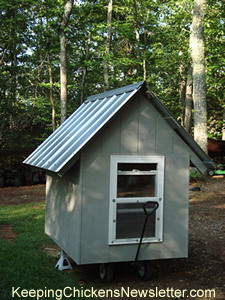
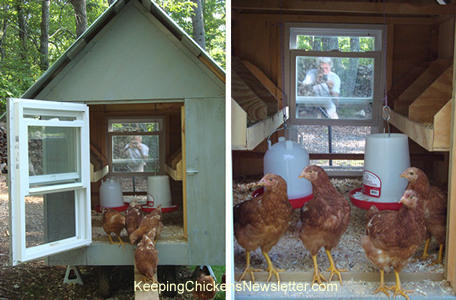
Steve : Attached are some photos of my peepers who are now teenagers. Also their coop which has small doors on either side to get easy access to their eggs, and a large door on one end so I can get in and clean it out. Thanks for your web site which is very helpful. Steve, Floyd, VA
Go to Top